Squawk: Something loose in cockpit. Reply: Something tightened in - - PowerPoint PPT Presentation

squawk
SMART_READER_LITE
LIVE PREVIEW

Squawk: Something loose in cockpit. Reply: Something tightened in - - PowerPoint PPT Presentation

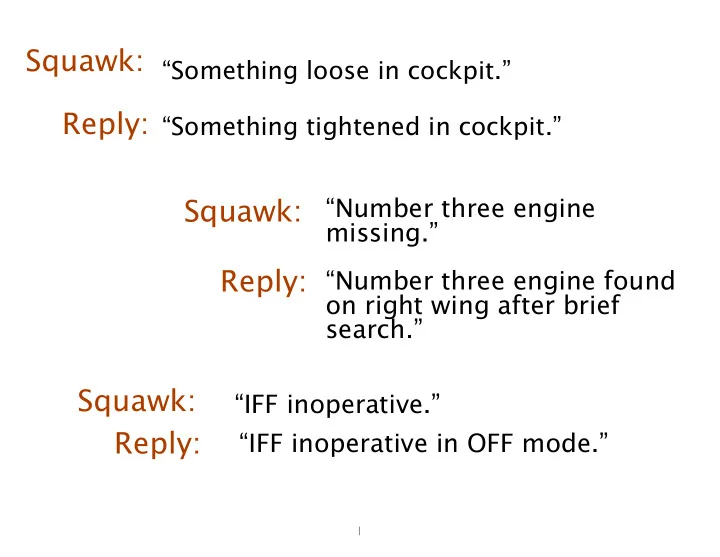
Squawk: Something loose in cockpit. Reply: Something tightened in cockpit. Number three engine Squawk: missing. Reply: Number three engine found on right wing after brief search. Squawk: IFF inoperative.


slide-1
SLIDE 1

“Number three engine missing.” “Number three engine found

  • n right wing after brief

search.”

“Something loose in cockpit.” “Something tightened in cockpit.”

Squawk: Reply: Squawk: Reply: Squawk: Reply:

1

“IFF inoperative in OFF mode.” “IFF inoperative.”

slide-2
SLIDE 2

ONWARD!

2

slide-3
SLIDE 3

ONWARD!

3

What causes misunderstanding? What can we do about it? What makes for intelligent teams? What can we do about it? communication collaboration

slide-4
SLIDE 4

HOW WILL YOU IMPROVE?

  • Participate in class
  • Participate with each other
  • Experiment (risk, be uncomfortable, make mistakes)
  • Ask questions
  • Observe
  • Ponder

4

A LOT LIKE LEARNING SAXOPHONE!

slide-5
SLIDE 5

Emotional Intelligence Framework

Self

Awareness

Social

Awareness

Self-

Management Relationship Management

Positive Impact On Others

Daniel Goleman, The Brain and Emotional Intelligence

5

empathy

slide-6
SLIDE 6

Collaboration and Self-Awareness Close your eyes (for just a minute).

6

slide-7
SLIDE 7

Collaboration and Self-Awareness

7

(how does this affect your collaboration?)

Everyone is not like you. Some people are like you.

slide-8
SLIDE 8

8

Collaboration and Self-Awareness We readily recognize our mistakes. We don’t so readily recognize our successes.

(how does this affect your collaboration?)

slide-9
SLIDE 9

We are hard-wired for fight

  • r

flight.

9

Collaboration and Self-Awareness

slide-10
SLIDE 10

10

MIT Professor Rebecca Saxe has shown that the TPJ is active when you think about other people’s thoughts!

slide-11
SLIDE 11

11

So what happens when you perceive others?

slide-12
SLIDE 12

12

data

adapted from Chris Argyris, Overcoming Organizational Defenses. Prentice-Hall, 1990..

slide-13
SLIDE 13

13

data

???

adapted from Chris Argyris, Overcoming Organizational Defenses. Prentice-Hall, 1990..

slide-14
SLIDE 14

14

data

*based on past, interests, training, culture, mood, need, etc....

select*

adapted from Chris Argyris, Overcoming Organizational Defenses. Prentice-Hall, 1990..

slide-15
SLIDE 15

15

data compare select* evaluate interpret

right wrong stupid smart good bad

adapted from Chris Argyris, Overcoming Organizational Defenses. Prentice-Hall, 1990..

slide-16
SLIDE 16

16

data compare select* act conclude evaluate interpret

  • h no!!

adapted from Chris Argyris, Overcoming Organizational Defenses. Prentice-Hall, 1990..

slide-17
SLIDE 17

17

data compare select* act conclude evaluate interpret

  • h great!!

Chris Argyris and Peter Senge dubbed this the “ladder of inference.”

adapted from Chris Argyris, Overcoming Organizational Defenses. Prentice-Hall, 1990..

slide-18
SLIDE 18

18

So a large part of developing self-awareness is becoming aware of yourself leaping up your ladder of inference, then learning to slow yourself down, and eventually to evaluate more objectively.

slide-19
SLIDE 19

THINK OF ONE OF THOSE THINGS YOU SCREWED UP.

19

THEN CLOSE YOUR EYES.

slide-20
SLIDE 20

IMAGINE THAT IT’S

20

  • worse
  • good
  • bad
  • right
  • wrong
  • smart
  • better
  • stupid

The purpose of this exercise is to increase your ability to think flexibly about your point of view.

slide-21
SLIDE 21

21

So what? What does this have to do with…

  • how we view the world?
  • how we listen to each other?
  • how we influence each other?
  • how we respond to each other?
slide-22
SLIDE 22

22

Everyone please stand up. a brief interlude on presentation…

slide-23
SLIDE 23

THEN HOW ABOUT TEAMS?

23

DO TEAMS HAVE A COLLECTIVE INTELLIGENCE FACTOR, SIMILAR TO IQ IN INDIVIDUALS?? Apparently, YES!

slide-24
SLIDE 24

24

Evidence for a Collective Intelligence Factor in the Performance of Human Groups*

. Anita Williams Woolley, et al.

Study 1. 40 3-person groups Study 2. 152 2- to 5-person groups Range of 5-10 tasks: puzzles, moral judgments, negotiating…

* Science, 29 October 2010: Vol. 330 no. 6004 pp. 686-688. DOI: 10.1126/science.1193147

slide-25
SLIDE 25

25

Evidence for a Collective Intelligence Factor in the Performance of Human Groups

. Anita Williams Woolley, et al.

“In predicting performance on the criterion task, c [collective intelligence factor] has a significant effect, but average individual intelligence and maximum individual intelligence do not.

slide-26
SLIDE 26

26

  • Fig. 1 Standardized regression coefficients for collective intelligence (c) and average individual

member intelligence when both are regressed together on criterion task performance in Studies 1 and 2 (controlling for group size in Study 2).

A W Woolley et al. Science 2010;330:686-688

Published by AAAS

slide-27
SLIDE 27

27

Evidence for a Collective Intelligence Factor in the Performance of Human Groups

. Anita Williams Woolley, et al.

So what comprises this c?

NOT: average or maximum individual IQ NOT: group cohesion, motivation, or satisfaction

slide-28
SLIDE 28

28

Evidence for a Collective Intelligence Factor in the Performance of Human Groups

. Anita Williams Woolley, et al.

  • 1. average social sensitivity of group members

So what comprises this c?

  • 2. variance in the number of speaking turns by

group members,

slide-29
SLIDE 29

29

  • 1. average social sensitivity of group members
  • 2. variance in the number of speaking turns by

group members, HOW MIGHT C (COLLECTIVE INTELLIGENCE), RELATE TO EI (EMOTIONAL INTELLIGENCE)?

slide-30
SLIDE 30

30

HOW MIGHT C (COLLECTIVE INTELLIGENCE), RELATE TO EI (EMOTIONAL INTELLIGENCE)? back to Self-Awareness….

slide-31
SLIDE 31
  • realizing others come with different outlooks
  • adjusting your own perspective

31

CURIOSITY

So what?

slide-32
SLIDE 32

HOMEWORK

  • By next Friday’s Forum, summarize your self-assessment with

your teammates:

  • what are three or four things that you want to work on

with regard to your communication and collaboration in this class?

32

  • Use the good/bad exercise with two or three times: share

your learning with your team, and, in a brief email, with me.

CURIOSITY LISTEN!

slide-33
SLIDE 33

Photo: NASA; JPL

33

To go fast, go alone. To go far, go with others.

Proverb, source unknown.

slide-34
SLIDE 34

Let’s practice :-) Take __ minutes Get in your teams Tell each other two or three things you want to improve with regard to your presenting Make a preliminary plan for preparing your briefing: roles and responsibilities schedule

34