SLIDE 1
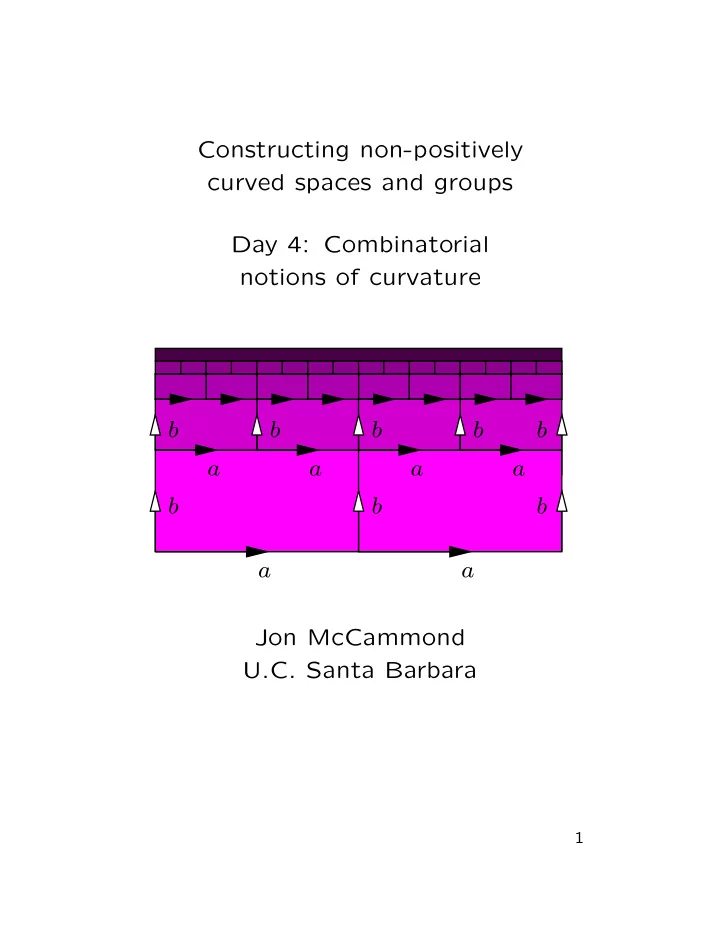
Constructing non-positively curved spaces and groups Day 4: Combinatorial notions of curvature a a a a a a b b b b b b b b Jon McCammond U.C. Santa Barbara
1
SLIDE 2
Outline I. Angles in Polytopes II. Combinatorial Gauss-Bonnet III. Conformally CAT(0) IV. One-relator groups
2
SLIDE 3
Let F be a face of a polytope P.
- The normalized internal angle α(F, P) is the
proportion of unit vectors perpendicular to F which point into P (i.e. the measure of this set of vectors divided by the measure of the sphere of the appropriate dimension).
- The normalized external angle β(F, P) is the
proportion of unit vectors perpendicular to F so that there is a hyperplanes with this unit normal which contains F and the rest of P is
Thm:
β(P, v) = 1.
3
SLIDE 4
Angle Sums The sum of the internal angles in a triangle is π, but the sum of the dihedral angles in a tetrahedron can vary. There are relations between the various inter- nal and external angles in a Euclidean polytope but we will need a digression into combina- torics in order to state the relationship prop- erly.
4
SLIDE 5 Posets and Incidence algebras Let P be a finite poset with elements labeled by [n]. The set of n × n matrices with aij = 0
- nly when i ≤P j is called the incidence algebra
- f P, I(P).
For any finite poset P there is a numbering of its elements which is consistent with its order. In this ordering, the incidence algebra is a set
- f upper triangular matrices.
1 5 4 3 2
ζP =
1 1 1 1 1 1 1 1 1 1 1 1
5
SLIDE 6 Delta, Zeta and M¨
Rem: The elements of I(P) can also be thought
- f as functions from P × P → R.
The identity matrix is the delta function where δ(x, y) = 1 iff x = y. The zeta function is the function ζ(x, y) = 1 if x ≤P y and 0 otherwise (i.e. 1’s wherever possible). The m¨
- bius function is the matrix inverse of
ζ. Note that µζ = ζµ = δ.
1 5 4 3 2
µP =
1 −1 −1 −1 2 1 −1 1 −1 1 −1 1
6
SLIDE 7 M¨
- bius functions and Euler characteristics
Let P be a finite poset and let ˆ P be the same poset with the addition of a new minimum el- ement ˆ 0 and a new maximum element ˆ
value of the m¨
- bius function on the interval
(ˆ 0, ˆ 1) is the reduced Euler characteristic of the geometric realization of the poset P. ˆ P =
1 5 4 3 2
˜ χ(P) = 2 In this example the realization of P is 3 discrete points.
7
SLIDE 8 Digression on ℓ(2) Betti numbers Following the type of philosophy espoused in Wolfgang L¨ uck’s talks, John Meier and I re- cently calculated the ℓ(2) Betti numbers of the pure symmetric automorphism groups with very few calculations. We used
- a spectral sequence to show that all but the
top Betti number was 0,
- the final Betti number must be the Euler
characteristic of the fundamental domain,
- which comes from the m¨
- bius function,
- which we computed using techniques from
enumerative combinatorics. HT4 =
A D D D D
8
SLIDE 9
Incidence algebras for Polytopes The faces of a Euclidean polytope under in- clusion is its face lattice. Traditionally ˆ 0 = ∅ is added so that the result is a lattice in the combinatorial sense. The set of all internal (external) angles forms an element of the incidence algebra of the face lattice, α (β). Rem: The notion of internal and external an- gle needs to be extended so that α(ˆ 0, F) and β(ˆ 0, F) have values, and there are many natu- ral ways to do this.
9
SLIDE 10 M¨
- bius functions for Polytopes
Lem: The m¨
- bius function of the face lattice
- f a polytope is µ(F, G) = (−1)dim G−dim F.
Proof: The geometric realization of the por- tion of the face lattice between F and G is a sphere. Def: Let ¯ α(F, G) = µ(F, G)α(F, G), [Hadamard product] (i.e. ¯ α is a signed normalized internal angle. Thm(Sommerville) µα = ¯ α i.e.
µ(F, G)α(G, H) = µ(F, H)α(F, H)
10
SLIDE 11 Equations for angles The most interesting of angle identity is the
- ne discovered by Peter McMullen.
Thm(McMullen) αβ = ζ, i.e.
α(F, G)β(G, H) = ζ(F, H) Proof Idea:
- Look at (a polytopal cone) × (its dual cone)
- Integrate f(
x) = exp(−|| x||2) over this R2n in two different ways. Cor: µαβ = ¯ αβ = δ.
11
SLIDE 12 Curvature in PE complexes Following Cheeger-M¨ uller-Schrader (and Charney- Davis), if X is a PE complex χ(X) =
(−1)dimP =
(−1)dimPβ(v, P) =
(−1)dimPβ(v, P) =
κ(v) where κ(v) :=
(−1)dim Pβ(v, P). Rem 1: κ(v) is similar to (but not) a signed version of β. Rem 2: The first step is really just replacing δ with ¯ αβ in a very precise sense.
12
SLIDE 13
- II. Combinatorial Gauss-Bonnet
An angled 2-complex is one where we assign normalized external angles β(v, f) for each ver- tex v in a face f. Define κ(v) as above. Define κ(f) as a correc- tion term which measures how far the external vertex angles are from 1. κ(f) = 1 −
β(v, f) Thm(Gersten,Ballmann-Buyalo,M-Wise) If X is an angled 2-complex, then
κ(v) +
κ(f) = χ(X) Rem: In all these papers the sum was 2πχ(X) since the angles were not normalized. As we have seen normalization is crucial for the equa- tions in higher dimensions.
13
SLIDE 14 Combinatorial Gauss-Bonnet in higher dimensions The formula
v∈P β(v, P) = 1 is a consequence
- f McMullen’s theorem under one extension of
α and β to the intervals (ˆ 0, F). Similarly, the combinatorial Gauss-Bonnet The-
- rem on the previous slide comes from revers-
ing the order of summation for another factor- ization of the zeta function. General CGB “Thm” Given any factorization αβ = ζ, reversing the order of summation gives a combinatorial Gauss-Bonnet type formula. Rem 1: Only factorizations which produce lots of 0s will be of much use, but there is room to explore. Rem 2: The Regge calculus should also fit into this framework.
14
SLIDE 15
- III. Conformal CAT(0) structures
A 2-complex X with an angle assigned to each corner is an angled 2-complex. If the vertex links are CAT(1), then X is called conformally CAT(0). Thm(Corson): Conformally CAT(0) 2-complexes are aspherical. Example: The Baumslag-Solitar groups are conformally CAT(0) - even though they are not CAT(0), except in the obvious cases. a a a a a a b b b b b b b b
15
SLIDE 16
Sectional curvature Def: Let X be an angled 2-complex. If ev- ery connected, 2-connected subgraph of each vertex link is CAT(1), then X has non-positive sectional curvature. Thm(Wise) If X is an angled 2-complex with non-positive sectional curvature, then π1X is coherent. Rem: Using Howie towers, these are the key types of sublinks that need to be considered.
16
SLIDE 17 Special polyhedra Def: A 2-complex is called a special polyhe- dron if the link of every point is either a circle, a theta graph, or the complete graph on 4 ver-
- tices. These points define the intrinsic 2-, 1-
and 0-skeleta of X.
17
SLIDE 18
Conformal CAT(0) structures and Special polyhedra Lem: If X is an angled 2-dimensional special polyhedron, then X is conformally CAT(0) if and only if X has non-positive sectional curva- ture. Pf: The only subgraphs to check are triangles, and whole graph. Cor: If X is a 2-dimensional special polyhedron with a conformal CAT(0) structure, then π1X is coherent.
18
SLIDE 19
Conj A: Every one-relator group is coherent. Conj B: Every one-relator group is the funda- mental group of a 2-dimensional special poly- hedron with a conformal CAT(0) structure. Rem 1: Conjecture B implies Conjecture A, and it would help explain why one-relator groups tend to “act like” non-positively curved groups. Rem 2: For Conjecture A it is sufficient to prove Conjecture B for 2-generator one-relator groups since every one-relator group is a sub- group of a 2-generator one-relator group. More-
- ver, the inequalities are tight (and become
equations) in this case.
19
SLIDE 20
Special polyhedra for one-relator groups Def: If x is a point in X(2) such that X − x deformation retracts onto a graph, then x is a puncture point. Rem: If X has a puncture point then π1X is a one-relator group. Thm(N.Brady-M) If X is the presentation 2- complex for a one-relator group, then X is simply-homotopy equivalent to a 2-dimensional special polyhedron Y with a puncture point. In addition, Y can be chosen so that it has no monogons, bigons, or untwisted triangles.
20
SLIDE 21 Additional remarks The puncture point and χ(X) = 0 allow you to remove most portions of the 2-skeleton which are not discs. The game is to use the flexibility in the spe- cial polyhedron construction to manipulate the linear system so that it has a solution. Since this system has 3n variables and 2n equations,
- ur odds are good in general – we only need
to avoid contradictions. The first several examples we tried by hand produced conformal CAT(0) structures, even when we proceeded “randomly”. A computer program to check all the one- relator groups out to a modest size is high on my to-do-list.
21