Lect. 17 General Relativity - Curved Space-Time. General Relativity - - PDF document

lect 17 general relativity curved space time
SMART_READER_LITE
LIVE PREVIEW

Lect. 17 General Relativity - Curved Space-Time. General Relativity - - PDF document

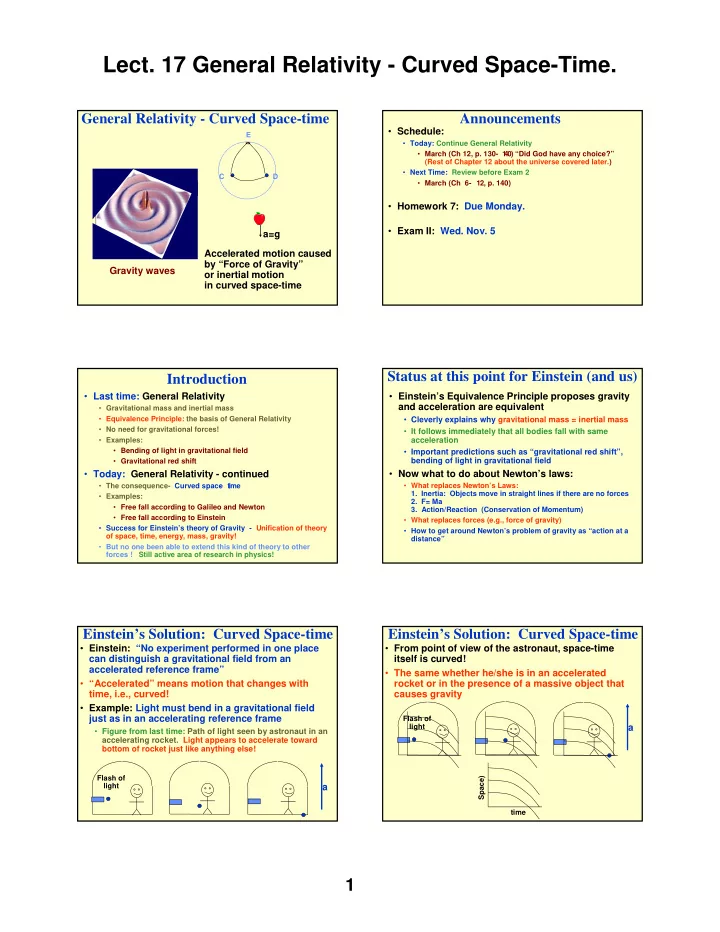
Lect. 17 General Relativity - Curved Space-Time. General Relativity - Curved Space-time Announcements Schedule: E Today: Continue General Relativity March (Ch 12, p. 130- 1 40) Did God have any choice? (Rest of Chapter 12


slide-1
SLIDE 1
  • Lect. 17 General Relativity - Curved Space-Time.

1

General Relativity - Curved Space-time

a=g Gravity waves Accelerated motion caused by “Force of Gravity”

  • r inertial motion

in curved space-time

C D E

Announcements

  • Schedule:
  • Today: Continue General Relativity
  • March (Ch 12, p. 130- 1

40) “Did God have any choice?” (Rest of Chapter 12 about the universe covered later.)

  • Next Time: Review before Exam 2
  • March (Ch 6
  • 12, p. 140)
  • Homework 7: Due Monday.
  • Exam II: Wed. Nov. 5

Introduction

  • Last time: General Relativity
  • Gravitational mass and inertial mass
  • Equivalence Principle: the basis of General Relativity
  • No need for gravitational forces!
  • Examples:
  • Bending of light in gravitational field
  • Gravitational red shift
  • Today: General Relativity - continued
  • The consequence
  • Curved space
  • t

ime

  • Examples:
  • Free fall according to Galileo and Newton
  • Free fall according to Einstein
  • Success for Einstein’s theory of Gravity - Unification of theory
  • f space, time, energy, mass, gravity!
  • But no one been able to extend this kind of theory to other

forces ! Still active area of research in physics!

Status at this point for Einstein (and us)

  • Einstein’s Equivalence Principle proposes gravity

and acceleration are equivalent

  • Cleverly explains why gravitational mass = inertial mass
  • It follows immediately that all bodies fall with same

acceleration

  • Important predictions such as “gravitational red shift”,

bending of light in gravitational field

  • Now what to do about Newton’s laws:
  • What replaces Newton’s Laws:
  • 1. Inertia: Objects move in straight lines if there are no forces
  • 2. F= Ma
  • 3. Action/Reaction (Conservation of Momentum)
  • What replaces forces (e.g., force of gravity)
  • How to get around Newton’s problem of gravity as “action at a

distance”

Einstein’s Solution: Curved Space-time

  • Einstein: “No experiment performed in one place

can distinguish a gravitational field from an accelerated reference frame”

  • “Accelerated” means motion that changes with

time, i.e., curved!

  • Example: Light must bend in a gravitational field

just as in an accelerating reference frame

  • Figure from last time: Path of light seen by astronaut in an

accelerating rocket. Light appears to accelerate toward bottom of rocket just like anything else!

a

Flash of light

Einstein’s Solution: Curved Space-time

  • From point of view of the astronaut, space-time

itself is curved!

  • The same whether he/she is in an accelerated

rocket or in the presence of a massive object that causes gravity a

Flash of light time Space)

slide-2
SLIDE 2
  • Lect. 17 General Relativity - Curved Space-Time.

2

Curved Space-time

  • One analogy: Shortest distance on the curved

(spherical) earth is a “geodesic” curved line

  • Two people starting at the equator and

each heading due north. Meet at the north pole. Is this due to some mysterious force of attraction?

A B C D

Curved Space-time

  • We now move to Einstein’s formulation of the theory

in terms of curved (non-Euclidean) spacetime.

  • Example: imagine you were on a merry-go-

round which was rotating at a fast speed. If you were asked to find the shortest distance between points A and B in the diagram, you would pick the “curved” line rather than the dashed line. Why?

  • Your meter sticks would shrink less at a smaller radius, therefore

you would need fewer of them on the “curved” path!

  • Similarly, you would find “curved paths” to be the shortest

routes between A & C and B & C. Therefore the sum of your angles in the triangle ABC would be < 180°! You would measure your space to be curved!

  • Applying the equivalence principle once again, we are led to the

conclusion that what we call a gravitational field can be viewed as just the “physical manifestation” of curved space-time!

A B ω C

Curved Space-time

  • Curved (non-Euclidean) space-time.
  • Example from previous slides: Space can be curved

in either positive or negative directions

A B C

Sum of angles less than 180°

C D

Sum of angles greater than 180°

E

  • “Inertial motion” in a curved space is defined to be

motion along the shortest path - generalizes the idea

  • f a “straight line” in flat space
  • Einstein’s theory: The mass in a region determines

the curvature of space-time.

  • Newton’s Theory: Force determines motion. For

example, the gravitational attraction between the Sun and a planet determines the curved orbit of the planet about the Sun.

  • Einstein: It is not necessary to “solve” for the
  • motion. All motion is along “straight lines”

(geodesics) in a curved spacetime! The notion of gravitational “force” then has essentially been eliminated.

  • “Matter tells space how to curve and space tells

matter how to move”. All is geometry!

No Need for “Force” of Gravity!

Motion in Curved Space-time

  • Newton’s Description
  • Held ball does not move

Dropped ball has accel. a = g

  • Einstein’s Description: No “force of gravity”
  • Held ball does not move

Dropped ball has accel. a = g Force of hand balances Inertial motion in curved the curvature of space-time space-time near earth

fgravity fhand f = ma a = f/m f = fgravity ftotal= 0 fhand

Path of light near sun

  • Measurement of positions of stars whose light

passes close to the Sun on its way to the Earth.

Is this due to a “force” causing light to bend - or to “straight- line motion (shortest path motion) in curved space-time near sun? Experiments support Einstein’s theory!

Sun Parallel lines can converge to a point in curved space

  • t

ime! Sun α α

Expected position of star if sun were not present

slide-3
SLIDE 3
  • Lect. 17 General Relativity - Curved Space-Time.

3

  • Recall from last time:
  • Einstein’s theory is very mathematical and difficult

to actually use.

  • Because Newton’s Theory is still very accurate for

small gravitational fields, and it is MUCH easier to use, it is used for “everyday” problems”

  • Falling Bodies, Projectiles, . . .
  • Moon going around the Earth
  • Planetary motion EXCEPT that very accurate descriptions require

Einstein’s theory of General Relativity (orbit of Mercury)

  • General Relativity VERY important to understand the

universe!

  • Black Holes, Big Bang, …..
  • More about this later in course!

No Need for “Force” of Gravity - Continued

  • Careful tests
  • The gravitational red shift observed in the laboratory
  • Seen in light from massive stars
  • The orbit of Mercury
  • …...

Evidence for General Relativity

Sun

Slightly elliptical orbit

  • f Mercury

Orbit of Mercury predicted to “precess” around sun slightly differently in Newton and Einstein Theories Experiment support Einstein!

The Speed of Gravity???

  • What about the problem of “action at a distance” in

Newton’s Theory of Gravity

  • Not plausible even in Newton’s time
  • Not allowed by special relativity - nothing can travel faster

than light!

  • Einstein’s theory predicts gravitation waves
  • Analogous to electromagnetic waves
  • Recall a wave is a moving pattern
  • A gravitation wave is a moving pattern of the

curvature of space-time!

Gravity Waves

  • Prediction for waves from

rotating binary stars

  • From Physics Today, October 1999

Waves going

  • utward
  • Not yet observed!

Can Gravity Waves be detected?

  • VERY Difficult!
  • Easy to detect electromagnet waves
  • But recall gravity is MUCH, MUCH weaker!
  • What would a gravity wave do?
  • Distort material just like a force (or acceleration)
  • Change the path of light

Bar of metal L Wave

Searches for Gravity Waves

  • Experiments over large distances
  • Coordinated measurements

across the US

(from Physics Today, October 1999)

  • Very large (4 km !)

Michelson interferometer to measure changes in the path of light VERY accurately 4 km vacuum pipes in the desert in Eastern Washington

slide-4
SLIDE 4
  • Lect. 17 General Relativity - Curved Space-Time.

4

Where To From Here?

  • Einstein’s general relativity is STILL our current

theory of gravitation. It provides the framework for all current work.

  • Example: Cosmology is understood in terms of the general
  • theory. The expansion of the universe from an initial “big

bang” around 14 billion years ago is a solution to Einstein’s equations for the evolution of the universe.

  • Example: Stellar evolution in terms of gravitational

collapse.

  • But what about other “forces”?
  • Attempts at “Grand Unification Theories” but none

complete up to now

  • Much Progress - see later - but unsolved!
  • The major scientific goal of Einstein during the last half of

his life was the search for the grand unification

  • He “failed” -- but he pointed the way for future work!

Summary

  • Matter causes space-time to be curved!
  • Matter moves along “geodesic lines” (shortest paths) in

curved space-time.

  • “Matter tells space how to curve and space tells matter how

to move”. All is geometry!

  • No need for forces!
  • General Relativity essential to understand the

universe

  • Predicts Black Holes, Big band , … (later)
  • Experimentally tested
  • Resolves problem - “no action at a distance”
  • Newton’s laws still work for “everyday problems”
  • Einstein’s theory very mathematical and very difficult
  • The theory is unfinished!
  • One of the goals of current physics research: to describe other

“forces” (like electrical forces) in a unified way.