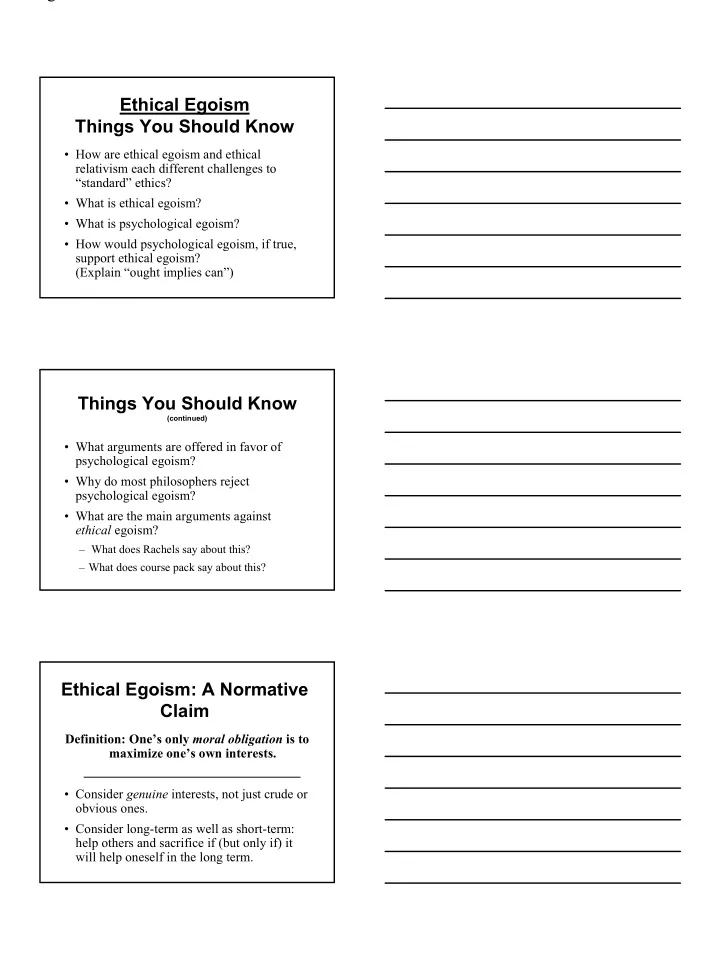
Ethical Egoism Things You Should Know How are ethical egoism and - - PDF document

ethical egoism things you should know
SMART_READER_LITE
LIVE PREVIEW

Ethical Egoism Things You Should Know How are ethical egoism and - - PDF document

Ethical egoism Ethical Egoism Things You Should Know How are ethical egoism and ethical relativism each different challenges to standard ethics? What is ethical egoism? What is psychological egoism? How would


slide-1
SLIDE 1

Ethical egoism 1 Phil and CRJ 240: Ethics

Ethical Egoism Things You Should Know

  • How are ethical egoism and ethical

relativism each different challenges to “standard” ethics?

  • What is ethical egoism?
  • What is psychological egoism?
  • How would psychological egoism, if true,

support ethical egoism? (Explain “ought implies can”)

Things You Should Know

(continued)

  • What arguments are offered in favor of

psychological egoism?

  • Why do most philosophers reject

psychological egoism?

  • What are the main arguments against

ethical egoism?

– What does Rachels say about this? – What does course pack say about this?

Ethical Egoism: A Normative Claim

Definition: One’s only moral obligation is to maximize one’s own interests.

  • Consider genuine interests, not just crude or
  • bvious ones.
  • Consider long-term as well as short-term:

help others and sacrifice if (but only if) it will help oneself in the long term.

slide-2
SLIDE 2

Ethical egoism 2 Phil and CRJ 240: Ethics

Psychological Egoism: A Purely Descriptive Claim

  • People are only capable of acting in what they

think is their own self-interest.

  • People are always motivated by self-interest.
  • It is impossible for people to act on a

motivation purely to help others or to do “the right thing,” conflicting with self-interest.

So what?

  • Psychological egoism is a descriptive claim,

not an ethical claim. So why does it matter?

  • If it only claimed that sacrificing self-

interest is difficult, it would not be a challenge to ethics.

  • Crucial point: “ought implies can”

Is Psychological Egoism (PE) True?

Look inside yourself

  • PE: People are motivated by desire for good

reputation, return gain, etc.

  • PE: Even when people help others or

sacrifice, they get a good feeling out of it.

  • PE: Whatever people do, they are satisfying
  • ne of their own desires.
slide-3
SLIDE 3

Ethical egoism 3 Phil and CRJ 240: Ethics

Response to Arguments for Psychological Egoism

  • Many acts not for obvious gains.
  • Not enough to show people GET a good

feeling, act must be for the sake of good feeling (or avoiding guilt).

  • Confusion: psychological egoism must

show that object of desire is self-interest.

Distinguish 2 Things

Mother Teresa helps starving children

The object must be herself. No evidence for this.

Of course it’s Mother Teresa’s desire, but that’s no argument for PE.

What is the object

  • f the desire?

Who is the subject? (Whose desire is being satisfied?)

Arguments Against Ethical Egoism

  • Why shouldn’t you harm others?

Because they would be harmed!

  • Ethical egoism is simply not the ethical

point of view because it cannot solve conflicts of interests.

(Note the assumption made about what the purpose of ethics.