Special Areas of Conservation cSACs Rathlin Annex 1 features - - PowerPoint PPT Presentation

special areas of conservation csac s
SMART_READER_LITE
LIVE PREVIEW

Special Areas of Conservation cSACs Rathlin Annex 1 features - - PowerPoint PPT Presentation

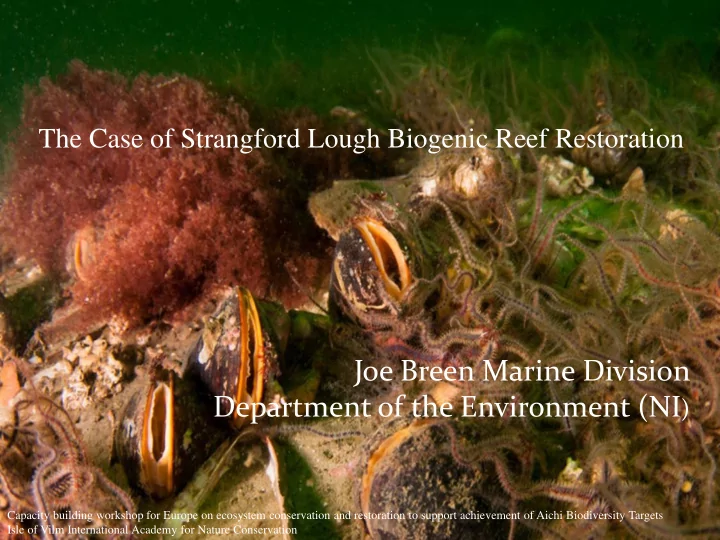
The Case of Strangford Lough Biogenic Reef Restoration Joe Breen Marine Division Department of the Environment (NI ) Capacity building workshop for Europe on ecosystem conservation and restoration to support achievement of Aichi Biodiversity


slide-1
SLIDE 1

Joe Breen Marine Division Department of the Environment (NI)

Capacity building workshop for Europe on ecosystem conservation and restoration to support achievement of Aichi Biodiversity Targets Isle of Vilm International Academy for Nature Conservation

The Case of Strangford Lough Biogenic Reef Restoration

slide-2
SLIDE 2
slide-3
SLIDE 3

Rathlin

  • Annex 1 features
  • Reefs,Sea Caves, Sandbanks Slightly covered

Strangford Lough

  • Annex 1 features
  • Large shallow inlet & bay, Coastal lagoons,

uncovered mudflats & sandflats, reefs

  • Annex 1 species, common seal

Murlough Bay

  • Annex 1 features
  • uncovered mudflats & sandflats, Sandbanks Slightly

covered, Atlantic salt meadow

  • Annex 1 species, common seal

Special Areas of Conservation cSAC’s

slide-4
SLIDE 4

A Jewel in the Crown of Nature Conservation

slide-5
SLIDE 5

S.P.A. and S.A.C. Marine Nature Reserve

Also RAMSAR, ASSI, NNR etc...

Strangford Lough, a protected area?

Conservation Zone

slide-6
SLIDE 6

Communities and substrates – Erwin 1977

slide-7
SLIDE 7

Natural undamaged biogenic reef

slide-8
SLIDE 8

Damaged biogenic reef

slide-9
SLIDE 9

The Main Anthropogenic Impacts

slide-10
SLIDE 10
slide-11
SLIDE 11
slide-12
SLIDE 12

Prawn/queen scallop trawling permitted ‘93 King scallop dredging permitted ‘93 Section 14 Oyster Dredging application 2002

Sites with Modiolus ‘dominant’ (Erwin et al) 1987

Fishery Conservation measures ‘93

slide-13
SLIDE 13

Monitoring conducted by DARD Scientists often joint funded by DOE. Mainly Broadscale acoustic methods using RoxAnn and Side scan sonar ground-truthed by video sledge.

slide-14
SLIDE 14

1993 2000

Year Area Modiolus Area of scattered shell 1993 8.13 3.84 2000 2.1 8.93

Source DARD 2002

There was no significant change between 1993 and 2000 in the area of Modiolus habitat coverage;

Such areas may be the result of physical disturbance to Modiolus clumps, such as trawling activity

RoxAnn Surveys Single beam acoustic discrimination mapping system

slide-15
SLIDE 15
slide-16
SLIDE 16
slide-17
SLIDE 17
slide-18
SLIDE 18

WP1 Nature and Extent of community change within Strangford Lough WP2 The current biological and ecological status of Strangford Modiolus

  • WP3. Commercial fishing
  • WP4. Boating activities
  • WP5. Change in weather patterns-Climate Change
  • WP6. Pollution
  • WP7. Dredging activities and Shore Works
  • WP8. Aquaculture
  • WP9. Harmful Algal Blooms, Diseases and Parasites
  • WP10. Alien species

WP11 National Workshop and bringing together of findings WP12 Recommendations to Government

Strangford Lough Ecological Change Investigation

slide-19
SLIDE 19

SLECI Survey 2003

Mahee Island IslandMore Reagh Island Island Taggart Conly Island Pawle Island Roe Is Rainey Island Sketrick Island Dunsy Island Chapel Island South Island Salt Island Trasnagh Island Darragh Island Green Island Chapel Island Inishanier Long Island Green Island Drummond Island Inisharoan Great Minnis Jackdaw Island Parton Is Little Minnis Shark Island Calf Island Ballyhenry Island Bird Island Round Island Hen Is Veagh Bird Island Gull Rock Dunsy Rock Black Rock DunnyNeil West DunnyNeil East

Legend

Other communities Modiolus beds Modiolus beds - damaged Mud with dead shell Nephrops bed Coastline 10mContour Islands

SLECI divesite positions 2003

slide-20
SLIDE 20

All factors except mobile gear fishing were excluded as probable cause of reef degradation

slide-21
SLIDE 21

What Have DOE done?

 Commissioned our own independent survey of the current status of all

feature interests within Strangford, SLECI

 Advised DARD that there is and has been credible scientific evidence

that bottom fishing reduces complexity and diversity of Modiolus biogenic reefs and hence they are consenting an action which is in breech of the Habitats Regulations

 The dive survey reveals that there are perhaps only three remaining

reefs in the Lough(this includes the areas were boats are excluded)

 We advisedDARD that in light of this recent evidence they as

Competent Authority should invoke the ‘Precautionary Principal’ by banning trawling/dredging until such time as we fully understand exactly what is happening in Strangford Lough. Failure to do so could result in Infraction Proceedings against the UK for permitting damage to a Natura 2000 site.

DARD Minister Pearson invoked temporary ban on all mobile fishing activity within Strangford Lough 1st December 2003, immediate effect midnight on day of announcement. Cited precautionary principal.
slide-22
SLIDE 22

2005

slide-23
SLIDE 23

ELEMENTS OF THE RESTORATION PLAN

(1) Strict protection of the remaining extant Modiolus biogenic reefs and areas where they were previously reported within Strangford Lough through: Maintaining the temporary ban

  • n mobile gear Establishing no-disturbance areas,

including disturbance by anchoring, potting and diving (2) Reviewing possible impacts from extant consented activities, e.g. sewage discharges, commercial fishing and aquaculture These measures may require amended and/or new legislation where it is found that existing measures (including voluntary codes of conduct) are found not to be sufficient to control an actual or potential threat to the interest feature.

slide-24
SLIDE 24

(2) Monitoring of the effectiveness of protection measures including: Compliance monitoring (policing of banned activities and activities within zoned areas) Detailed reef mapping Monitoring natural recovery

slide-25
SLIDE 25

(3) Intervention action. There is a need to identify methodologies aimed at artificially restoring the reef feature in the event of natural recovery failing to achieve a trend towards Favourable Conservation Status (FCS). These will include: Pilot-scale studies to assess whether conditions in areas based

  • n historical presence are currently favourable for Modiolus

restoration. Translocation of natural Modiolus reefs. Experimental re-seeding of historical Modiolus reef sites.. This element will require the following lines of research: Production of young mussels for re-seeding. Establishing the most suitable sites for re-seeding and mussel recruitment . Creating favourable sites, through provision of artificial substrate for both wild and laboratory-reared seed.

slide-26
SLIDE 26

Strangford Lough Modiolus Restoration Research Project:

As part of the delivery of the Restoration Plan

slide-27
SLIDE 27

OBJECTIVES: Modiolus Restoration Plan 2005 DARD DOENI Identify, map and protect Modiolus reef within 1 year To assess if conditions are favourable for restoration using pilot translocation trials To show evidence of recovery of Modiolus reefs towards ‘Unfavourable Condition, Recovering’ within 5 years OBJECTIVES: Modiolus Restoration Research Project 2007 DARD DOENI QUB To restore Modiolus reefs to ‘Favourable Conservation Status’ ‘My authorities wish to reassure the Commission that they are committed to ensuring no further deterioration to the biogenic reefs.’ Second secretary Environment COMMITMENT 2004 Reef Mapping Monitoring Restoration & Intervention trials Scientific advice & Recommendations

slide-28
SLIDE 28

Objective 1 Reef mapping Undertaking 1: Identify good condition Modiolus Undertaking 2: Identify poor condition Modiolus Undertaking 7: Determine distributional range of Modiolus

slide-29
SLIDE 29

Method Description Advantage Disadvantage

Boundary Mapping Using diver mounted sonar beacon and DPVs to map the edge

  • f reefs

Could produce accurate boundary maps of habitat Beds too fragmented to find edge No quantitative data collected Transect mapping 100 m leaded line 20-25 Photo quadrats taken Quantitative and Qualitative data of Modiolus community Historical comparison Does not deliver clear boundary to a reef habitat ROV Video Ray- deployed Ruled out obviously unsuitable area without wasting diver time Small area covered Technical difficulties

Mapping data collection

slide-30
SLIDE 30

1973-2005 2008-2010

North: Dunsey Island to Gransha Point South: Southern tip of Island Taggart to Kate’s

Pladdy

slide-31
SLIDE 31
slide-32
SLIDE 32

Species increasing

  • Mycale similaris
  • Balanus crenatus
  • Liocarcinus corrugatus
  • Mytilus edulis
  • Pecten maximus
  • Ostrea edulis
  • Antedon bifida
  • Thyone roscovita
slide-33
SLIDE 33

Species decreasing

  • Spanioplon armaturum
  • Iophon hyndmani
  • Protula tubularia
  • Modiolus modiolus
  • Aequipecten opercularis
  • Chlamys varia
  • Munida rugosa
  • Thyonidium drummondi
  • Pyura microcosmus
  • Corella parallelogramma
slide-34
SLIDE 34

Notable species unchanged

  • Virgularia mirabilis
  • Sagartiogeton laceratus
  • Doto cuspidata
  • Aeolidiella glauca
  • Arctica islandica
  • Eucratea loricata
  • Leptasterias mulleri
  • Boltenia echinata
slide-35
SLIDE 35

Modiolus condition definitions

Modiolus Condition

Grade

Continuous clumps (> 5 Ind. clump -1) or > 1 clump m -2

1

Discrete clumps (> 3 Ind. clump -1) < 1 clump m -2

2

Modiolus present ( 0 – 3 Ind. clump -1) < 1 clump m -2

3

Modiolus absent

4

slide-36
SLIDE 36
slide-37
SLIDE 37

North: Dunsey Island to Gransha Point South: Southern tip of Island Taggart to Kate’s

Pladdy

Conclusions

  • Current distributional range has been

established

  • Since SLECI, (2004) the Modiolus north of

Hadd Rock has disappeared (Green Island Passage, Slave Rock).

  • Previously unrecorded good condition

area revealed (central channel up to Craigyourran)

slide-38
SLIDE 38

 There has been an overall decline of Modiolus densities within the current

range since 2003

 The greatest decline has occurred in the area north of Long Sheelah

(condition indices, presence/absence transects and density calculations)where recruitment is also low.

 Modiolus at Round Island Pinnacle and Brown/Black rock decreased only

slightly recruitment is higher within these areas.

 Potential cause is continued disturbance due to increase in static gear

fishing which is a non selective extractive fishery, not managed by quota and may cause physical disturbance to recovering reefs.

 The Departments did not introduce total protection

Conclusions of MRRG

slide-39
SLIDE 39

What Now

slide-40
SLIDE 40

EU Infraction Number 2

slide-41
SLIDE 41
slide-42
SLIDE 42

Workstream 1 Protection

Objective:

  • To prevent further damage to surviving Modiolus reefs and

create conditions favourable for their recovery Critical Actions:

  • Introduction of pot fishing regulations and byelaws in the

protection zone

  • .
  • Introduction of pot fishing permit scheme in the remainder of

the Lough.

  • Appoint a dedicated Fisheries Officer and Marine Ranger.
  • Consider any justification and basis for public support to

assist transition to the fishing permit scheme.

slide-43
SLIDE 43
slide-44
SLIDE 44

Workstream 2 Intervention

 Objective:  To investigate options to restore Modiolus reefs and

implement agreed approaches.

 Critical Actions:  Appoint a post-doctorate researcher to take forward the

intervention action.

 Set up a Restoration Working Group with stakeholders.  Evaluate translocation/intervention methodology and

secure the necessary approvals and resources.

 Implement intervention methodology.

slide-45
SLIDE 45

b b b

slide-46
SLIDE 46

Workstream 3 Monitoring

 Objective:  To record temporal and spatial changes in the extent and

condition of biogenic reefs, including Modiolus populations and associated communities.

  Critical Actions  Develop long-term monitoring protocol.  Review rate and extent of recovery.  Compare with Modiolus reef outside Strangford Lough. 

slide-47
SLIDE 47
  • RO2. EXAMINE

GENETIC CONNECTIVITY AND DIVERSITY OF

  • M. MODIOLUS POPULATIONS

Complete mitochondrial and microsatellite analyses of M. modiolus populations and link with previously completed analyses; Determine levels of connectivity and diversity.

Isle of Man Wales Scotland N.Irelan d Norway Isle of Man Scotland Wales

  • N. Ireland

Southern Limit

slide-48
SLIDE 48
slide-49
SLIDE 49
slide-50
SLIDE 50

Costs

 SLECI

2002-2004 300k Euro

 MRRG

2008-2010 1250k Euro

 MRRG II 2013-2016

350k Euro

 Total

1.9 Million Euro

slide-51
SLIDE 51

In fact there is no computer now, or likely to be in the future, which can integrate and correlate with the speed of the human brain the hundreds of variables noted with a single human glance If it looks alright, then it probably is? R H Parker 1974, Science

slide-52
SLIDE 52

‘If you are going to achieve anything you MUST take the management of Strangford Lough away from Portaferry, Belfast and maybe even London. You MUST get as far away as possible from people who have a direct interest in the discussions. The principal justification for any marine protected area MUST be the conservation of the resource and NOT the maintenance of privilege which, with time, has become a right.’