Public Consultation for Request for Exemption to Permit Jets at - - PowerPoint PPT Presentation

public consultation for
SMART_READER_LITE
LIVE PREVIEW

Public Consultation for Request for Exemption to Permit Jets at - - PowerPoint PPT Presentation

Public Consultation for Request for Exemption to Permit Jets at Billy Bishop Toronto City Airport (BBTCA) process Monday September 9, 2013 1 Background On May 7, 8, 9 and 10, 2013, City Council directed staff to undertake a review


slide-1
SLIDE 1

1

process

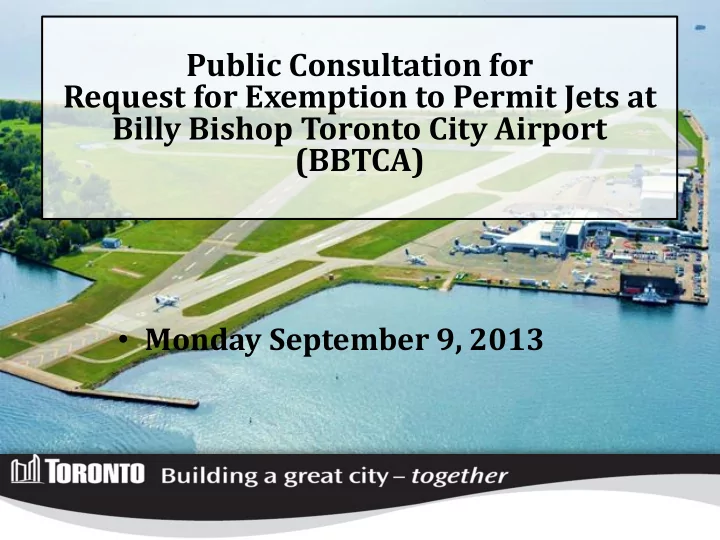
Public Consultation for Request for Exemption to Permit Jets at Billy Bishop Toronto City Airport (BBTCA)

  • Monday September 9, 2013
slide-2
SLIDE 2

2

Background

  • On May 7, 8, 9 and 10, 2013, City Council directed staff to undertake a

review of the request from Porter Airlines for an exemption to operate jet- powered aircraft at BBTCA.

  • The City Council decision included the following directions:

1. Review the necessary approval process to amend the Tripartite Agreement; conformity with the terms of the Tripartite Agreement, and the passenger and airport capacity that can be achieved in conformity with the Tripartite Agreement. 2. Review Transport Canada regulations for the proposed runway. 3. Review the physical and operational requirements associated with Porter Airlines’ proposal, including City infrastructure, compatibility with NEF contours, changes in take-off and landing approach, protected airspaces and the Marine Exclusion Zone.

slide-3
SLIDE 3

Background

4. Determine the airside and landside constraints and related infrastructure requirements relevant to expansion of aeronautical and non-aeronautical operations at BBTCA. 5. Propose an overall methodology for evaluating the airport with the broader planning framework to understand effects on waterfront revitalization and examine other examples of urban jet use in waterfront cities. 6. Analyze potential economic impacts and opportunities associated with this request, including maritime, aviation, and other uses and users that could be affected by physical and operational expansion at BBTCA. 7. Coordinate public consultation and discussions with the Toronto District School Board, Waterfront Toronto, TRCA, GTAA, NAV Canada and other aviation stakeholders.

3

slide-4
SLIDE 4

4

Background

8. Evaluate the impact on to emergency services navigating to and from the harbour through the Western Channel to Lake Ontario. 9. Evaluate the implications of the proposal on the Open Skies Agreement and other international agreements.

  • 10. Examine the noise, environmental and traffic/congestion impacts

associated with the Porter Airlines’ request.

slide-5
SLIDE 5

5

Background

Additional direction provided by City Council:

  • Exclude an expansion into the Toronto Island Park system south of the

current southern boundary of the airport.

  • Exclude any consideration of either a runway or an extension of the

Marine Exclusion Zone (MEZ).

  • Exclude any changes to the existing noise guidelines for individual

airplanes or amendments to the provisions and guidelines that set the NEF contours currently in place.

slide-6
SLIDE 6

6

Background

June July August Sept. Oct. Nov. Dec. Preliminary Analysis (Environment, Transportation, Navigation, other)      Information Report #1 to Executive Committee  Public Consultation  Town Hall Meeting  Information Report #2 to Executive Committee  Evaluation by City Staff and follow-up analysis from consultants     Final Report to Executive Committee  Final Report to City Council for Decision 

We Are Here

slide-7
SLIDE 7

7

Background

  • The City has been asked to consider

permitting jet‐powered aircraft at BBTCA.

  • This could have negative and positive

effects on the Waterfront, nearby communities, the natural environment and our local economy.

  • Porter Airlines and Air Canada

currently operate out of BBTCA.

  • Passenger volumes at the BBTCA have

increased significantly since 2006.

slide-8
SLIDE 8

8

Background

  • Increased passenger volumes have

impacted groundside facilities causing conflicts between the airport and the adjacent community.

  • The airport currently permits 202

commercial slots per day (take-off and landing).

  • Flights are restricted to between 6:45 a.m.

and 11 p.m.

  • Jet aircraft are currently not permitted

except for Medivac flights.

  • The City is reviewing the role and function
  • f the airport and how its operations impact

the waterfront and adjacent community.

slide-9
SLIDE 9

9

What Have We Heard

  • 200+ people have attended public and stakeholder meetings
  • n the issue.
  • 300+ items of correspondence submitted to date.
  • Detailed submissions from individuals, stakeholders,

recreational users, airlines and manufacturers on topics ranging from waterfront revitalization, competition at the airport, health impacts of aircraft and airports, impacts on the boating community, etc.

  • Online survey is ongoing, concludes on October 11, 2013.
slide-10
SLIDE 10

10

What Have We Heard

  • How does an expanded airport fit

into the waterfront revitalization?

  • Does this open the door for further

airport expansion?

  • Is this consistent with the spirit of

the Tripartite Agreement?

  • What is the effect on birds and

aquatic life?

  • How can the City make a decision

if the CS-100 hasn’t had it first test flight?

  • Runway expansion will bring

planes closer to existing residential areas.

  • Safety of airport operations within

a busy urban environment.

  • Health effects of noise, air

pollution and flights frequency.

  • Increase in groundside traffic and

impact on Queen’s Quay.

  • Impact on Waterfront School and

Harbourfront Community Centre.

  • Impacts extend beyond immediate

vicinity.

  • Airport is conveniently located

close to downtown.

slide-11
SLIDE 11

11

What Have We Heard

  • Toronto Islands is a city-wide

recreational and natural amenity, it should be enhanced for all residents.

  • How will this affect the Union-

Pearson Rail Link?

  • What is the long term role of this

airport within a regional system

  • f airports?
  • The pace of the review is too fast

given the complexity of the issue and long term impact.

  • How will Runway End Safety Area

(RESA) requirements affect this proposal?

  • What is the potential impact of

noise from maintenance, particularly engine-run ups.

  • Potential impact on adjacent land

values.

  • Will noise, pollution (air and

water) affect marine life around the airport?

  • What is the impact on non-

commercial operators at the airport?

slide-12
SLIDE 12

12

Technical Studies

  • A series of Technical Studies have been initiated by the City to examine

topics related to: – Aviation (noise, safety and infrastructure) – Economic Impacts – Land Use and Community Impacts – Marine Navigation, Coastal and Habitat Assessments – Transportation Impacts – Health Impact Assessment (Human Health, Noise, Air Emissions)

  • Consultants were asked to review the original proposal and identify

potential impacts.

  • A Fairness Monitor was retained to monitor the procurement process

and ensure that consultants did not have a conflict of interest with airport stakeholders.

slide-13
SLIDE 13

13

Public Consultation

  • The purpose of tonight’s meeting is to present our consultant’s findings

(both negative, positive and unknown) and provide an opportunity for the public to ask questions and provide comments.

  • All questions and comments will be recorded and reviewed by staff as part
  • f the staff-led evaluation process.
  • We are still gathering information, public feedback at this stage is vital to

ensure that the City’s review is comprehensive. If we have missed an important issue or have not adequately addressed your concerns, please advise us.

  • The work of the consultants is not complete, there will be follow-up

reports based on public consultation feedback.

  • The review of Porter Airlines’ revised proposal for 200m runway

extensions is ongoing.

slide-14
SLIDE 14

14

Next Steps

  • Next steps:

– Town Hall meeting on September 19th at Direct Energy Convention Centre, Exhibition Place, Salon 105. – Update Report to September 24, 2013 Executive Committee. – Additional Town Hall meeting in November (TBD). – Final Report to Executive Committee (December 5, 2013) and City Council (December 16, 2013).

slide-15
SLIDE 15

15

Contact

Please send any questions, comments, or submissions to:

  • Christopher Dunn, Project Manager

Waterfront Secretariat, City of Toronto Tel: (416) 395-1211 E-mail: cdunn@toronto.ca

  • To submit comments, please e-mail: wps@toronto.ca
slide-16
SLIDE 16

GUIDANCE

  • We will follow the order of presentation as per the

agenda

  • We will stick to the timeline
  • Please only ask questions that deal with the topic of

presentation

  • In order to accommodate as many participants as possible

– we will call on those who have yet to ask a question first

  • If you still have a question or require clarification join the

consultant in the discussion room

  • Please be respectful – forms of intimidation will not be

tolerated

16

slide-17
SLIDE 17

TIME AGENDA ITEM TOPIC PRESENTER AND AFFILIATION ROOM

6:00 – 7:00 pm Drop-In

Review of Display Boards

308-309

PRESENTATION AND QUESTIONS/ANSWER

7:00 – 7:20 pm Presentation 1

Process Update

Chris Dunn, City of Toronto

308

7:20 – 7:40 pm Presentation 2

Aviation

Martin Leprohon AirBiz Aviation Strategies Ltd.

TBD

7:40 – 8:00 pm Presentation 3

Land Use and Community Impacts

Josh Neubauer Urban Strategies Inc.

TBD

8:00 – 8:20 pm Presentation 4

Transportation Impacts

Ralph Bond BA Group

TBD

8:20 – 8:40 pm Presentation 5

Economic Impacts

Ken Lambert HLT Advisory Inc.

TBD

8:40 – 9:00 pm Presentation 6

Marine Navigation, Coastal and Habitat Assessments

Leah Weller CH2M Hill

TBD

9:00 pm

Wrap-up

City Staff

308-309

Agenda

17 DATE: Monday, September 9, 2013 TIME: 6:00 - 7:00 p.m. Drop-In; 7 – 9 p.m. Presentations and Q&A LOCATION: Metro Hall

slide-18
SLIDE 18

BILLY BISHOP TORONTO CITY AIRPORT

PORTER AIRLINES PROPOSAL REVIEW

9 SEPTEMBER 2013

PUBLIC WORKSHOP

slide-19
SLIDE 19
  • Scope Overview
  • Methods Used
  • Key Findings
  • Further Work
  • Exclusions

OUTLINE

BILLY BISHOP TORONTO CITY AIRPORT

slide-20
SLIDE 20
  • Determine airport ultimate capacity based upon Jets operating at the airport,

within the remaining restrictions of the Tripartite Agreement.

  • Examination of preliminary information for the Bombardier CS-100 aircraft,

including specifications and identification of comparable aircraft.

  • Review of the infrastructure requirements within the proposal.
  • Review of the preliminary information on aircraft noise and emissions

associated with the CS-100 operations.

SCOPE OVERVIEW

BILLY BISHOP TORONTO CITY AIRPORT

slide-21
SLIDE 21
  • Review impact of the proposed Runway End Safety Area (RESA) regulation .
  • Review impact on General Aviation (GA) activities.
  • Examine impact on airspace operations.
  • Estimate order of magnitude cost and comment on financial feasibility of the extended

runway requirements within the proposal.

  • Benchmark other waterfront airports, located within urban areas, to provide

comparative analysis and precedents to City staff.

SCOPE OVERVIEW

BILLY BISHOP TORONTO CITY AIRPORT

slide-22
SLIDE 22
  • Review of the Proposal and associated reference material
  • Review of International and National Regulations, Guidelines and Best

Practices

  • Review of the Tripartite Agreement
  • Review of Publicly Available Reference Material

METHODS

BILLY BISHOP TORONTO CITY AIRPORT General Aviation Noise Airport Infrastructure Airspace Aircraft

slide-23
SLIDE 23
  • Existing 202 commercial movement cap is assumed to remain; this constraint

sets the annual capacity at the airport.

  • Runway-End Safety Areas (RESA) are expected to become a requirement at

BBTCA.

  • RESA requirements themselves will not impact current Marine Exclusion Zones

(MEZ).

ASSUMPTIONS

BILLY BISHOP TORONTO CITY AIRPORT

slide-24
SLIDE 24
  • Bombardier CS100 is the first of several comparable “next generation” aircraft

expected to enter the market before the end of the decade.

  • Transport Canada must be engaged to review the current operational exemptions and

define how the CS100 (or comparable aircraft) will impact these exemptions, especially in regards to the need to maintain the integrity of the Marine Exclusion Zone (MEZ).

  • The Pearson Airport and Billy Bishop Airport airspace is co-dependant. The ability of

both airports to operate in the general Toronto airspace will not be negatively affected by the proposal.

  • CS100 is proposed to meet cumulative noise certification levels set within the

Tripartite Agreement. However it is too early to confirm either the cumulative or individual (Approach, Take-Off and Flyover) compliance as certification measurement has not been completed.

KEY FINDINGS

BILLY BISHOP TORONTO CITY AIRPORT

slide-25
SLIDE 25
  • The use of jets at the airport permits General Aviation (GA) activities.
  • A lift of the ban on jet movements could allow Very Light Jet (VLJ) aircraft to operate
  • n the existing airport infrastructure. GA activities could include VLJ operations.
  • The proposal requires expansion of the terminal and apron areas which will impact

adjacent functions and operations.

  • CS100 operations will have a limited impact on annual passenger capacity (+15%), but

will have a sizeable impact on busy hour capacity (+40%).

  • Order of magnitude cost of the proposed runway extension is $80 million, excluding

any pavement or terminal upgrade works.

  • Other waterfront or urban airports were reviewed and found to have a variety of
  • perating restrictions imposed.

KEY FINDINGS

BILLY BISHOP TORONTO CITY AIRPORT

slide-26
SLIDE 26
  • Review of the revised the Proposal
  • Airside and airspace capacity considerations
  • Review of new information from Bombardier as it becomes available

FURTHER WORK

BILLY BISHOP TORONTO CITY AIRPORT

slide-27
SLIDE 27
  • Impact of the proposal on the existing daily movement cap
  • Cost of improvements other than the runway extension associated with the

introduction of jet aircraft

EXCLUSIONS

BILLY BISHOP TORONTO CITY AIRPORT

slide-28
SLIDE 28

DEVELOPMENT CONSTRAINTS

BILLY BISHOP TORONTO CITY AIRPORT

slide-29
SLIDE 29

CUMULATIVE CERTIFICATION NOISE LEVELS

BILLY BISHOP TORONTO CITY AIRPORT

slide-30
SLIDE 30

COMPARABLE AIRPORTS

BILLY BISHOP TORONTO CITY AIRPORT

Billy Bishop Toronto City Airport London City Airport Bromma-Stockholm Airport George Best Belfast City Airport IATA Code YTZ LCY BMA BHD Country Canada United Kingdom Sweden United Kingdom Major Airport Toronto-Pearson London Heathrow Arlanda-Stockholm Belfast Airport Distance from City

  • 11km

8km 5km Passengers (2012) 1.9 million 3.0 million 2.2 million 2.3 million Aircraft (2012) 111,000 (2011) 71,000 47,000 42,000 Jets Allowed No Yes Yes Yes Hours of Operation (Weekdays) 6:45-23:00 6:30-22:30 6:00-21:00 6:30-21:30 Approach Slope 3.9°-4.8° 5.5° 3.5° 3.0° Movement Cap Noise-Based Quotas Currently 202 daily commercial slots 120,000 annual movements and daily restrictions. Noise-based quotas Partial weekend curfew 80,000 Annual (including 20,000 aircraft with more than 60 seats and EPNdB 86-89) 48,000 annual movements 4 million seats for sale per year Rail Link Off-Airport Light Rail On-Airport Rail Station Off-Airport Light Rail Off-Airport Rail Station

slide-31
SLIDE 31

ELEVATION VIEW

BILLY BISHOP TORONTO CITY AIRPORT

slide-32
SLIDE 32

Our Role in the Study

Urban Strategies was retained to:

  • Review existing, planned, and proposed land uses
  • Summarize the planning policy framework
  • Review and analyze examples of waterfront/urban

airports

  • Develop an evaluation tool to understand the

impacts of proposed Airport expansion

  • “Fill in” the evaluation tool to help inform staff’s

recommendations to City Council

32

slide-33
SLIDE 33

Evaluation Tool: Identifying Existing and Potential Impacts

Identified a wide range of existing and potential impacts based on:

  • Community concerns
  • Discussions with City staff
  • Discussions with other consultants
  • Internal workshop among planners at Urban Strategies
  • Site visits
  • Review of past Airport-related reports
  • Review of other urban/waterfront airports around the world

33

slide-34
SLIDE 34

Evaluation Tool: Preliminary List of Impacts

The list is a work in progress, and will be refined with community and consultant input.

34

slide-35
SLIDE 35

Evaluation Tool: Scenarios

Scenario 1: 2012 baseline

  • Only propeller aircraft (within current limitations)
  • No runway extensions or expansions
  • 2.3 million passengers/year

Scenario 2: Maximizing capacity of existing aircraft and facilities

  • Only propeller aircraft (within current limitations)
  • No runway extensions or expansions
  • Potential increase in capacity to 3.8 million passengers per/year

Scenario 3: Proposed Airport expansion

  • Mix of propeller and jet powered aircraft (likely 75% propeller, 25% jet)
  • Extension of Runway 08/26
  • Potential increase in capacity to 4.3 million passengers/year

35

We developed 3 scenarios to isolate expansion-related impacts:

slide-36
SLIDE 36

Official Plan

  • Site and Area Specific Policy No. 194 permits the airport

provided that the use is in accordance with the lease.

  • The policy allows the lease to be revised provided that

the City is satisfied that there are no adverse impacts on the surrounding residential and recreational environment.

  • Central Waterfront Plan envisions a revitalized waterfront

based on principles of making connections, building parks, promoting a green environment and creating diverse communities.

36

slide-37
SLIDE 37

Potential Areas of Concern

  • Absence of planning framework specifically

related to Airport

  • Fragmentation of parks and open space network
  • Inconsistency of traffic with local planning goals
  • Development heights and Federal Airport Zoning
  • Impacts on schools, Community Centre,

residents, especially near Airport access points

  • Impact on redevelopment of Canada Malting site
  • Role of the Airport within a revitalized, public

space-oriented waterfront

37

At this stage, it is difficult to separate existing concerns from expansion-related concerns.

slide-38
SLIDE 38

Potential Benefits

  • Asset to city in terms of

providing business and leisure travel service at central location, accessible by several modes of transport

38

slide-39
SLIDE 39

Unknowns to Date

  • Most technical findings not yet fully available

(e.g. noise, environment, health, traffic)

  • Detailed plans for Canada Malting site and

Ontario Place not yet available

  • The potential conditions associated with

proposed expansion (and the degree to which they are acceptable)

39

slide-40
SLIDE 40

Public Consultation

  • n the Use of Jets at Billy Bishop

Toronto City Airport (BBTCA)

Transportation Slides

Monday, September 9, 2013

slide-41
SLIDE 41

Transportation

Purpose of Analysis

  • Review the traffic impact of airport

expansion on land side (e.g. Eireann Quay, Bathurst Street, Queens Quay, etc.) Methodology

  • Traffic forecasting model based on

airport passenger volumes, traffic conditions, passenger behaviour

  • Pedestrian & vehicle simulation

model

  • Site observations

2

slide-42
SLIDE 42

Transportation

Preliminary Findings

  • Transportation impacts depend on the number of flights coming

& going in an hour

  • Currently there are approximately 16 flights in the busiest hour
  • If jets are permitted, but the number of flights stays the same,

traffic volumes could increase by 20%

  • A portion of the impact on local traffic of introducing jets could

be off-set by increases in shuttle and transit use

3

slide-43
SLIDE 43

Transportation

Preliminary Findings

  • BBTCA could potentially increase the number of flights in an

hour, regardless of whether jets are permitted or not

  • Increasing the number of flights in an hour could have a bigger

impact than the introduction of jets

  • If the number of flights increases (for example) to an upper-limit
  • f 30 per hour, the number of vehicles per hour could increase

significantly

4

slide-44
SLIDE 44

Transportation

Preliminary Findings

5

Existing No Jets Existing With Jets Max Potential Capacity* No Jets Max Potential Capacity* With Jets

Number of Flights (Per Hour)

16 16 30 30

Traffic Volumes

  • n Eireann Quay

(Cars Per Hour)

750 900 1250 1715

* Max potential capacity to be confirmed

slide-45
SLIDE 45

Transportation

Preliminary Findings

  • Improvements are required to address the existing situation, for

example:

  • Temporary taxi/shuttle area improvements
  • Private vehicle pick-up & drop-off system improvements
  • Shuttle & transit use improvements
  • Pedestrian/vehicular conflict improvements
  • Other options as identified during the review process

6

slide-46
SLIDE 46

Transportation

Preliminary Findings

  • Substantial infrastructure additions are required to

accommodate a significant increase in planes per hour (with or without jets).

  • Options under review include:

– Providing a pedestrian/cyclist grade separation of Eireann Quay south of Queens Quay – Extending Streetcar down Eireann Quay – Extending moving sidewalk up to Queens Quay Streetcar – Grade separating Streetcar through key intersections – Tunneling Bathurst St. under Queens Quay – Extending Dan Leckie Way south and through Canada Malting site

7

slide-47
SLIDE 47

Transportation

Preliminary Findings

  • The possible concepts(to date) for improving traffic conditions at

the BBTCA are outlined on the presentation boards

  • An evaluation matrix is being developed to help determine which

improvements have the greatest benefit to all stakeholders and are consistent with Waterfront objectives

8

slide-48
SLIDE 48

Transportation

Work To Be Completed

  • Confirm the impact of jets (if permitted) and the impact if the

number of flights is increased

  • Complete simulation analysis of the various improvements to

confirm their impacts

  • Provide high level cost estimates of the recommended

improvements

  • Evaluate improvement options and provide preliminary

recommendations

  • Recommend improvements to improve existing operations and to

accommodate potential traffic growth from BBTCA

  • Provide a report summarizing findings to City Staff

9

slide-49
SLIDE 49

Economic Development - Process

  • Collect and analyze data indicating the type and

magnitude of economic impacts expected to result if jet aircraft are introduced to BBTCA

  • Focus on commercial impacts related to:

– scheduled aviation

– Waterfront development – potential impacts on key sectors such as film studios operating in the Port Lands – Tourism spending – Aircraft manufacturing within GTA

  • HLT interviewed Pearson Airport staff as well as national

carriers (Can/USA) with respect to BBTCA airport usage and impact on Pearson Airport

41

slide-50
SLIDE 50

Areas of Concern

  • Other air carriers voiced concerns with respect to access

and slot allocation at BBTCA

  • Film Studios voiced noise concerns with the potential of

increased activity on flight paths along the waterfront

  • Canadian Owners Pilot Association expressed concerns of

private flight operators being moved out of BBTCA after having access for many years

42

slide-51
SLIDE 51

Areas of Opportunity

  • Businesses see BBTCA as an advantage for their

employees who make use of its convenience to downtown core

  • Tourism authorities view existence of BBTCA as supportive

in attracting conferences/events to Toronto

  • Economic impact of increased leisure visitor spending
  • Residential developers cite value of BBTCA as a

percentage of condo residents view access to airport an advantage.

43

slide-52
SLIDE 52

Unknown factors

  • The impact of US long haul flights introduced at BBTCA on

future growth at Pearson Airport has not been specifically quantified; however interviews with Pearson management suggest that passenger growth will continue as it adds more global carriers.

  • BBTCA airline decisions :

– Scheduling – Aircraft type

  • BBTCA airport decisions:

– Ground capacity – Terminal capacity

44

slide-53
SLIDE 53

Marine Navigation, Coastal & Habitat Assessment

Scope:

  • sediment transport
  • bathymetry (underwater topography)
  • water circulation and water quality
  • marine navigation impacts

Methods

  • Review and analysis of existing literature,

legislation, studies and data

  • Review of TRCA, City of Toronto,

Waterfront Toronto and other maps and reports

  • Site visit

45

slide-54
SLIDE 54

Marine Navigation, Coastal & Habitat Assessment

Key Findings

  • Aquatic habitat currently needs improvement
  • If the extension is permitted, there are opportunities

to improve fish habitat; may attract more birds

  • Minor impacts to sediment transport and dune

environment

  • Minor reduction in wave energy entering Western

Gap

  • Minimal to no change to overall currents,

shoreline, wind or ice formation

  • Boats/vessels must continue to travel around

existing marine exclusion zone

46

slide-55
SLIDE 55

Marine Navigation Coastal & Habitat Assessment

Impact Mitigation Measures

  • Sediment and Erosion Control
  • Habitat Design
  • Construction Timing Windows (for example, avoiding bird

breeding or migration periods)

  • Structure Design

Regulatory Framework

  • Canadian Environmental Protection Act
  • Migratory Birds Convention Act
  • Fisheries Act
  • Navigable Waters Protection Act
  • Endangered Species Act

47

slide-56
SLIDE 56

Marine Navigation Coastal & Habitat Assessment

Recommended Further Study

  • Bird Strike Study
  • Jet Blast Study (navigation)
  • Detailed numerical modelling of currents,

sediment transport, ice formation

  • Detailed habitat survey

48