SLIDE 1 1
Competencies for Health Care Ethics Consultation- Health Care Ethics Consultation Team Mark A. Skaja M. Div, BCC John A. Gallagher, Ph.D.
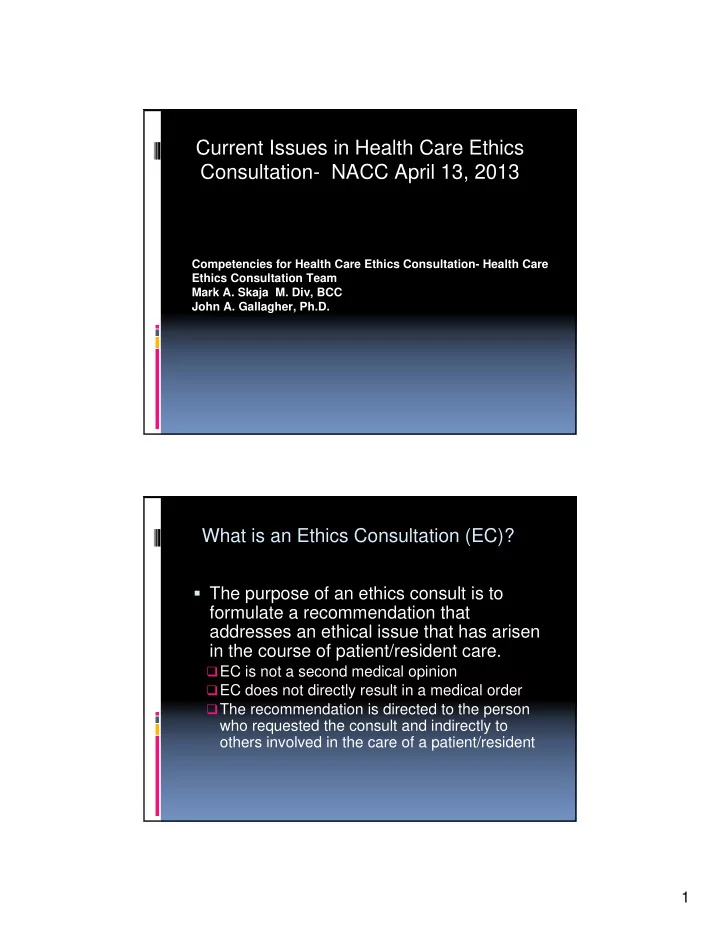
Current Issues in Health Care Ethics Consultation- NACC April 13, 2013
What is an Ethics Consultation (EC)?
- The purpose of an ethics consult is to
formulate a recommendation that addresses an ethical issue that has arisen in the course of patient/resident care.
EC is not a second medical opinion EC does not directly result in a medical order The recommendation is directed to the person
who requested the consult and indirectly to
- thers involved in the care of a patient/resident
SLIDE 2
2
What is an Ethics Consultation?
What distinguishes an ethics consultation
from other types of patient encounters is that its focus is the resolution of a value laden or ethical issue.
Thus it is distinguishable from:
A pastoral visit A clinical visit
Ethics Consultation (EC)
Health care ethics consultation is a service
provided by an individual or a group to help patients, families, surrogates, health care providers or other involved parties address uncertainty or conflict regarding value-laden issues that emerge in health care.
SLIDE 3
3
Team vs. Individual
“…a service provided by an individual or a group…”
In the most authentic sense, EC should be a
service provided by a team.
EC require a range of competencies if they are to be done well The competencies required to conduct an EC are rarely, if ever, possessed by one person. However, circumstances such as week ends, time constraints and urgency may require that at times an EC be conducted by an individual.
Risks of Curbside Consultations
He said She said Not consistent Giving an opinion Documentation
SLIDE 4
4
Team vs. Ethics Committee
Time Size Consensus Other
Ethics Consultation Team
Consultation Team
One size does not fit all Build to size
Membership
Physicians Risk Management/Legal Nurses Administration Chaplains Social Workers Therapists
SLIDE 5
5
ETHICS CONSULTATION TEAM
Availability – 24/7 Intake officers Initial assessment
Identification of an ethical issue
The first step for EC is to identify the ethical
issue, for example:
Is the withdrawal of a peg tube consistent with
ERD #58, the human dignity, or autonomy of the patient?
Is the care accorded a patient/resident consistent
with the values of excellence and service?
Is the allocation of limited beds in an ICU
consistent with justice?
SLIDE 6 6
Identification of an ethical issue
If it is not an ethical issue – ensure proper
hand off to:
Pastoral Care Palliative Care Legal/risk Clinical Manger/Director
Identify Needed Resources Leadership Support
Ethics Consultation
- 2. “… to help patients, families, surrogates,
health care providers or other involved parties address uncertainty or conflict regarding value laden issues that emerge in health care.”
This is the heart of what EC is about – value
laden issues, issues of ethics
SLIDE 7 7
CORE COMPETENCIES
What are the competencies (skills and knowledge areas) that are essential for an Ethics Consultation?
Competencies (skills and knowledge)
The American Society of Bioethics and the Humanities has identified twelve skills and nine knowledge areas that should be present in ethics consultation teams. Together they constitute the competencies required for effective, high quality case consultation.
- The expectation is that these competencies are represented in
the ethics consultation team, not that each individual on the team has all nineteen competencies.
SLIDE 8 8
Competencies (skills and knowledge)
As you review each of these skills and areas of knowledge, do a self-assessment at the same time. Is each competency an area in which you are proficient, an area of weakness, or somewhere in between. It can also be beneficial if the ECT performs such a self-assessment as a team project. Such assessments can lead to individual and group learning plans.
The 12 Skill Areas
- 1. Skills necessary to identify the nature of
the value uncertainty or conflict that underlies the need for ethics consultation
- This is the ability to recognize the value laden
- r ethical issues embedded in a clinical case
- This skill is grounded in moral theory, what
ethics is about. Ethics is concerned with identifying authentic human goods and the avoidance of what harms such goods.
SLIDE 9 9
The 12 Skill Areas
- 2. Skills necessary to analyze the value
uncertainty or conflict
- This skill is associated with moral reasoning,
what are the potential appropriate and fitting responses to the ethical issue.
- Reasoning from analogy is helpful here. This
case is similar to another case. Does understanding what is similar and what is dissimilar help evoke a fitting response.
The 12 Skill Areas
3.The ability to facilitate formal and informal meetings
- This is the ability to conduct meetings that are
efficient and effective.
- The appropriate issues are surfaced
- Participants are free to express themselves in an
- pen manner
SLIDE 10 10
The 12 Skill Areas
- 4. The ability to build moral consensus
- This skill is crucial to the ethics facilitation
process
- This is the capacity to generate cognitive and
affective support for an appropriate/fitting ethical response
- Out of moral confusion and frequently familial or
caregiver anguish a shared consensus about the right thing to do emerges
The 12 Skill Areas
- 5. The ability to utilize institutional structures and
resources to facilitate the implementation of the chosen
- ption.
- This is the ability to recognize the resources within an
- rganization that can support and implement a fitting response.
Or impede such a response
- Such resources range from case managers, social workers,
pastoral care, financial advisors as well as the panoply of medical and clinical resources available within a facility.
SLIDE 11 11
The 12 Skill Areas
- 6. The ability to document consults and elicit
feedback regarding the process of consultation so that the process can be evaluated.
- ECs should be documented in the manner
indicated by the Legal Network
- The evaluation of ECs by the ECT and the
Ethics Committee are essential for continuous quality improvement.
The 12 Skill Areas
- 7. The ability to listen well and to
communicate interest, respect, support and empathy to involved parties
- The ability to listen well is the first step in
identifying the value laden/ moral issue
- Consensus can only occur when everyone
believes they have been heard
- Consensus is also the product of mutual
interest, respect, support and empathy.
SLIDE 12 12
The 12 Skill Areas
- 8. The ability to educate involved parties
regarding he ethical dimensions of the case
- The presence of this skill within the ECT ensures
that all the participants stay focused on the value laden/ethical issue
- This is as much a communication skill as an
educational skill
The 12 Skill Areas
- 9. The ability to elicit the moral view of
involved parties
- The parties to an EC can come from a range of
moral points of view or convictions
- If someone’s perspective is not drawn into the
consultation, it will be difficult, if not impossible to attain consensus
- The ability is frequently associated with trust.
SLIDE 13 13
The 12 Skill Areas
- 10. The ability to represent the views of
involved parties to others.
- This is the ability to frame and reframe the
positions of participants
- This ensures that participants have a sense that
they are being heard, understood and respected.
- This is both a listening and communication skill.
The 12 Skill Areas
11.The ability to enable the involved parties to
communicate effectively and to be heard by
- ther parties.
- This is a facilitation skill.
- It switches the focus from the EC process to the
participants within the EC.
- This facilitation skill is extremely important in ECs
where medical language marginalizes some
- parties. It can also bridge cultural and educational
differences.
SLIDE 14 14
The 12 Skill Areas
- 12. The ability to recognize and attend to
various relational barriers to communication
- The potential relational barriers in an EC are
numerous – gender, race, religion, etc.
- This ability is first of all the skill to recognize and
call out the presence of such barriers in an EC
- Secondly it is the ability to overcome such
barriers so that common ground, a consensus can emerge.
The 9 Knowledge Areas
SLIDE 15 15
The 9 Knowledge Areas
- 1. Moral reasoning and ethical theory as it
relates to ethics consultation
- This area will be discussed more
thoroughly in the final section of this module.
The 9 Knowledge Areas
- 2. Knowledge of bioethical issues and
concepts that typically emerge in ethics consultation
- Benefit/burden
- Informed consent
- Mental capacity
- Truth telling
- Just allocation of resources
- Confidentiality
SLIDE 16 16
The 9 Knowledge Areas
- 3. Knowledge of health care systems as they
related to ethics consultation
- Managed care systems
- Governmental system
- Charity care policies
The 9 Knowledge Areas
- 4. Knowledge of the clinical context as it
relates to ethics consultation
- Sufficient medical knowledge to be able to
understand the clinical issues that arise in EC
- Understanding of the various roles of health
care providers.
- Understanding of the grieving process
SLIDE 17 17
The 9 Knowledge Areas
- 5. Knowledge of the health care institution in
which the consultants work
- Mission Statement and Core Values
- Structure and organization of the facility
- Range of service and sites of delivery
- Ethics Consultation Process – who can call, how
to call
The 9 Knowledge Areas
- 6. Knowledge of the local health care
institution’s policies
- Withholding/withdrawing life sustaining
technologies
- Informed consent
- Do Not Resuscitate
- Medically non-beneficial care
- Organ donation and procurement
- Disruptive behavior
SLIDE 18 18
The 9 Knowledge Areas
- 7. Knowledge of the beliefs and perspectives
- f the patient and staff population
- Ethnic, religious, cultural, and racial make up of
the community served
- Availability of medical translators
The 9 Knowledge Areas
- 8. Knowledge of relevant codes of ethics,
codes of professional conduct and guidelines
- f accrediting organizations as they related
to ethics consultation
- e.g. The Ethical and Religious Directives for
Catholic Health Care Services
- Medical and nursing codes of ethics
- The Joint Commission
- Medicare Conditions of Participation
SLIDE 19 19
The 9 Knowledge Areas
- 9. Knowledge of health care law relevant to
ethics consultation.
- Basic case law regarding end of life as
discussed in most bioethics texts.
- State advance directive and DNR legislation
- The role of a guardian ad litem
Creating a note in the Medical Record
- Professional in content and tone
- Accurate & Ethically Relevant
- Accountability and transparency