What Is Active Ethics? Vigorous application of professional ethics, - - PDF document

what is active ethics
SMART_READER_LITE
LIVE PREVIEW

What Is Active Ethics? Vigorous application of professional ethics, - - PDF document

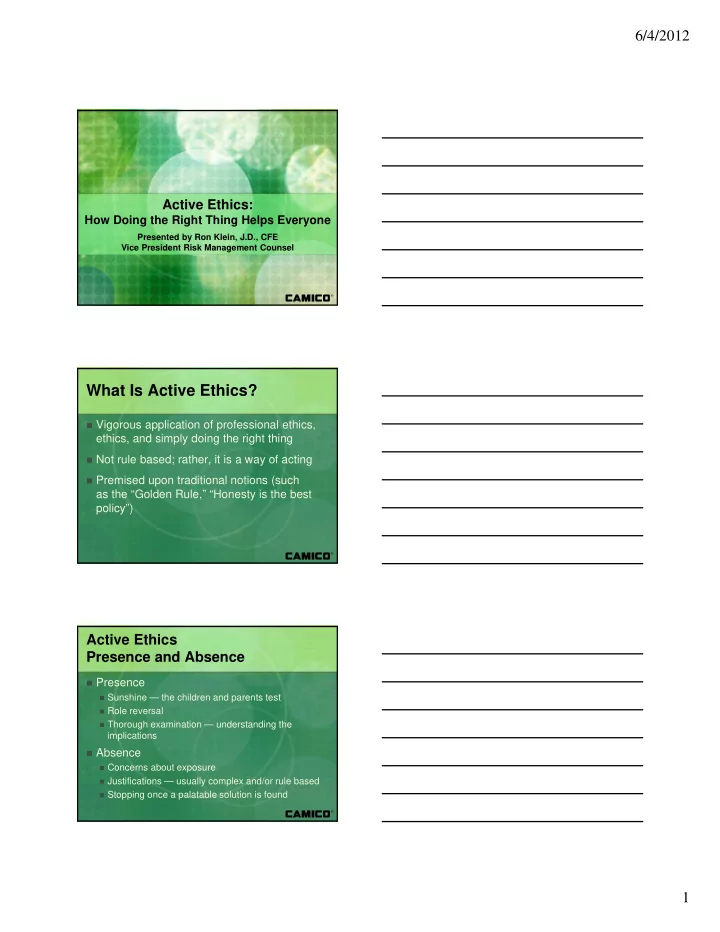
6/4/2012 Active Ethics: How Doing the Right Thing Helps Everyone Presented by Ron Klein, J.D., CFE Vice President Risk Management Counsel What Is Active Ethics? Vigorous application of professional ethics, ethics, and simply doing the


slide-1
SLIDE 1

6/4/2012 1

Active Ethics:

How Doing the Right Thing Helps Everyone

Presented by Ron Klein, J.D., CFE Vice President Risk Management Counsel

What Is Active Ethics?

 Vigorous application of professional ethics,

ethics, and simply doing the right thing

 Not rule based; rather, it is a way of acting  Premised upon traditional notions (such

as the “Golden Rule,” “Honesty is the best policy”)

Active Ethics Presence and Absence

 Presence

 Sunshine — the children and parents test  Role reversal  Thorough examination — understanding the

implications

 Absence

 Concerns about exposure  Justifications — usually complex and/or rule based  Stopping once a palatable solution is found

slide-2
SLIDE 2

6/4/2012 2

The Incomplete Audit/Review Scenario

 Your firm is in the early stages of field work.  You develop “suspicions” that there may be

management fraud but no “proof.”

 You ask for explanations.  You get half-explanations and pressure that “We

need to get this financial statement issued.”

 After three or four go-rounds you are informed by

the client that you have been terminated.

 What do you do?

“Standards” in Play

 Professional standards

 Notification? If so, to whom?  Does no issuance mean no notification?

 Jury standards

 You are the watchdog.  Are expected “users” at risk?

 Doing the right thing

 If you were the bank…  What would your children/parents expect?

The Overly Aggressive Tax Client Scenario

 Smith has been a tax client of the firm for a few years.  You prepare his business corporate return and his

personal return.

 Smith is extremely aggressive about business

expenses and everything else.

 While preparing the current year business return you

notice significant increases in some expense accounts and hear a few off-hand remarks from Smith’s bookkeeper about personal expenses running through the business.

 Smith provides a plausible explanation.  What do you do?

slide-3
SLIDE 3

6/4/2012 3

Your Duties and a Peek into the Future

 “Advise and warn”

 Does client understand risks and rewards

resulting from his behavior?

 After informing client, if he proceeds and it all

blows up, will he blame it on you?

 If you proceed you have “partnered” with

your client (complicity)

 Sharing of rewards  If things go wrong it is “every man for himself”

Questioning Authority — Loyalty and Obedience

 You are working as a senior on an audit team.  The client has government contracts and needs

the audit issued ASAP.

 There has been significant discussion about the

support for a number of AJEs that have “redistributed” a balance in a suspense account.

 You are working late and the audit partner comes

in and tells you the AJE is okay, he had a discussion with the CFO, but no explanation or support is provided.

 What do you do?

Whose Life Is It Anyway?

 What do audit standards tell you to do?  What does firm policy tell you to do?  What is the impact on your career? Does

it matter?

 “Do you swear to tell the truth…?”  Applying the role reversal test

slide-4
SLIDE 4

6/4/2012 4

2% 13% 34% 43% 8%

0% 20% 40% 60% 80% 100% Strongly Disagree Somewhat Disagree Neither Somewhat Agree Strongly Agree

The pressure on accountants to keep clients causes them to look the other way when their clients distort the value of their companies.

12% 14% 17% 35% 22%

0% 20% 40% 60% 80% 100% Strongly Disagree Somewhat Disagree Neither Somewhat Agree Strongly Agree

Accountants often manipulate their numbers and opinions to say what their clients want them to say.

6% 4% 5% 20% 65%

0% 20% 40% 60% 80% 100% Strongly Disagree Somewhat Disagree Neutral Somewhat Agree Strongly Agree

While some accountants have done bad things, the entire accounting profession should not be condemned.

slide-5
SLIDE 5

6/4/2012 5

 Fraudsters have an advantage. They are

playing the fraud game before the CPA knows it.

 The fraudster’s tactic of “incrementalization.”  Fraudsters read people. They spot

weaknesses and desires, and exploit them.

How Do Honest CPAs Get Caught Up in Frauds?

 Know your own weaknesses and desires. Refine them

and/or compensate for them.

 You can sell your services daily, your reputation only

  • nce.

 Do not become a slave to professional standards. They

are a tool, not a master.

 Be skeptical in ALL things.  Communicate concerns; others may feel the same way.  Concentrate on impacts, present and future. What is the

real trade-off you are making?

How Can Honest CPAs Protect Themselves from Fraudsters?

Thank You