Data ethics Data ethics is the study and evaluation of Data ethics - - PDF document

data ethics
SMART_READER_LITE
LIVE PREVIEW

Data ethics Data ethics is the study and evaluation of Data ethics - - PDF document

Data ethics Data ethics is the study and evaluation of Data ethics data problems related to data, algorithms, and generation, recording, curation, processing, dissemination, sharing, & use to formulate Studies & & support


slide-1
SLIDE 1

Data ethics

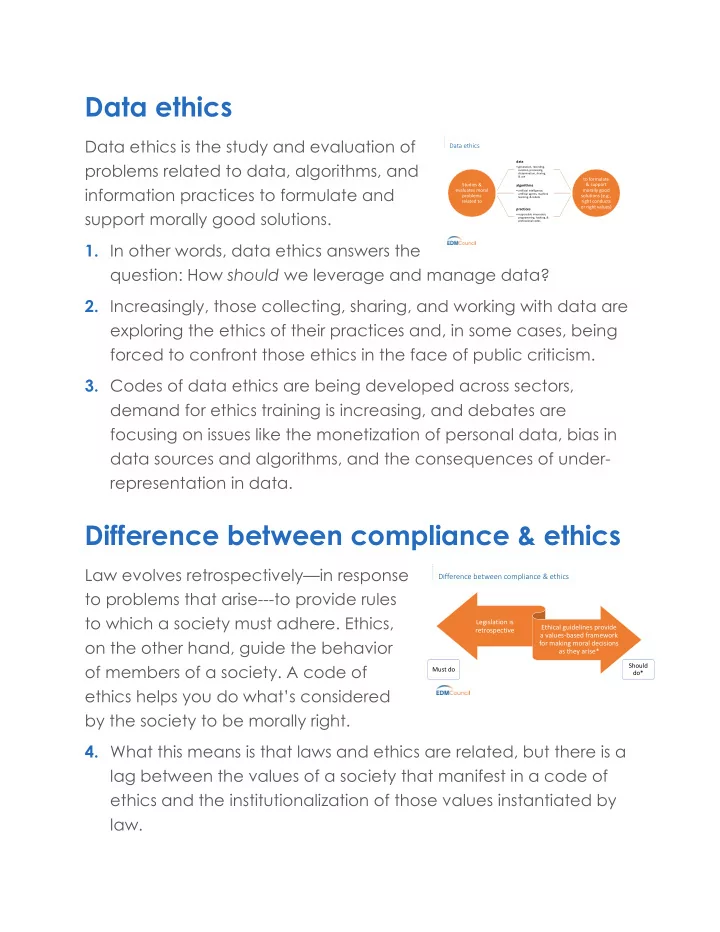
Data ethics is the study and evaluation of problems related to data, algorithms, and information practices to formulate and support morally good solutions.

  • 1. In other words, data ethics answers the

question: How should we leverage and manage data?

  • 2. Increasingly, those collecting, sharing, and working with data are

exploring the ethics of their practices and, in some cases, being forced to confront those ethics in the face of public criticism.

  • 3. Codes of data ethics are being developed across sectors,

demand for ethics training is increasing, and debates are focusing on issues like the monetization of personal data, bias in data sources and algorithms, and the consequences of under- representation in data.

Difference between compliance & ethics

Law evolves retrospectively—in response to problems that arise---to provide rules to which a society must adhere. Ethics,

  • n the other hand, guide the behavior
  • f members of a society. A code of

ethics helps you do what’s considered by the society to be morally right.

  • 4. What this means is that laws and ethics are related, but there is a

lag between the values of a society that manifest in a code of ethics and the institutionalization of those values instantiated by law.

Data ethics

Studies & evaluates moral problems related to

data

  • generation, recording,

curation, processing, dissemination, sharing, & use

algorithms

  • artificial intelligence,

artificial agents, machine learning, & robots

practices

  • responsible innovation,

programming, hacking, & professional codes

to formulate & support morally good solutions (e.g., right conducts

  • r right values)

Difference between compliance & ethics

Legislation is retrospective Ethical guidelines provide a values-based framework for making moral decisions as they arise* Must do Should do*

slide-2
SLIDE 2

2

Data professionals & the public good

The public expects data professionals to steward data according to standards of practice that not only protect their privacy and security, but also generate positive outcomes that contribute to the public good.

  • 5. What ethics is not
  • a. Checklist of fixed rules
  • b. Etiquette
  • c. Legal compliance
  • d. List of what not to do
  • e. Religion
  • f. Subjective right & wrong
  • g. Unquestioning obedience to authority
  • 6. What ethics is
  • a. Cultivating improved character over time, based on

moral integrity & principle

  • b. Doing good work & producing good effects
  • c. Prioritizing relationships & duty to others in support of

human dignity

  • d. Pursuing good & avoiding evil
  • e. Reflective decision making that contributes to human

well-being

  • 7. Increasingly, ethical data management is becoming a central

aspect of the data professional’s identity. There is an elevated social status associated with the ethical management of data, in

Data professionals & the public good

Professionals secure a vital public good Trust is an inherent aspect of professional identity

slide-3
SLIDE 3

3 much the same way as other professionals who secure a public

  • good. For example, doctors engender trust by virtue of their

medical and ethical expertise; without them, public health would

  • suffer. They swear an oath.
  • 8. Similarly, legal professionals are held accountable for securing a

vital public good. Lawyers and judges demonstrate their commitment to justice through both educational success—they have to pass the bar exam—and ethical success—they have to meet the ethical standards of moral conduct.

  • 9. Continuing education and training reinforce data professionals’

commitment to ethical data stewardship, in much the same way as other professionals who secure a vital public good, such as health or justice.

Ethical challenges facing data professionals

Perfect Storm of Ethical Risk

  • 10. Powerful data analytics
  • 11. Data-saturated & poorly regulated

commercial environment

  • 12. Lack of widespread, adequate

standards for data practice

  • 13. Focus on technological possibilities
  • 14. Insufficient regulation for needed self-reflection
  • Powerful data analytics
  • Data-saturated & poorly regulated

commercial environment

  • Lack of widespread, adequate

standards for data practice

  • Focus on technological possibilities
  • Insufficient regulation for needed

self-reflection

Ethical challenges facing data professionals

slide-4
SLIDE 4

4

Best practices & tools

When we start interrogating the issues that arise with data management, a pattern tends to emerge. These are 12 ethical principles that have implications for data management.

  • 15. Companies that want to lead in

ethical data management will encourage a culture that values these principles.

  • a. Human Dignity
  • b. Downstream Use
  • c. Provenance
  • d. Expectations
  • e. Professionalism
  • f. Aspiration
  • g. Ethical Review
  • h. Robust Governance
  • 16. Operationalization with DCAM
  • a. A Code of Data Ethics articulates how the organization

understands the meaning of the data it stewards—now, and in the future

  • b. Benefits
  • i. Demonstrate organizational intent
  • ii. Provide a heuristic model for operational decision

making

  • iii. Lay the groundwork for eventual legislation

Best practices & tools

Leaders in ethical data management Step-by-step

  • perationalization using

DCAM

APPLIED DATA ETHICS

Human Dignity Downstream Use Provenance Expectations Professionalism Aspiration Ethical Review Robust Governance Codes of Data Ethics

Benefits Examples & Parallels

Integration in Policy

Top-down Mandate Bottom-Up Discussion Forums Explicit Accountability

Need for Diverse Workforce

Assumptions & Proxy Variables

slide-5
SLIDE 5

5

  • c. Examples & Parallels
  • i. NIST
  • ii. GDPR
  • iii. FAIR
  • iv. Sustainability (Green Washing)
  • d. Integration in Policy
  • i. Top-down Mandate
  • ii. Bottom-Up Discussion Forums
  • iii. Explicit Accountability
  • e. Need for Diverse Workforce
  • i. Assumptions & Proxy Variables
  • 1. Nuances revealed by diverse participation and

culture of openness to varied perspectives

Data ethics in DCAM

DCAM helps organizations establish policies and procedures that increase the likelihood that data-driven decisions with potential for such unintended outcomes will be identified and modified accordingly.

  • 17. Governing the data ethics includes:
  • a. establishing a formal data ethics oversight function;
  • b. adhering to the ethical access and appropriate use of

data; and

  • c. monitoring whether the outcomes of data access and use

are ethical.

2.0 Data Management Program & Funding 1.0 Data Strategy & Business Case 4.0 Data & Technology Architecture 6.0 Data Governance 3.0 Business & Data Architecture 5.0 Data Quality Management 7.0 Data Control Environment

Data ethics in DCAM

  • Create an organizational culture

that embraces data ethics

  • Establish policies & procedures

that increase the likelihood of detecting potential for unintended

  • utcomes
  • Craft classification schemas that

reflect diverse perspectives

7 Components of the Data Capability Assessment Model

slide-6
SLIDE 6

6

  • 18. An organizational culture that embraces data ethics can go a

long way toward minimizing vulnerability to data breaches and

  • ffsetting the biases inherent in programming assumptions.
  • 19. An authentic commitment to data ethics starts with a top-down

mandate, which is supported throughout the organization by specific practices and empowered accountability. In other words, employees must be empowered to insist on data practices that are aligned with the data ethics mandate. Without empowered employee actions and established routines, data ethics will not permeate the organizational culture.