Designation of Areas under Evacuation Orders under Evacuation - - PowerPoint PPT Presentation

designation of areas under evacuation orders
SMART_READER_LITE
LIVE PREVIEW

Designation of Areas under Evacuation Orders under Evacuation - - PowerPoint PPT Presentation

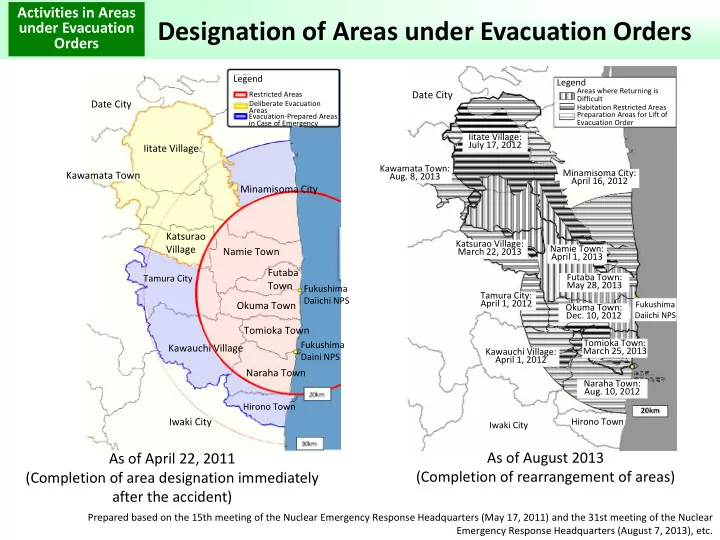
Activities in Areas Designation of Areas under Evacuation Orders under Evacuation Orders Legend Legend Areas where Returning is Date City Restricted Areas Difficult Date City Deliberate Evacuation Habitation Restricted Areas Areas


slide-1
SLIDE 1

As of August 2013 (Completion of rearrangement of areas) As of April 22, 2011 (Completion of area designation immediately after the accident)

Prepared based on the 15th meeting of the Nuclear Emergency Response Headquarters (May 17, 2011) and the 31st meeting of the Nuclear Emergency Response Headquarters (August 7, 2013), etc.

Iitate Village: July 17, 2012 Kawamata Town:

  • Aug. 8, 2013

Katsurao Village: March 22, 2013 Minamisoma City: April 16, 2012 Namie Town: April 1, 2013 Futaba Town: May 28, 2013 Okuma Town:

  • Dec. 10, 2012

Tomioka Town: March 25, 2013 Naraha Town:

  • Aug. 10, 2012

Kawauchi Village: April 1, 2012 Tamura City: April 1, 2012

Fukushima Daiichi NPS

Activities in Areas under Evacuation Orders

Designation of Areas under Evacuation Orders

Legend

Restricted Areas Deliberate Evacuation Areas Evacuation‐Prepared Areas in Case of Emergency

Fukushima Daiichi NPS Fukushima Daini NPS

Iwaki City

Hirono Town

Naraha Town Tomioka Town Okuma Town Kawauchi Village Futaba Town Namie Town

Tamura City

Katsurao Village Kawamata Town Iitate Village

Hirono Town Iwaki City Legend

Areas where Returning is Difficult Habitation Restricted Areas Preparation Areas for Lift of Evacuation Order

Minamisoma City Date City Date City

slide-2
SLIDE 2

⑤‐102

Areas under Evacuation Orders:

Areas for which evacuation orders were issued based on Article 15, paragraph (3) of the Act on Special Measures Concerning Nuclear Emergency Preparedness; Areas under Evacuation Orders and the 20‐km zone of the Nuclear Power Station were rearranged and were newly designated as Preparation Areas for Lift of Evacuation Order, Habitation Restricted Areas or Areas where Returning is Difficult.

Restricted Areas:

Areas where access is restricted pursuant to the provisions of Article 63, paragraph (1) of the Disaster Countermeasures Basic Act as applied pursuant to Article 28, paragraph (2) of the Act on Special Measures Concerning Nuclear Emergency Preparedness, following the deemed replacement of terms

Prepared based on the "Basic Idea on Review of the Restricted Areas and Areas under Evacuation Orders in Response to the Completion of Step 2 and Matters to be Discussed" (December 26, 2011; Nuclear Emergency Response Headquarters)

Activities in Areas under Evacuation Orders

Designation of Restricted Areas and Areas under Evacuation Orders and Removal Thereof

April 22, 2011, onward

Area designation immediately after accident

April 2012, onward

After confirming cold shutdown of the reactors

Restricted Areas

Areas within 20 km in radius from the Nuclear Power Station (NPS); The relevant areas were designated as Areas under Evacuation Orders on March 12, 2011.

Preparation Areas for Lift of Evacuation Order

Areas where it is confirmed that annual cumulative doses will surely become 20 mSv or lower(*)

Deliberate Evacuation Areas

Areas 20 km or farther from the NPS where cumulative doses would be highly likely to exceed 20 mSv within one year after the accident

Habitation Restricted Areas

Areas where annual cumulative doses would be highly likely to exceed 20 mSv(*)

Evacuation‐Prepared Areas in Case of Emergency

Areas within 20 km to 30 km in radius from the NPS other than Deliberate Evacuation Areas; The relevant areas were designated as In‐house Evacuation Areas on March 12, 2011.

Areas where Returning is Difficult

Areas where annual cumulative doses exceed 50 mSv(*) at present and would be highly likely to remain above 20 mSv(*) even after 6 years from the accident

(*) Based on the dose data obtained through the 4th airborne monitoring survey after correction as of March 31, 2012

slide-3
SLIDE 3

Reconstruction and Recovery from the Accident

Removal of the Designation of Areas under Evacuation Orders and Development of the Specified Reconstruction and Revitalization Base

Legend

Areas where Returning is Difficult Habitation Restricted Areas Preparation Areas for Lift of Evacuation Order Former Areas under Evacuation Orders (areas whose designation was removed by the spring of 2017)

Fukushima Daiichi Nuclear Power Station (NPS) Fukushima Daini NPS

Iwaki City Hirono Town Naraha Town Tomioka Town Kawauchi Village Okuma Town Futaba Town Namie Town Tamura City Katsurao Village Kawamata Town Iitate Village Minamisoma City

Prepared based on the 45th meeting of the Nuclear Emergency Response Headquarters (March 10, 2017), etc. April 1, 2014 Tamura City Removal of the designation as Preparation Areas for Lift of Evacuation Order October 1 Kawauchi Village Removal of the designation as Preparation Areas for Lift of Evacuation Order Shift from Habitation Restricted Areas to Preparation Areas for Lift of Evacuation Order September 5, 2015 Naraha Town Removal of the designation as Preparation Areas for Lift of Evacuation Order June 12, 2016 Katsurao Village Removal of the designation as Habitation Restricted Areas Removal of the designation as Preparation Areas for Lift of Evacuation Order June 14 Kawauchi Village Removal of the designation as Preparation Areas for Lift of Evacuation Order July 12 Minamisoma City Removal of the designation as Habitation Restricted Areas Removal of the designation as Preparation Areas for Lift of Evacuation Order March 31, 2017 Iitate Village, Kawamata Town, Namie Town Removal of the designation as Habitation Restricted Areas Removal of the designation as Preparation Areas for Lift of Evacuation Order April 1 Tomioka Town Removal of the designation as Habitation Restricted Areas Removal of the designation as Preparation Areas for Lift of Evacuation Order

○ Removal of the designation as Areas under Evacuation Orders for respective municipalities

Date City

slide-4
SLIDE 4

"Progress of the Fukushima Innovation Coast Framework," the first meeting of the Fukushima Innovation Coast Framework Promotion Committee

Reconstruction and Recovery from the Accident Fukushima Innovation Coast Framework

Fukushima Innovation Coast Framework: Major sites, projects, related (research) organizations, etc.

As of November 2017

LNG Thermal Power Generation Project (Shinchi Town) Algae Biomass Energy Demonstration Facility

(Haramachi District, Minamisoma City) Fukushima Robot Testing Field (Haramachi District, Minamisoma City; Namie Town)

Flower Coast Creation Project

(Iitate Village; Katsurao Village; Kawamata Town, etc.)

Promotion of the introduction of renewable energy in evacuated areas Fisheries Research Base (Iwaki City) Fish Seed Research and Production Facility (Soma City)

Integrated Coal Gasification Combined Cycle (IGCC) Project (Hirono Town; Nakoso, Iwaki City)

Creation of smart communities

(Shinchi Town; Soma City; Namie Town; Naraha Town; Katsurao Village) Fukushima Robot Testing Field (Haramachi District, Minamisoma City; Namie Town)

Agricultural Technology Centre (Koriyama City) Hama Agricultural Regeneration Research Centre

(Haramachi District, Minamisoma City)

Hamadori Research Centre (Soma City) Controlled Environment Horticulture Project

(Okuma Town; Minamisoma City; Kawauchi Village; Iwaki City, etc.)

Information Transmission Base (Archive Base)(Futaba Town) Floating Offshore Wind Farm Demonstration Project

(off Futaba‐gun) (i) Okuma Analysis and Research Center (Okuma Town) (ii) Collaborative Laboratories for Advanced Decommissioning Science, International Collaborative Research Building (Tomioka Town) (iii) Naraha Center for Remote Control Technology Development (Naraha Town)

LNG thermal power plant A project to develop an LNG thermal power plant consisting of two units of 590,000‐kW combined‐cycle generators

Promoting shift to non‐edible crops and flower growing as an attractive form of agriculture; Growing gypsophila, Texas bluebell, phalaenopsis and anthurium, etc.

Growing of anthurium in Kawamata Town

Conducting development of a large‐ scale hydrogen energy system using renewable energy; A NEDO project decided in August 2017

Renewable Energy‐ derived Large‐scale Hydrogen Production Demonstration Base * Material of Toshiba Energy Systems & Solutions Corporation Developing shared transmission lines that enable large‐scale introduction of wind power generation and solar power generation in the mountainous district in Abukuma and in coastal areas with the aim of promoting the introduction of renewable energy in evacuated areas Restoring functions of the damaged Fish Seed Research and Production Facility in Okuma Town and developing a base for fisheries research where technology development is to be conducted for securing the safety of fisheries products Fish Seed Research Facility

Constructing and operating the world's most‐advanced IGCC plant (approx. 540,000 kW), one unit each in Hirono and Nakoso

Tokyo Electric Power Company: Fukushima IGCC Project (2010 ‐); Nakoso site and Hirono site

Establishing technologies for producing domestic biofuel using native microalgae in Fukushima Prefecture

Algae Biomass Energy Demonstration Facility Smart community Promoting a demonstration project for creating smart communities in five municipalities (Shinchi Town, Soma City, Namie Town, Naraha Town and Katsurao Village)

Developing a robot testing field for the demonstration of robot development and an international government‐industry‐academia shared facility; The facilities are to be opened sequentially in FY2018 onward.

Fukushima Robot Testing Field

Comprehensively carrying out monitoring, survey research, information collection and provision, and education, training and exchange activities for the recovery and development of the environment to achieve reconstruction Conducting survey research on site for resuming and regenerating agriculture in the Hamadori District

Hama Agricultural Regeneration Research Centre Promoting the introduction of greenhouse horticulture utilizing cutting‐edge technologies, such as ICT‐based management of growing conditions (temperature, humidity, etc.) and labor‐saving techniques; Developing low‐cost and weather‐resistant greenhouses (tomato cultivation) and solar‐power plant factories (strawberry cultivation), etc. Tomato cultivation in Iwaki City A base to transmit information with the aim

  • f passing on lessons of the nuclear disaster;

The basic concept was formulated in March 2017 and the base is scheduled to be opened in FY2020.

Archive Base Conducting a full‐scale demonstration using multiple

  • ffshore wind power‐generating units, all of which started
  • peration in FY2017, for the first time in the world

Offshore wind power‐generating unit (i) Planning to conduct development of analysis methods for radionuclides difficult to measure that are included in fuel debris and radioactive waste, ascertaining of properties of fuel debris and secondary waste after treatment of contaminated water, etc. and development of treatment and disposal technologies (ii) Conducting R&D on decommissioning and human resource development by calling for wisdom broadly from universities, research institutes and the industrial arena inside and outside Japan; The Center opened in April 2017. (iii) Conducting development and demonstration tests of equipment and devices, such as robots that search and repair leak points on the bottoms of containment vessels, and development and demonstration tests of equipment and devices for fuel debris retrieval Collaborative Laboratories for Advanced Decommissioning Science, International Collaborative Research Building Naraha Center for Remote Control Technology Development

Iwaki City Hirono Town Kawauchi Village Tomioka Town Naraha Town Futaba Town Okuma Town Katsurao Village Namie Town Minamisoma City Iitate Village Tamura City Kawa‐ mata Town Soma City Shinchi Town

Renewable Energy‐derived Large‐scale Hydrogen Production Demonstration Base (Namie Town)

Centre for Environmental Creation (Miharu Town) Environmental Radiation Monitoring Centre

(Haramachi District, Minamisoma City)

JAEA‐related facilities
slide-5
SLIDE 5

⑤‐1

Reconstruction and Recovery from the Accident

Results of Radiation Dose Surveys along Major Roads in Areas where Returning is Difficult

Joban Expressway The entirety was restored with the reopening of the section between Namie IC and Joban Tomioka IC on March 1, 2015. JR Joban Line The section between Tomioka Station and Namie Station is scheduled to be reopened at the end of FY2019. National roads and prefectural roads Through operational change of the Special Transit Permission System, transit without carrying and presenting a pass came to be permitted for National Road 6 on September 15, 2014, for National Road 288 on February 28, 2015, and for National Road 114 on September 20, 2017. Exposure doses of drivers passing through, measured before reopening of roads

National Road 6 (special transit permission on September 15, 2014) 1.2 μSv (between Naraha Town and Minamisoma City)

*Equivalent to one‐167th of the exposure dose during a flight between Tokyo and New York (approx. 0.2 mSv)

Joban Expressway (reopened on March 1, 2015) Four‐wheeled vehicles: 0.37μSv; Motorcycles: 0.46μSv (between Hirono IC and Minamisoma IC)

*Equivalent to one‐540th and one‐430th, respectively, of the exposure dose during a flight between Tokyo and New York (approx. 0.2 mSv)

National Road 288 (special transit permission on March 1, 2015) 0.28 μSv (between Tamura City and Joban Tomioka IC) National Road 114 (special transit permission on September 20, 2017) 1.01 μSv (between Kawamata Town and Namie IC)

Finally confirmed radiation doses measured before reopening of roads

Ban‐etsu Expressway Joban Expressway JR Joban Line

Naraha Town ‐ Minamisoma City (National Road 6) Exposure dose while passing through: 1.2 μSv Surveyed from July to August 2014 Hirono IC ‐ Minamisoma IC (Joban Expressway) Exposure dose while passing through: 0.37 μSv (Motorcycles: 0.46 μSv) Surveyed in October 2014 Kawamata Town ‐Namie IC (National Road 114) Exposure dose while passing through: 1.01 μSv Surveyed in August 2017 Tamura City ‐ Joban Tomioka IC (National Road 288) Exposure dose while passing through: 0.28 μSv Surveyed from November 2014 to January 2015

Minamisoma

Odaka Namie Town Futaba Town Okuma Town Tomioka Town Naraha Town Hirono Town