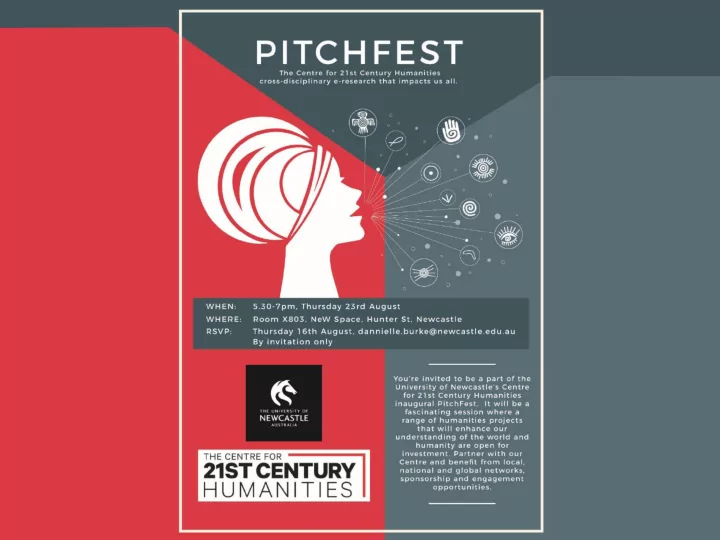
2 Welcome Pro Vice-Chancellor John Germov, Faculty Education and - - PowerPoint PPT Presentation

2
SMART_READER_LITE
LIVE PREVIEW

2 Welcome Pro Vice-Chancellor John Germov, Faculty Education and - - PowerPoint PPT Presentation

2 Welcome Pro Vice-Chancellor John Germov, Faculty Education and Arts Welcome Director Prof Ros Smith, Centre for 21 st Century Humanities Project 1. Colonial Frontier Massacres Lyndall Ryan and Bill Pascoe Project 2. Certified Corethics


slide-1
SLIDE 1
slide-2
SLIDE 2 2
slide-3
SLIDE 3

Welcome

Pro Vice-Chancellor John Germov, Faculty Education and Arts
slide-4
SLIDE 4

Welcome

Director Prof Ros Smith, Centre for 21st Century Humanities
slide-5
SLIDE 5

Project 1. Colonial Frontier Massacres

Lyndall Ryan and Bill Pascoe

slide-6
SLIDE 6

Project 2. Certified Corethics – The App

Melissa McCabe

slide-7
SLIDE 7

newcastle based

international development not-for-profit

slide-8
SLIDE 8
slide-9
SLIDE 9

your logo

  • n sign-in
slide-10
SLIDE 10

hello… ethical world

slide-11
SLIDE 11
slide-12
SLIDE 12
slide-13
SLIDE 13
slide-14
SLIDE 14
slide-15
SLIDE 15

an exclusive partnership

slide-16
SLIDE 16

we’re ready… are you?

slide-17
SLIDE 17

Project 3. Preserving an Endangered Torres Straits Language

Bill Palmer

slide-18
SLIDE 18

Bill Palmer

Preserving an endangered Torres Strait language

slide-19
SLIDE 19

A global extinction event

7000 languages – 7 billion people = 1 million people per language, right? Wrong!

1 billion speakers: 1 language 1 billion humans 100-500 million: 9 languages 2.5 billion humans 1-100 million: 379 languages 3.6 billion humans 0-1 million: 6711 languages 400 million humans (6%) A few giant languages Many tiny languages Small Indigenous languages are vulnerable in the face
  • f globalisation

50%-90% of all languages will die by the end

  • f this century

Every fortnight a language dies

slide-20
SLIDE 20

Indigenous Australian languages

Australia - world’s worst record for Indigenous language death

In 1788: Around 400 separate languages spoken Today: Perhaps 80 are still spoken
  • Half have fewer than 10
speakers
  • A quarter have only 1!
  • Only 18 are being learnt
by children
slide-21
SLIDE 21

Indigenous Australian languages

Australia - world’s worst record for Indigenous language death

In 1788: Around 400 separate languages spoken

If current trends continue no Indigenous language will be spoken by 2050

National Indigenous Languages Survey Report 2005 Today: Perhaps 80 are still spoken
  • Half have fewer than 10
speakers
  • A quarter have only 1!
  • Only 18 are being learnt
by children
slide-22
SLIDE 22

Why care?

Lower rates of:
  • youth suicide
  • violence victimization
  • incarceration
  • diabetes
  • poor health (on defined measures)
  • smoking
  • illicit drug use
  • excessive alcohol use
Higher rates of:
  • wellness (on defined measures)
  • high school completion
Enhanced:
  • Identity and self-esteem
  • Social cohesion
  • Empowerment

The death of a language means loss of

  • accumulated knowledge of environmental
management, natural resources, plant- based medicines…
  • a people’s history, culture and world-view
  • individual and community cultural identity

Speakers of Indigenous languages have

(Studies in Australia, NZ, USA & Canada)
slide-23
SLIDE 23

Kala Lagaw Ya

Endangerment rating: Critically Endangered

NILS

A worrying trajectory:

  • How many speakers?
1984: 2006: around 2800 1216 Under 20yrs 3/10 20-60 yrs 4.5/10 Over 60 yrs 7/10 Today: about 1000
  • Some islands no longer use it
  • Kids are switching to English & creole!

Hopeful signs:

  • Many kids are still learning the language
  • Young people text in the language
slide-24
SLIDE 24

We will

Maintenance and revitalization needs language materials

books of traditional culture & knowledge dictionaries literacy materials digital archiving language apps

language description

video recordings

language documentation

work with the community to document and help preserve Kala Lagaw Ya for future generations

slide-25
SLIDE 25

We need

  • Support for 1 student stipend

(3.5 years for PhD research program) $28,000pa (total $98,000)

We will provide

  • Tuition fee scholarship ($21,000pa (total $74,000))
  • Fieldwork equipment
  • Fieldwork expenses

We will produce

  • PhD thesis description of Kala Lagaw Ya (published as a book)
  • A video corpus digitally archived in perpetuity
  • Maintenance materials in consultation with the community
slide-26
SLIDE 26

Project 4. Deep Time 2.0

Amir Morgadam and Gaute Rasmussen

slide-27
SLIDE 27

DEEP TIME 2.0 2.0 DEMOC OCRATISING NG HI HISTOR ORY

  • Dr. Amir Mogadam
University Conservator Cultural Collections Expert in historical preservation Gaute Rasmussen Innovation Specialist IT Services Expert in technology and software development
slide-28
SLIDE 28

THE HE PROB OBLE LEM

  • Development in Newcastle destroys a lot of
information about Newcastle’s past, but also generates archaeological data
  • Some information is captured, but no
cohesive approach to storing it
  • Novocastrians don’t have easy access to the
information that is uncovered
slide-29
SLIDE 29

DEEP DEEP TIME TIME 1.0 1.0

  • Developed by UON as a collaboration
between Cultural Collections and IT Innovation Team
  • ~$200k spent on developing the prototype
  • Focused on the 2009 excavation of the
“KFC / Palais Royale” site
slide-30
SLIDE 30
slide-31
SLIDE 31

WHA WHAT WE WE’VE ACHI HIEVED

  • Novel way of presenting archaeological data
  • Fun and engaging
  • Established Work Integrated Learning
program to scan artefacts
slide-32
SLIDE 32

REMAINI NING NG PROB OBLE LEMS

  • Single Site (KFC)
  • Missing big picture
  • Scanning of artefacts is a slow process
  • Not publicly available
slide-33
SLIDE 33

NE NEXT STEPS STEPS

  • Create a platform where similar data from
all archaeological sites can be added
  • Develop a map view to see sites in
context
  • Add support for simpler forms of data
(text / images) to speed up data entry
  • Add two more sites
  • Make the data available to a wide
audience
slide-34
SLIDE 34

THE HE MONE ONEY

  • Year 1: $330k
  • $80k – turn the prototype into a product
(includes support for multiple sites)
  • $80k – Add map component
  • $30k – Data Storage
  • $10k – Establish public facing website
  • 2X $65k pa per person – Archaeological
data entry
  • Year 2: $85k
  • $65k pa per person – Archaeological
data entry
  • $20k ongoing running costs
  • Total: $415k
All numbers are estimates only and may change during development
slide-35
SLIDE 35

VISION ON FOR FOR THE HE FUT FUTUR URE

  • More sites added
  • More types of content
  • More functionality
  • Take over the world
slide-36
SLIDE 36

AC ACT NO NOW W

  • Lots of development happening in
Newcastle
  • If we don’t act now we might lose
important information
slide-37
SLIDE 37

DEEP TIME 2.0 2.0 DEMOC OCRATISING NG HI HISTOR ORY

  • Dr. Amir Mogadam & Gaute Rasmussen

THANK YOU

slide-38
SLIDE 38

Project 5. Kawa Translation Hub

Bill Pascoe

slide-39
SLIDE 39

slide-40
SLIDE 40

KAWA

slide-41
SLIDE 41

Bill Pascoe Ali Al-Kinani Dan Price

slide-42
SLIDE 42

“The original idea of the web was that it should be a collaborative space where you can communicate through sharing information.” ― Tim B Berners-Lee

slide-43
SLIDE 43
slide-44
SLIDE 44

Kawa is an interactive crowd sourced web map of the history of world poetry in any language.

slide-45
SLIDE 45

http://hri.newcastle.edu.au/ kawa/

slide-46
SLIDE 46

CRITICAL MASS

slide-47
SLIDE 47

SUSTAINABLE PLAN

slide-48
SLIDE 48

BUDGET

Development $5,000 IT Requirements $200 User testing and post launch support $3,800 Promotions 1,000 $1 $10, 0,000 000
slide-49
SLIDE 49

Project 6. Future of Humanities

Hugh Craig

slide-50
SLIDE 50

THE FUTURE OF HUMANITY

A NEWCASTLE-HOSTED CONFERENCE
slide-51
SLIDE 51 OUR FUTUREPHILIC JOURNEY The future of humanity is suddenly looking a lot different. It used to seem assured, highly positive, a continuation of trends already happening towards longer lives, better health, more fun jobs, more available (cheaper, better, lighter) everything. Australians in particular were known as futurephilic – we were in love with a vague wonderful future.
slide-52
SLIDE 52 UNPRECEDENTED RATE OF TECHNOLOGY DEVELOPMENT We still live in a world where technology is developing at an unprecedented rate, and yet it now seems clear that these advances also bring new threats to the survival of humanity. The most obvious is the uncontrolled development of artificial intelligence – towards autonomous robots with superior mental capacity to humans. There are also more familiar threats that now seem much closer and more real like….
slide-53
SLIDE 53

NUCLEAR WAR

slide-54
SLIDE 54

CATASTROPHIC CLIMATE CHANGE

slide-55
SLIDE 55

SYSTEMIC GLOBAL INEQUITY OF OPPORTUNITY

slide-56
SLIDE 56

MEET NICK BOSTROM

One person who has done a huge amount to advance thinking about existential threats to the future of humanity is the Oxford philosopher Nick Bostrom. The hypothetical invention of the super-destructive, easily constructed weapon comes from him. So does the idea that AI is the greatest threat to the survival of
  • humanity. He says our attitude to AI
is like a child playing with an armed atom bomb, and hearing a faint
  • ticking. He runs the Future of
Humanity Institute at Oxford and is famous for promoting the idea of “philosophy with a deadline”.
slide-57
SLIDE 57
slide-58
SLIDE 58

SPONSOR OUR NEWCASTLE- BASED CONFERENCE

The event would bring together a panel of speakers including Professor Bostrom to discuss how the humanities can contribute to a better future for humanity and to managing existential risks to
  • humanity. Other speakers would come from areas like critical
computer science, environmental humanities, the history of violence, political science, and development studies. The duration would be one day. A final session would focus on short and medium term avenues for action in the local context (City of Newcastle, Hunter region, State of NSW, and Commonwealth of Australia). The supporter would have their name attached to the meeting alongside that of the University of Newcastle and would be credited with an engagement with questions of national and global importance.
slide-59
SLIDE 59

THANK YOU

Proposed funding: $18,200 Fares, accommodation and a fee for Prof Bostrom ($3500; $900; $2000 = $6400 total) Fares and accommodation for 3 invited speakers from within Australia and NZ ($1500; $1800) Venue hire $1500 Pre-publicity $1500 Administrator $1000 Catering $1000 Videographer $3500
slide-60
SLIDE 60 60