Outline CSEP 590A Summer 2006 Biological roles for RNA What is - - PowerPoint PPT Presentation

outline
SMART_READER_LITE
LIVE PREVIEW

Outline CSEP 590A Summer 2006 Biological roles for RNA What is - - PowerPoint PPT Presentation

Outline CSEP 590A Summer 2006 Biological roles for RNA What is secondary structure? Lecture 8 How is it represented? RNA Secondary Structure Prediction Why is it important? Examples Approaches RNA Structure RNA Pairing Watson-Crick


slide-1
SLIDE 1

CSEP 590A

Summer 2006 Lecture 8

RNA Secondary Structure Prediction

Outline

Biological roles for RNA What is “secondary structure? How is it represented? Why is it important? Examples Approaches

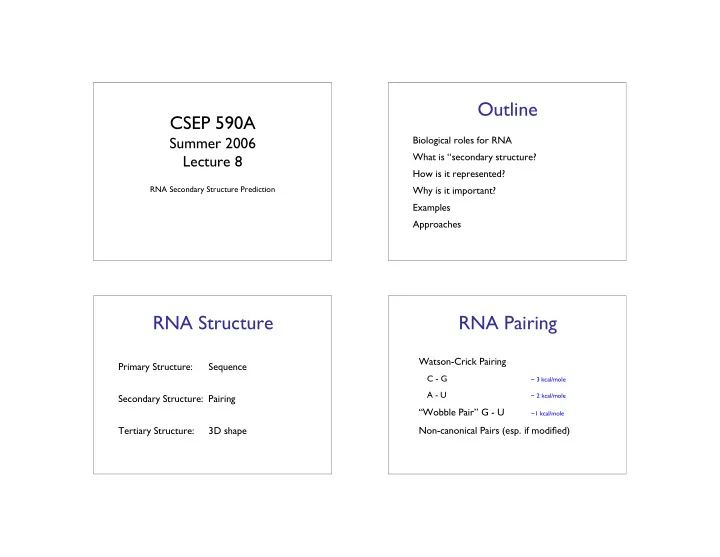
RNA Structure

Primary Structure: Sequence Secondary Structure: Pairing Tertiary Structure: 3D shape

RNA Pairing

Watson-Crick Pairing

C - G ~ 3 kcal/mole A - U

~ 2 kcal/mole

“Wobble Pair” G - U

~1 kcal/mole

Non-canonical Pairs (esp. if modified)

slide-2
SLIDE 2

Ribosomes

Watson, Gilman, Witkowski, & Zoller, 1992

tRNA 3d Structure

tRNA - Alt. Representations

Anticodon loop Anticodon loop

3’ 5’

tRNA - Alt. Representations

Anticodon loop Anticodon loop

3’ 5’

slide-3
SLIDE 3

“Classical” RNAs

tRNA - transfer RNA (~61 kinds, ~ 75 nt) rRNA - ribosomal RNA (~4 kinds, 120-5k nt) snRNA - small nuclear RNA (splicing: U1, etc, 60-300nt) RNaseP - tRNA processing (~300 nt) RNase MRP - rRNA processing; mito. rep. (~225 nt) SRP - signal recognition particle; membrane targeting (~100-300 nt) SECIS - selenocysteine insertion element (~65nt) 6S - ? (~175 nt)

Semi-classical RNAs

(discovery in mid 90’s)

tmRNA - resetting stalled ribosomes Telomerase - (200-400nt) snoRNA - small nucleolar RNA (many varieties; 80-200nt)

Recent discoveries

microRNAs riboswitches many ribozymes regulatory elements … Hundreds of families

Rfam release 1, 1/2003: 25 families, 55k instances Rfam release 7, 3/2005: 503 families, 300k instances

Why?

RNA’s fold, and function Nature uses what works

slide-4
SLIDE 4

Breakthrough

  • f the Year

Noncoding RNAs Example: Glycine Regulation

How is glycine level regulated? Plausible answer:

glycine cleavage enzyme gene g g TF g TF gce protein g g

DNA

transcription factors (proteins) bind to DNA to turn nearby genes on or off

The Glycine Riboswitch

Actual answer (in many bacteria):

glycine cleavage enzyme gene g g g g gce mRNA gce protein

5′ 3′

DNA

Mandal et al. Science 2004

Alberts, et al, 3e.

Gene Regulation: The Met Repressor

SAM DNA Protein

slide-5
SLIDE 5

Alberts, et al, 3e.

Corbino et al., Genome Biol. 2005

Two SAM Ribo- switches 6S mimics an

  • pen promoter

Barrick et al. RNA 2005 Trotochaud et al. NSMB 2005 Willkomm et al. NAR 2005

E.coli

Bacillus/ Clostridium Actino- bacteria

The Hammerhead Ribozyme

Involved in “rolling circle replication” of viruses.

Wanted

Good structure prediction tools Good motif descriptions/models Good, fast search tools

(“RNA BLAST”, etc.)

Good, fast motif discovery tools

(“RNA MEME”, etc.)

Importance of structure makes last 3 hard

slide-6
SLIDE 6

Why is RNA hard to deal with?

A C U G C A G G G A G C A A G C G A G G C C U C U G C A A U G A C G G U G C A U G A G A G C G U C U U U U C A A C A C U G U U A U G G A A G U U U G G C U A G C G U U C U A G A G C U G U G A C A C U G C C G C G A C G G G A A A G U A A C G G G C G G C G A G U A A A C C C G A U C C C G G U G A A U A G C C U G A A A A A C A A A G U A C A C G G G A U A C G

A: Structure often more important than sequence

Task 1: Structure Prediction RNA Pairing

Watson-Crick Pairing

C - G

~ 3 kcal/mole

A - U

~ 2 kcal/mole

“Wobble Pair” G - U

~ 1 kcal/mole

Non-canonical Pairs (esp. if modified)

Definitions

Sequence 5’ r1 r2 r3 ... rn 3’ in {A, C, G, T} A Secondary Structure is a set of pairs i•j s.t.

i < j-4, and no sharp turns if i•j & i’•j’ are two different pairs with i ≤ i’, then

j < i’, or i < i’ < j’ < j

2nd pair follows 1st, or is nested within it; no “pseudoknots.”

slide-7
SLIDE 7

Nested Pseudoknot Precedes

A Pseudoknot

A-C / \ 3’ - A-G-G-C-U U U-C-C-G-A-G-G-G | C-C-C - 5’ \ / U-C-U-C

Approaches to Structure Prediction

Maximum Pairing + works on single sequences + simple

  • too inaccurate

Minimum Energy + works on single sequences

  • ignores pseudoknots
  • only finds “optimal” fold

Partition Function + finds all folds

  • ignores pseudoknots

Approaches, II

Comparative sequence analysis + handles all pairings (incl. pseudoknots)

  • requires several (many?) aligned,

appropriately diverged sequences Stochastic Context-free Grammars Roughly combines min energy & comparative, but no pseudoknots Physical experiments (x-ray crystalography, NMR)

slide-8
SLIDE 8

Nussinov: Max Pairing

B(i,j) = # pairs in optimal pairing of ri ... rj B(i,j) = 0 for all i, j with i ≥ j-4; otherwise B(i,j) = max of: B(i,j-1) max { B(i,k-1)+1+B(k+1,j-1) | i ≤ k < j-4 and rk-rj may pair}

Time: O(n3) J Unpaired: Find best pairing of ri ... rj-1 J Paired: Find best ri ... rk-1 + best rk+1 ... rj-1 plus 1 Why is it slow? Why do pseudoknots matter?

“Optimal pairing of ri ... rj”

Two possibilities

j i j-1 j k-1 k i j-1 k+1

Pair-based Energy Minimization

E(i,j) = energy of pairs in optimal pairing of ri ... rj E(i,j) = ∞ for all i, j with i ≥ j-4; otherwise E(i,j) = min of: E(i,j-1) min { E(i,k-1) + e(rk, rj) + E(k+1,j-1) | i ≤ k < j-4 }

Time: O(n3) energy of j-k pair

Detailed experiments show it’s more accurate to model based

  • n loops, rather than just pairs

Loop types

Hairpin loop Stack Bulge Interior loop Multiloop

Loop-based Energy Minimization

1 2 3 4 5

slide-9
SLIDE 9

thymine cytosine adenine

uracil

Base Pairs and Stacking

guanine

The Double Helix Loop Examples Zuker: Loop-based Energy, I

W(i,j) = energy of optimal pairing of ri ... rj V(i,j) = as above, but forcing pair i•j W(i,j) = V(i,j) = ∞ for all i, j with i ≥ j-4 W(i,j) = min(W(i,j-1), min { W(i,k-1)+V(k,j) | i ≤ k < j-4 } )

slide-10
SLIDE 10

V(i,j) = min(eh(i,j), es(i,j)+V(i+1,j-1), VBI(i,j), VM(i,j)) VM(i,j) = min { W(i,k)+W(k+1,j) | i < k < j } VBI(i,j) = min { ebi(i,j,i’,j’) + V(i’, j’) | i < i’ < j’ < j & i’-i+j-j’ > 2 }

Time: O(n4) O(n3) possible if ebi(.) is “nice”

Zuker: Loop-based Energy, II

hairpin stack bulge/ interior multi- loop bulge/ interior

Suboptimal Energy

There are always alternate folds with near-optimal

  • energies. Thermodynamics: populations of identical

molecules will exist in different folds; individual molecules even flicker among different folds Mod to Zuker’s algorithm finds subopt folds McCaskill: more elaborate dyn. prog. algorithm calculates the “partition function,” which defines the probability distribution over all these states.

Two competing secondary structures for the Leptomonas collosoma spliced leader mRNA.

Example of suboptimal folding

Black dots: pairs in opt fold Colored dots: pairs in folds 2-5% worse than
  • ptimal fold
slide-11
SLIDE 11

Accuracy

Latest estimates suggest ~50-75% of base pairs predicted correctly in sequences of up to ~300nt Definitely useful, but obviously imperfect

Task 2: Motif Description

How to model an RNA “Motif”?

Conceptually, start with a profile HMM:

from a multiple alignment, estimate nucleotide/ insert/delete preferences for each position given a new seq, estimate likelihood that it could be generated by the model, & align it to the model all G mostly G del ins

How to model an RNA “Motif”?

Add “column pairs” and pair emission probabilities for base-paired regions

paired columns

<<<<<<< >>>>>>> … …

slide-12
SLIDE 12

RNA Motif Models

“Covariance Models” (Eddy & Durbin 1994)

aka profile stochastic context-free grammars aka hidden Markov models on steroids

Model position-specific nucleotide preferences and base-pair preferences Pro: accurate Con: model building hard, search sloooow

Summary

RNA has important roles beyond mRNA Many unexpected recent discoveries Structure is critical to function True of proteins, too, but they’re easier to find, due, e.g., to codon structure, which RNAs lack RNA secondary structure can be predicted (to useful accuracy) by dynamic programming RNA “motifs” (seq + 2-ary struct) well-captured by “covariance models”