Software Product Maturity in SIS Source Selection Childhood Youth - - PowerPoint PPT Presentation

software product maturity in sis source selection
SMART_READER_LITE
LIVE PREVIEW

Software Product Maturity in SIS Source Selection Childhood Youth - - PowerPoint PPT Presentation

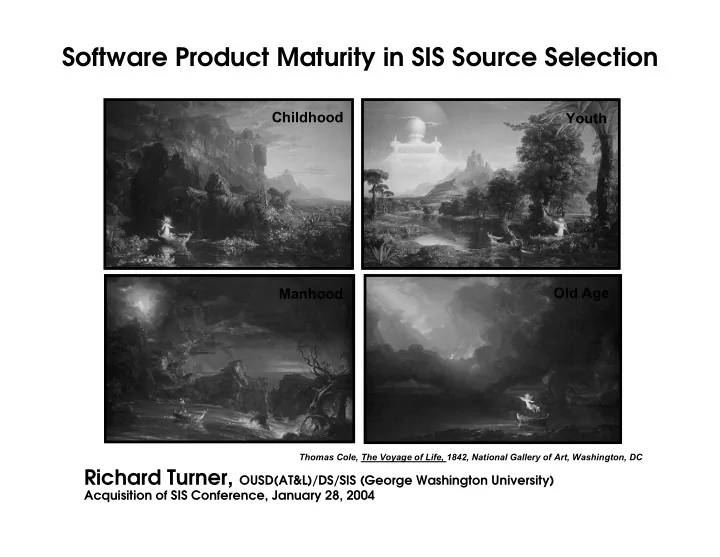
Software Product Maturity in SIS Source Selection Childhood Youth Old Age Manhood Thomas Cole, The Voyage of Life, 1842, National Gallery of Art, Washington, DC Richard Turner, OUSD(AT&L)/DS/SIS (George Washington University) Acquisition


slide-1
SLIDE 1

Childhood

Software Product Maturity in SIS Source Selection

Richard Turner, OUSD(AT&L)/DS/SIS (George Washington University)

Acquisition of SIS Conference, January 28, 2004

Youth Manhood Old Age

Thomas Cole, The Voyage of Life, 1842, National Gallery of Art, Washington, DC

slide-2
SLIDE 2

Childhood

Software Product Maturity in SIS Source Selection

Richard Turner, OUSD(AT&L)/DS/SIS (George Washington University)

Acquisition of SIS Conference, January 28, 2004

Youth Manhood Old Age

Thomas Cole, The Voyage of Life, 1842, National Gallery of Art, Washington, DC

slide-3
SLIDE 3

3

The Requirement

  • Section 804 of the ‘3 Defense Authorization Act

requires that OSD “assist MILDEPs by ensuring criteria applicable to

selection of sources provides added emphasis on

  • Past performance of potential sources
  • Maturity of software products offered by potential

sources”

slide-4
SLIDE 4

4

Defining SW Product Maturity

  • No standard definitions/scales
  • Not Software Technology Readiness Levels (TRL)

– Maturity addresses a specific product – TRL addresses underlying technology

  • Highly dependent on environment and

application context

  • Many dimensions of maturity
slide-5
SLIDE 5

5

The Approach

  • Gathered a group of experts to:
  • Review existing approaches
  • Develop characteristics and information

sources

  • Develop guidance for source selection
  • Develop RFQ/RFP language
slide-6
SLIDE 6

6

Focus on Source Selection

  • General maturity problem is extremely difficult

– Limited time and resources – Need for significant effort to work on development- based maturity – Some promising work (MDA, AF) but untried

  • Source selection was the Congressional

emphasis

  • Source selection bounds the problem to

measuring existing, working software (e.g. COTS, GOTS, legacy)

slide-7
SLIDE 7

7

Software in Source Selection

  • Software doesn’t exist

(Not measurable)

– Developmental software

  • Software exists

(Measurable)

– COTS – GOTS – Prototype – NDI/Legacy – Experimental

  • Many different kinds of source selections

– Greenfield vs. Upgrade – Traditional business-process IT system implementation vs. Command and Control or embedded software

  • Different kinds of software in programs

– Only software that exists has determinable maturity – Aggregations of existent and non-existent software are common

slide-8
SLIDE 8

8

Observations

  • Software product maturity is value-neutral

– Mature software not better than immature software in some instances; must be interpreted in light of risk

  • Web-pages
  • Proofs of concept
  • Software can become senile

– Collective impact of changes overwhelm the architecture – Environment changes – Utility degrades

  • Level of understanding of context directly

impacts risk and interpretation of maturity

– Poorly understood application environment or target makes risk assessment difficult

slide-9
SLIDE 9

9

Notional SW Maturity Lifecycle

Utility of Software

Technology Development Product Development Product Sustainment Product Aging Obsolescence Science and Technology TRL 1-4 Alpha Release TRL 5 Beta Release TRL 7 Official Release TRL 8 Operational Installation TRL 9

slide-10
SLIDE 10

10

Candidate Characteristics

  • Represent areas/dimensions affecting product

maturity

  • Must be considered both separately and as a

group

  • Weight of each characteristic may differ in any

particular situation

  • Must be evaluated against intended purpose
slide-11
SLIDE 11

11

Candidate Characteristics

  • Understanding of the potential for latent

defects within the product

  • Understanding of the domain of product

applicability

  • Predictability of product behavior (within well-

defined parameters)

  • Product stability
  • Product supportability
  • Product pedigree
slide-12
SLIDE 12

12

Potential for Latent Defects

  • Addresses the risk of undetected bugs
  • Possible measures or information sources

– Test regimen – Test coverage – History and trends of types/frequency of faults – Certifications and test packages

slide-13
SLIDE 13

13

Domain of Product Applicability

  • Addresses risk of suitability of the product to the

intended task

  • Possible measures or information sources

– Compatibility measures – Robustness (adaptability, scalability, portability, security, safety, integrity, etc.) – Availability and quality of design and maintenance documents – Certifications and test packages – Specific operational environment(s) – Limitations on product use

slide-14
SLIDE 14

14

Predictability of Product Behavior

  • Addresses the risks associated with suitability of
  • perational and functional quality
  • Possible measures or information sources

– Test regimen – Test coverage – History and trends of types/frequency of faults – MTBF – Availability – Recovery from faults – Compatibility measures – Accuracy – Completeness of features/functions definition

slide-15
SLIDE 15

15

Product Stability

  • Addresses the risks associated with historic

volatility that could re-emerge

  • Possible measures or information sources

– Release history and frequency – History and trends of types/frequency of faults – Obsolescence potential – Software aging characteristics

slide-16
SLIDE 16

16

Product Supportability

  • Addresses the risks associated with continuing

suitability of the product

  • Possible measures or information sources

– Availability of training – Availability of vendor/developer/consultant support – Recovery from faults – Mean time between failure – Availability and quality of design/maintenance documents – Dependency on events out of product control – Life expectancy

  • First shipment date
  • End-of-life plans
  • Market share
  • Market trend
  • Rights granted on discontinuation of product
slide-17
SLIDE 17

17

Product Pedigree

  • Addresses the risks associated with the

developers/sources for the product

  • Possible measures or information sources

– Installed base – Market share – Market trend – Maturity of underlying software technology(ies) – Customer references – Confidence in adherence to standards – History of upward compatibility

slide-18
SLIDE 18

18

Additional Factors

  • Control over configuration/evolution

– Does the acquisition need to determine when or how the product will change and the type of features that may be added or dropped?

  • Predictability of evolution and obsolescence

– Does the acquisition have a clear understanding of the direction and speed of product evolution and the time remaining in the product’s likely supported life?

  • Schedule

– Does the acquisition understand when the product will be available or updated (such as availability of NDI or required product functionality)?

  • Costs

– Does the acquisition understand the full costs associated with the product, such as licensing, refresh, maintenance

slide-19
SLIDE 19

19

Additional Factors - 2

  • Architecture

– Will the product require significant changes to an existing software architecture?

  • Operational Context

– Will the product fit the current or envisioned modes of

  • peration, operational environment (e.g. platform)

and process context?

  • Fitness for use

– Do the product characteristics meet the needs of the envisioned use (such as security, availability, and scalability)?

  • Modification of product

– Will there need to be modifications to the product that will prevent normal developer/vendor refresh?

slide-20
SLIDE 20

20

Additional Factors - 3

  • Release synchronization

– Will the vendor release schedule impact operations?

  • Pedigree of product developer

– Does the acquisition have confidence in the developer/vendor (including disclosure of subcontractors)?

slide-21
SLIDE 21

21

Context Impacts Risk

LOW HIGH

Risk/Degree of Needed Assurance NDI/COTS Single Solution

Single Local Precedented missions Many users Enterprise-wide Unprecedented missions

NDI/COTS Aggregate

Peripheral to Mission Precedented missions Short System Operational Life Central Element

  • f mission

Unprecedented Missions Long System Operational Life

slide-22
SLIDE 22

22

Summary

  • Maturity can only be measured on existing

software

– For source selection this means COTS, GOTS, NDI, prototype, experimental

  • Initial set of software product maturity

characteristics defined

  • Maturity evaluation complex - dependent on

context and related factors

  • Next steps

– Complete draft language for OSD Guidebook – Refine characteristics and measures – Continue to evaluate development maturity concepts

slide-23
SLIDE 23

23

Questions?

  • Contact Information

– Rich.turner.ctr@osd.mil – 703.602.0851 x 124