Skeletal System The skeletal system is made up of your bones made - - PDF document

skeletal system
SMART_READER_LITE
LIVE PREVIEW

Skeletal System The skeletal system is made up of your bones made - - PDF document

The skeletal system is the name given to the collection of bones in your body. Skeletal System The skeletal system is made up of your bones made up of your bones, cartilage, and the Bones and muscles work together connective tissue


slide-1
SLIDE 1

1

Skeletal System

Bones and muscles work together to provide a structural framework for movement.

The skeletal system is the name given to the collection of bones in your body.

  • The skeletal system is

made up of your bones made up of your bones, cartilage, and the connective tissue holding your bones together.

A baby's body has about 300 bones at birth.

  • However, much of a baby’s

skeleton is made of cartilage which is needed for flexibility, especially for y p y passage through the birth canal.

  • As you grow, most of the

cartilage grows and is slowly replaced by bone with help from calcium.

The bones eventually fuse (grow together) to form the 206 bones in an adult.

  • By the time you are

25, growth is complete. p

  • Then, your bones will

have reached their final size.

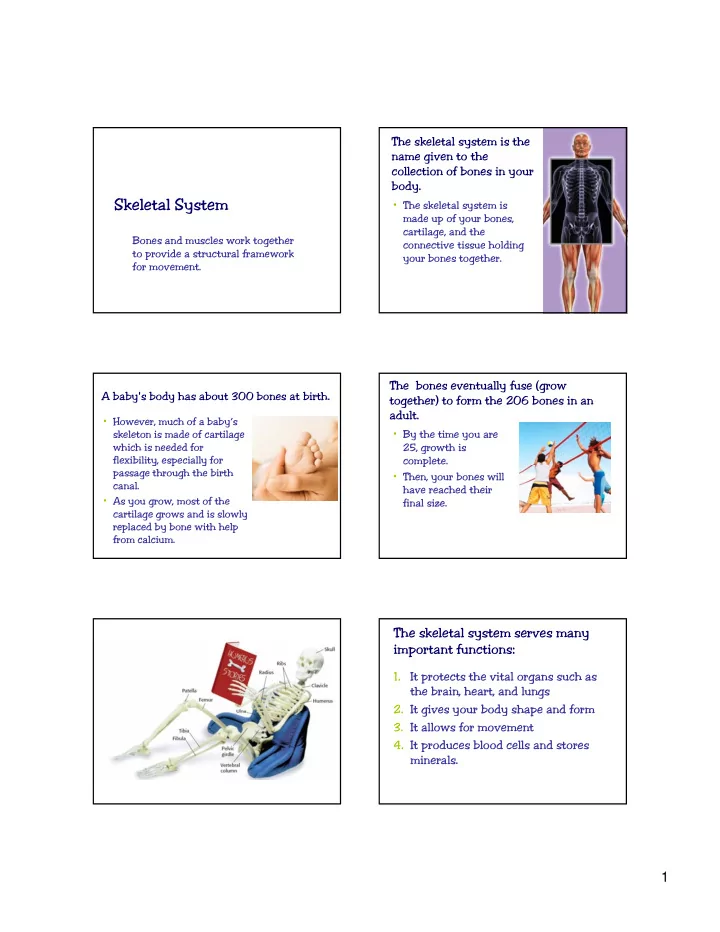
  • 1. It protects the vital organs such as

the brain, heart, and lungs 2 It gives your body shape and form

The skeletal system serves many important functions:

  • 2. It gives your body shape and form
  • 3. It allows for movement
  • 4. It produces blood cells and stores

minerals.

slide-2
SLIDE 2

2

The human skeleton is divided into two parts. The axial skeleton consists of bones that form the axis of the body.

  • It supports and

protects many organs and includes the skull, vertebral column ribs vertebral column, ribs, and sternum.

The appendicular skeleton includes the bones of the limbs and the girdles.

  • The pectoral girdle

forms your shoulders and anchors your arms.

  • The pelvic girdle forms
  • The pelvic girdle forms

your hips and anchors your legs.

Here are common names for some of your bones:

  • mandible - jaw
  • sternum - breast

bone

  • tibia - shin
  • phalanges - fingers

and toes

  • scapula - shoulder

blade

  • humerus - upper arm
  • radius/ulna - forearm
  • pelvis - hip
  • femur - thigh
  • patella - knee cap
  • calcaneus - heel

You might think that all bones are dead, but the bones that make up your skeleton are living organs.

  • Bones are made of

many layers of i i d connective tissue and minerals produced by living cells.

Almost every bone in your body has a similar structure similar structure.

slide-3
SLIDE 3

3

Periosteum

  • The outer surface of bone is called the

periosteum.

  • The periosteum is a thin membrane that

The periosteum is a thin membrane that contains blood vessels to nourish the bone and nerves.

Compact Bone

  • The next layer, compact bone, provides

most of the strength and support.

  • Compact bone is the smooth, hard part you

see when you look at a skeleton.

  • Tiny canals within compact bone contain

blood vessels.

Blood Vessels

  • Blood vessels run throughout the bone

carrying nutrients and gases.

Cancellous Bone (Spongy Bone)

  • Within the compact

bone are many layers

  • f cancellous bone

which has many open spaces like a sponge.

  • Cancellous bone is not

quite as hard as compact bone, but it is still very strong.

In many bones (like the femur), the cancellous bone protects the innermost part of the bone called bone marrow.

  • Bone marrow is a thick, jelly-like layer that

makes blood cells or stores fat.

  • Red bone marrow produces red blood cells.
  • Yellow bone marrow stores fat.