Human body animation March 2010 Based on slides by Marco Gillies - - PDF document

human body animation
SMART_READER_LITE
LIVE PREVIEW

Human body animation March 2010 Based on slides by Marco Gillies - - PDF document

Computer Animation Aitor Rovira Human body animation March 2010 Based on slides by Marco Gillies Human Body Animation Skeletal Animation Skeletal Animation (FK, IK) Motion Capture The fundamental aspect of human body motion is the


slide-1
SLIDE 1

Computer Animation

Aitor Rovira

March 2010

Based on slides by Marco Gillies

Human body animation

  • Skeletal Animation (FK, IK)
  • Motion Capture
  • Motion Editing (retargeting, styles, content)
  • Motion Graphs
  • Skinning
  • Multi-layered Methods

Human Body Animation Skeletal Animation

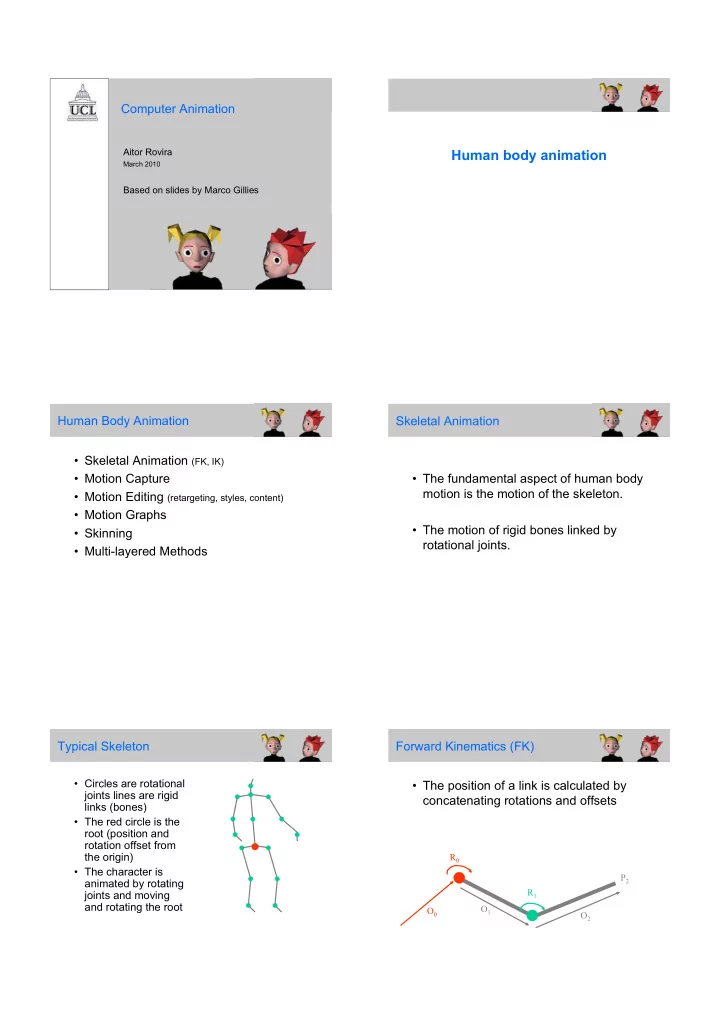
  • The fundamental aspect of human body

motion is the motion of the skeleton.

  • The motion of rigid bones linked by

rotational joints. Typical Skeleton

  • Circles are rotational

joints lines are rigid links (bones)

  • The red circle is the

root (position and rotation offset from the origin)

  • The character is

animated by rotating joints and moving and rotating the root

Forward Kinematics (FK)

  • The position of a link is calculated by

concatenating rotations and offsets

O0 R0 O1 O2 R1 P2

slide-2
SLIDE 2

Joint Limits

  • Joints are generally represented as full

3 degrees of freedom quaternion rotations.

  • Human joints can’t handle that range.
  • Either you build rotation limits into the

animation system.

  • Or you can rely on the methods

generating joints angles to give reasonable values. Forward Kinematics (FK)

  • Pros:

– Simple. – Used for the majority of real time animation systems.

  • Cons:

– It can be fiddly to animate with in some cases, e.g. if you want to make sure that a hand is in contact with an object it can be difficult.

Inverse Kinematics

  • Given a desired position for a part of the body

(end effector) work out the required joint angles to get it there.

  • In other words, given Pt what are R0 and R1?

R1 Pt R0 O1 O2

Inverse Kinematics

  • Pros:

– Very powerful tool. – Generally used in animation tools and for applying specific constraints.

  • Cons:

– Computationally intensive. – Underconstrained for more than 2 links.

Motion Capture

  • Record motion

from a real actor performing actions and map it to a skeleton.

  • Very heavily used

in film industry and computer games. Motion Capture

  • Put markers on

the body.

  • Track the

positions of the marker points.

slide-3
SLIDE 3

Motion Capture - Pipeline Motion Capture

  • (video)
  • Use reflective passive markers and

infra-red to avoid problems of colour.

  • Pros:

– Lightweight, Cheap. – Most commonly used.

  • Cons:

– Problems of occlusion. – Restricted to a certain 3D space.

Optical Motion Capture

  • Just point a camera at someone and

figure out their motion.

  • Pros:

– Almost perfect in theory.

  • Cons:

– Very, very, difficult computer vision issues – Still at the stage of research prototypes

Markerless Optical Motion Capture

  • Magnetic transmitters on

the body (active markers)

  • Base station measures

relative positions

  • Pros:

– Very accurate

  • Cons:

– Expensive

Magnetic Motion Capture

  • Pros:

– Self contained (less constrained by area in which you do it) – Can directly output joint angles

  • Cons:

– Bulky

  • Put strain gauges
  • etc. on the body

Mechanical Motion Capture

slide-4
SLIDE 4
  • Pros:

– Motion capture produces highly realistic animation.

  • Cons:

– Cleaning process can be really time consuming. – it is inflexible, you can only play back what you have captured. – difficult to apply to new physical situations (picking up a cup from a different place) – or new styles (different emotion)

Mocap - Conclusions Motion Editing

  • How can we transform motion data to

that we can re-use it in new contexts?

  • If we can do this in real time it allows us

to have characters that respond to events realistically.

  • A motion can be separated into a

Content component and a Style component

– Content: walking, sitting down, jumping – Style: angry, masculine, proud

  • Attempt to separate style and content

– change style of a motion – apply style of one motion to another

Motion Editing – Style and Content Motion Editing - Retargeting

  • Retargeting: maps the motion of a

performer to a character of different proportions.

  • Motion Warping: smoothly add small

changes to a motion to adapt it to a different style.

  • Useful to create sequences of random

motions.

  • Given a corpus of motion capture data

(usually short clips), automatically construct a directed graph connecting the different motions and the transitions.

  • L.Kovar, SIGGRAPH ‘02

Motion Graphs

  • Each node is a

possible transition point.

  • Each edge is a

motion clip to go between transition points.

  • Walking the graph

generates a motion. Motion Graphs

slide-5
SLIDE 5

Motion Graphs Making it look good

  • A skeleton is a great way of animating a

character but it doesn’t necessarily look very realistic when rendered.

  • The simplest way is to make each joint

a transform.

  • OK, but body is broken up.

! We need to add a graphical “skin” around the character. Smooth Skinning

  • We want to represent a character as a

single smooth mesh (a “skin”).

  • This should deform smoothly based on

the motion of the skeleton. Smooth Skinning

  • Associate each vertex in a mesh with
  • ne or more joints.
  • The vertices are transformed

individually by their associated joints.

  • Each vertex has a weight for each joint.
  • The resulting position is a weighted sum
  • f the individual joint transforms.

Smooth Skinning Multi-layered Methods

  • The deformation of a human body does

not only depend on the motion of the skeleton.

  • The movement of muscle and fat also

affect the appearance.

  • Soft tissues need different techniques

from rigid bones.

slide-6
SLIDE 6

Multi-layered Methods

  • More advanced character animation

systems use multiple layers.

  • Geometric methods.

– e.g. free form deformations (based on NURBS)

  • Physical models based on fat and

muscle layers.

Facial Animation

  • Concepts
  • Methods

– Facial Bones – Muscle Models – Facial Motion Capture – Morph Targets

  • Visemes and Lip Sync

Facial animation Facial Animation

  • Do not have a

common underlying structure like a skeleton.

  • Psychologist Paul Eckman defines a set
  • f six universal human emotions:

– Joy, sadness, surprise, anger, disgust, fear

  • All are independent of culture.
  • Each has a distinctive facial expression.

Concepts

  • There is plenty of methods:

– Facial bones – Muscle models – Facial Motion Capture – Morph Targets

Methods

slide-7
SLIDE 7

Facial Bones

  • Similar to bones in body animation
  • A set of underlying objects that can be

moved to control the mesh

– Position change – Springs

  • Each bone affects a number of vertices

with weights in a similar way to smooth skinning for body animation. Muscle Models

  • Model each of the muscles of the face.
  • Each muscle is affected by a bone.
  • Or there could be a more complex

physical simulation as mentioned for multi-layered body animation. Facial Motion Capture Facial Motion Capture

  • Markerless motion capture techniques

can also be considered.

  • Better developed than for body motion.
  • Gives reasonable results.

! The motion capture is mapped to the mesh, not to a set of bones. Morph Targets

  • Have a number of facial expressions,

each represented by a separate mesh.

  • Build new facial expressions out of

these base expressions.

  • Transition from one to another

smoothly. Morph Targets

slide-8
SLIDE 8

Morph Targets

  • Movie
  • Pros:

– A good low level animation technique. No restrictions to design them.

  • Cons:

– Making them can take a lot of time if done manually. – Requires a lot of memory. – We might need higher level ways to animate faces.

Morph Targets Visemes and Lip-sync

  • An important problem is how to animate

people talking.

  • In particular how to animate appropriate

mouth shapes for what is being said. Visemes and Lip-sync

  • Each sound (phoneme) has a distinctive

mouth shape

  • Can create a morph target for each

sound (visemes)

  • Analyse the speech or text into

phonemes (automatically done by text to speech engine)

  • Match phonemes to visemes and

generate morph target weights Visemes and Lip-sync

  • Very hard to do well (I’ve never seen it

done perfectly).

  • Speech and mouth shapes are more

complex than phonemes and visemes

– e.g. running one word into another

Thanks