Simultaneous observations for MLT Neutral Winds by FPI and Meteor - - PowerPoint PPT Presentation

simultaneous observations for mlt neutral winds by fpi
SMART_READER_LITE
LIVE PREVIEW

Simultaneous observations for MLT Neutral Winds by FPI and Meteor - - PowerPoint PPT Presentation

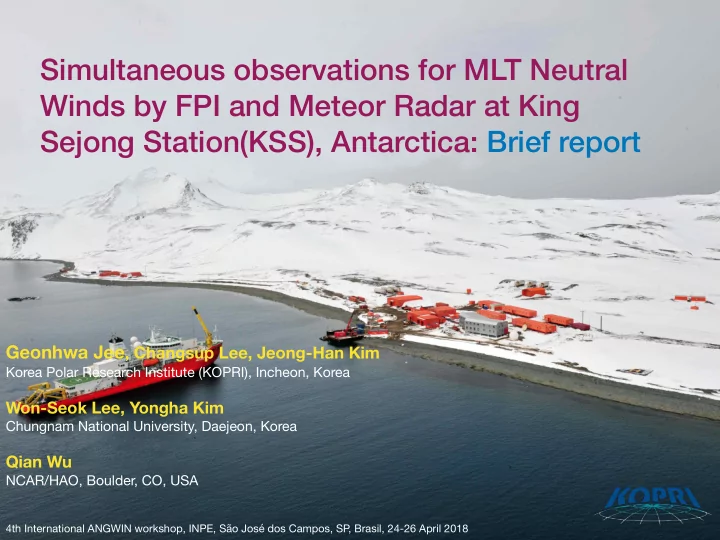
Simultaneous observations for MLT Neutral Winds by FPI and Meteor Radar at King Sejong Station(KSS), Antarctica: Brief report Geonhwa Jee , Changsup Lee, Jeong-Han Kim Korea Polar Research Institute (KOPRI), Incheon, Korea Won-Seok Lee, Yongha Kim


slide-1
SLIDE 1

Simultaneous observations for MLT Neutral Winds by FPI and Meteor Radar at King Sejong Station(KSS), Antarctica: Brief report

Geonhwa Jee, Changsup Lee, Jeong-Han Kim

Korea Polar Research Institute (KOPRI), Incheon, Korea

Won-Seok Lee, Yongha Kim

Chungnam National University, Daejeon, Korea

Qian Wu

NCAR/HAO, Boulder, CO, USA

4th International ANGWIN workshop, INPE, São José dos Campos, SP , Brasil, 24-26 April 2018

slide-2
SLIDE 2

King Sejong Station (KSS)

Geomagnetic North Pole Dasan Station (& KHO)

78° 55' N, 11° 56' E

King Sejong Station (KSS)

62° 13' S, 58° 47' W

Jang Bogo Station (JBS)

74º 37' S, 164º 13' E

Kiruna (Esrange)

67° 51' N, 20° 13' E

Geomagnetic South Pole

Palmer

slide-3
SLIDE 3

Optical Obs. FPI & ASC Meteor Radar

King Sejong Station (KSS)

slide-4
SLIDE 4

KSS-Meteor Radar

Jang Bogo Station (JBS) Kiruna

slide-5
SLIDE 5

KSS-Meteor Radar

Jang Bogo Station (JBS) Kiruna

  • ATRAD meteor detection radar
  • Continuously operated since March 2007
  • Number of echo: 15,000~40,000 per day, which is more

than twice of typical meteor radar observations

  • Hourly mean neutral wind profiles (75~105 km) and daily

mean temperature at around the meteor peak height (~ 90 km)

slide-6
SLIDE 6

KSS-FPI

slide-7
SLIDE 7

KSS-FPI

  • It was operated by NCAR/HAO at US Palmer station,

Antarctica

  • Moved to KSS in Jan. 2017 in collaboration with NCAR/

HAO

  • Operates with three filters for 630.0 nm, 557.7 nm, 892.0

nm airglow emissions

  • Snapshot winds for each filter with about 55 min.

temporal resolution

slide-8
SLIDE 8

Spatial Coverage

75 km 105 km 250 km 87 km 97 km ~200 km meteor

  • bs.

892.0nm 557.7nm

slide-9
SLIDE 9

FPI vs. MR

FPI winds MR winds Temporal resol.

55 min. (with 3 filters) :snap shot winds & temp. for each filter 1 hour :hourly mean winds & daily mean temp.

Spatial resol.

~200 km ~250 km

Height

87 km (OH 892.0 nm) 97 km (O 557.7 nm) 250 km (O 630.0 nm) 75~105 km (with 2 km step)

slide-10
SLIDE 10

FPI & MR : Meridional winds

slide-11
SLIDE 11

FPI & MR : Zonal winds

slide-12
SLIDE 12

→ : OI 5577(97 km) → : OH 8920(87 km) → : meteor radar(75 ~ 105km, 2km bin)

N S W E

slide-13
SLIDE 13

→ : OI 5577(97 km) → : OH 8920(87 km) → : meteor radar(75 ~ 105km, 2km bin)

N S W E

slide-14
SLIDE 14

→ : OI 5577(97 km) → : OH 8920(87 km) → : meteor radar(75 ~ 105km, 2km bin)

N S W E

slide-15
SLIDE 15

→ : OI 5577(97 km) → : OH 8920(87 km) → : meteor radar(75 ~ 105km, 2km bin)

N S W E

slide-16
SLIDE 16

Correlation btw MR and FPI winds

slide-17
SLIDE 17

FPI vs. MR winds at mid- latitude region

Yu et al., 2016

slide-18
SLIDE 18

Summary

  • Simultaneous measurements of MLT neutral winds at KSS, Antarctica.

However,

  • Optical vs. radar
  • Snapshot vs. hourly mean winds
  • Relatively large differences may indicate that there are large variabilities

within 1-hour time period in the MLT winds.

  • Any complementary aspects of these two measurements?
  • What information can we obtain with this simultaneous observation?
  • With the MR wind observations, is it necessary to keep observing the

MLT winds by FPI?

slide-19
SLIDE 19

Future works

  • Large number of observed meteor echos: 15,000~40,000

per day

  • Increase the temporal resolution of neutral wind
  • bservation: 1-hour —> 0.5-hour
  • Daily mean temperature —> separate day & night mean

temperatures

  • Compare them with FPI winds & temp.