SLIDE 1
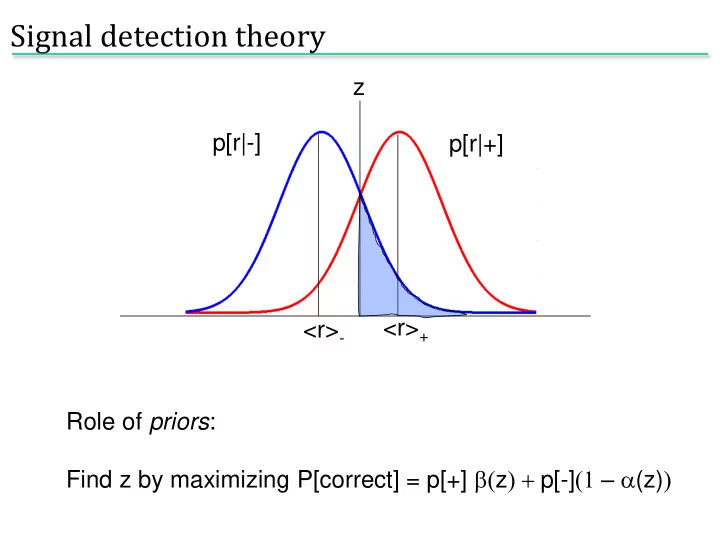
p[r|+] p[r|-] <r>+ <r>- z Role of priors: Find z by maximizing P[correct] = p[+] b(z) + p[-](1 – a(z))
Signal detection theory
SLIDE 2
The optimal test function is the likelihood ratio, l(r) = p[r|+] / p[r|-]. (Neyman-Pearson lemma)
Is there a better test to use than r?
p[r|+] p[r|-] <r>+ <r>- z
SLIDE 3
Penalty for incorrect answer: L+, L- For an observation r, what is the expected loss? Loss- = L-P[+|r] Cut your losses: answer + when Loss+ < Loss- i.e. when L+P[-|r] < L-P[+|r]. Using Bayes’, P[+|r] = p[r|+]P[+]/p(r); P[-|r] = p[r|-]P[-]/p(r); l(r) = p[r|+]/p[r|-] > L+P[-] / L-P[+] . Loss+ = L+P[-|r]
Building in cost
SLIDE 4
- Population code formulation
- Methods for decoding:
population vector Bayesian inference maximum likelihood maximum a posteriori
Decoding from many neurons: population codes
SLIDE 5
Cricket cercal cells
SLIDE 6
Theunissen & Miller, 1991
RMS error in estimate
Population vector
SLIDE 7 Cosine tuning:
Population coding in M1
SLIDE 8
The population vector is neither general nor optimal. “Optimal”: make use of all information in the stimulus/response distributions
Is this the best one can do?
SLIDE 9
Bayes’ law: likelihood function a posteriori distribution conditional distribution marginal distribution prior distribution
Bayesian inference
SLIDE 10
Introduce a cost function, L(s,sBayes); minimize mean cost. For least squares cost, L(s,sBayes) = (s – sBayes)2 . Let’s calculate the solution.. Want an estimator sBayes
Bayesian estimation
SLIDE 11
By Bayes’ law, likelihood function a posteriori distribution
Bayesian inference
SLIDE 12
Find maximum of p[r|s] over s More generally, probability of the data given the “model” “Model” = stimulus assume parametric form for tuning curve
Maximum likelihood
SLIDE 13
By Bayes’ law, likelihood function a posteriori distribution
Bayesian inference
SLIDE 14
ML: s* which maximizes p[r|s] MAP: s* which maximizes p[s|r] Difference is the role of the prior: differ by factor p[s]/p[r]
MAP and ML
SLIDE 15
Comparison with population vector
SLIDE 16 Many neurons “voting” for an outcome. Work through a specific example
- assume independence
- assume Poisson firing
Noise model: Poisson distribution PT[k] = (lT)k exp(-lT)/k!
Decoding an arbitrary continuous stimulus
SLIDE 17
E.g. Gaussian tuning curves
Decoding an arbitrary continuous stimulus
.. what is P(ra|s)?
SLIDE 18
Assume Poisson: Assume independent:
Population response of 11 cells with Gaussian tuning curves
Need to know full P[r|s]
SLIDE 19
Apply ML: maximize ln P[r|s] with respect to s Set derivative to zero, use sum = constant From Gaussianity of tuning curves, If all s same
ML
SLIDE 20
Apply MAP: maximise ln p[s|r] with respect to s Set derivative to zero, use sum = constant From Gaussianity of tuning curves,
MAP
SLIDE 21
Given this data:
Constant prior Prior with mean -2, variance 1
MAP:
SLIDE 22
For stimulus s, have estimated sest Bias: Cramer-Rao bound: Mean square error: Variance:
Fisher information
(ML is unbiased: b = b’ = 0)
How good is our estimate?
SLIDE 23
Alternatively: Quantifies local stimulus discriminability
Fisher information
SLIDE 24
For the Gaussian tuning curves w/Poisson statistics:
Fisher information for Gaussian tuning curves
SLIDE 25
Approximate: Thus, Narrow tuning curves are better But not in higher dimensions!
Are narrow or broad tuning curves better?
..what happens in 2D?
SLIDE 26
Recall d' = mean difference/standard deviation Can also decode and discriminate using decoded values. Trying to discriminate s and s+Ds: Difference in ML estimate is Ds (unbiased) variance in estimate is 1/IF(s).
Fisher information and discrimination
SLIDE 27
- Tuning curve/mean firing rate
- Correlations in the population
Limitations of these approaches
SLIDE 28
The importance of correlation
Shadlen and Newsome, ‘98
SLIDE 29
The importance of correlation
SLIDE 30
The importance of correlation
SLIDE 31
Model-based vs model free
Entropy and Shannon information