Sharks sought for: The EU has a lead role to play in shark fishing - - PDF document

sharks sought for the eu has a lead role to play in shark
SMART_READER_LITE
LIVE PREVIEW

Sharks sought for: The EU has a lead role to play in shark fishing - - PDF document

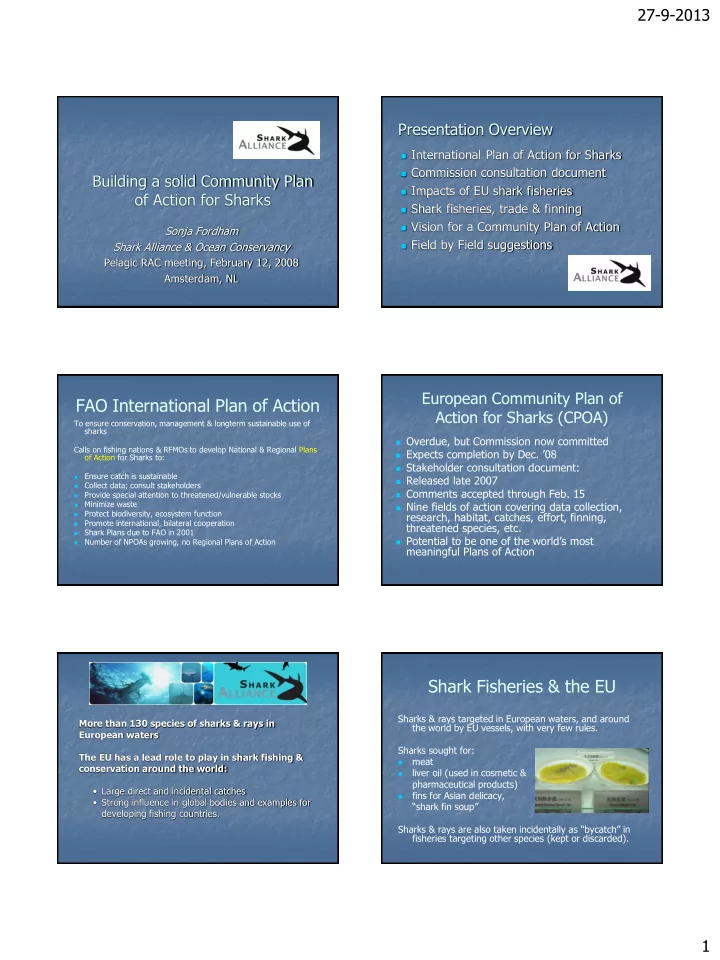
27-9-2013 Presentation Overview International Plan of Action for Sharks Commission consultation document Building a solid Community Plan Impacts of EU shark fisheries of Action for Sharks Shark fisheries, trade & finning


slide-1
SLIDE 1

27-9-2013 1 Building a solid Community Plan

  • f Action for Sharks

Sonja Fordham Shark Alliance & Ocean Conservancy Pelagic RAC meeting, February 12, 2008 Amsterdam, NL

Presentation Overview

 International Plan of Action for Sharks  Commission consultation document  Impacts of EU shark fisheries  Shark fisheries, trade & finning  Vision for a Community Plan of Action  Field by Field suggestions

FAO International Plan of Action

To ensure conservation, management & longterm sustainable use of sharks Calls on fishing nations & RFMOs to develop National & Regional Plans

  • f Action for Sharks to:

Ensure catch is sustainable

Collect data; consult stakeholders

Provide special attention to threatened/vulnerable stocks

Minimize waste

Protect biodiversity, ecosystem function

Promote international, bilateral cooperation

Shark Plans due to FAO in 2001

Number of NPOAs growing, no Regional Plans of Action

European Community Plan of Action for Sharks (CPOA)

 Overdue, but Commission now committed  Expects completion by Dec. ’08  Stakeholder consultation document:  Released late 2007  Comments accepted through Feb. 15  Nine fields of action covering data collection,

research, habitat, catches, effort, finning, threatened species, etc.

 Potential to be one of the world’s most

meaningful Plans of Action

More than 130 species of sharks & rays in European waters The EU has a lead role to play in shark fishing & conservation around the world:

  • Large direct and incidental catches
  • Strong influence in global bodies and examples for

developing fishing countries.

Shark Fisheries & the EU

Sharks & rays targeted in European waters, and around the world by EU vessels, with very few rules. Sharks sought for:

meat

liver oil (used in cosmetic & pharmaceutical products)

fins for Asian delicacy, “shark fin soup” Sharks & rays are also taken incidentally as “bycatch” in fisheries targeting other species (kept or discarded).

slide-2
SLIDE 2

27-9-2013 2

Shark trade & the EU

The European Union is a significant player:

 global catch  consumption  trade of sharks & rays.

In 2004, Europe responsible for:

 ~30 % of the world’s imports and  ~40 % of world exports of shark products.

Sharks are Vulnerable

 Because most sharks:

 Grow slowly  Mature late  Produce few young

 Fishing pressure can easily

deplete shark populations.

 Such damage often requires decades, centuries to repair.  Most European targeted shark fisheries have declined

along with shark populations.

Sharks in Trouble

 One-third of European shark populations assessed by

the IUCN are considered Threatened with extinction.

 Mediterranean- highest % in world, so far (42%)  At least two species

  • f European rays -

“common” skate & “common” sawfish – thought locally extinct

Shark Fin Trade from Europe

 Europe’s participation in Hong Kong fin

market has increased dramatically

 From insignificant levels

to 1/3 of total imports

 Fins (for soup) worth

more than bodies

 Economic incentive to “fin”  “Finning” = taking fins,

discarding body at sea

 EU banned finning in 2003, but  Loopholes in the regulation remain

EU Finning Ban Opportunities for Improvement

EU Finning Regulation allows for landing fins & carcasses separately

Bans removal of fins at sea, but allows for exceptions under special fishing permits

Caps “fin to carcass” ratio at 5% of whole weight when most advice dictates 2%

Finning can therefore continue under limits

EU fin to carcass ratio replicated in int’l finning bans, makes them ineffective too

Finning bans: scientific advice

 2006, EU scientists reviewed EU fin situation at

technical workshop, 2007 report

 Concluded ratios complicated, unreliable  Fins should remain attached:

 Better enforcement  Improved species-specific

collection data

 Underscores previous tech. advice

slide-3
SLIDE 3

27-9-2013 3

Context: Wide ranging effects

 Most sharks are important predators in marine

ecosystems, key to ocean balance

 EU = major power at

most int’l fisheries & wildlife organizations

 Therefore, EU shark

regulations have wide ranging implications for the health of world’s oceans

Shark Alliance Vision for a Community Plan of Action for Sharks

We envision the CPOA as umbrella document to:

 Address EU & int’l waters  Not only review situation  Also commit to concrete

limits on fishing

 Map out future initiatives  Cover actions by fisheries & environment

administrations

 Other actions more immediate, should be built in

Commission consultation paper

Sound objectives aimed essentially at ensuring:

A deeper understanding of sharks, their role in ecosystems & the take of sharks in fisheries;

Sustainable directed shark fisheries and properly regulated bycatch; and

A coherent approach between internal and external Community fishery policies for sharks.

Key Points for Field of Action #1

Facilitate improved species-specific catch information Shark Alliance supports Commission proposals to:

 increase investment in collection and verification

  • f species-specific shark fisheries data at

landings sites, but also at sea.

 promote Regional Plans of Action for sharks and

close attention to related commitments made through CITES.

Key Points for Field of Action #2

Facilitate collection of species-specific biological and trade data

Shark Alliance supports Commission proposals to:

 increase observer coverage and improve reporting of

shark trade by species, and

 record all landings and trade of shark separately by

commodity and to the species level. In addition, Shark Alliance proposes:

 consideration of video monitoring,  a broader scope of shark products to include teeth,

hides, cartilage and whole specimens.

Key Points for Field of Action #3

Assess threats to populations, identify & protect critical habitats

Shark Alliance supports Commission proposals to:

 regularly assess status of shark populations,  determine levels of fishing mortality on sharks,  study and protect key habitats where sharks congregate

& can be vulnerable to fishing Shark Alliance also proposes:

 determination of sustainable levels of fishing and/or

precautionary catch limits in data-poor situations.

slide-4
SLIDE 4

27-9-2013 4

Key Points for Field of Action #4

Research threats to shark populations associated with biology & bycatch

Shark Alliance supports Commission proposals to:

 improve understanding of shark life history traits &

ecological impacts of shark depletion,

 investigate means of reducing shark bycatch and discard

mortality for unwanted and non-commercial species. In addition, Shark Alliance proposes:

 Aiming to minimise, not just reduce, bycatch  For protected, threatened & unmanaged species as well.

Field of Action #5

Improve stakeholder consultation and awareness

Shark Alliance supports Commission proposals to:

 educate fishermen & public re: shark status & rules,  consult the RACs for best practices for bycatch reduction,  offer greater public access to shark fisheries info.

In addition, Shark Alliance proposes that the Commission:

 Publicize information regarding safe handling & release of

sharks (to minimise harm to fishermen & sharks).

Field of Action #6

Adjust fishing effort to ensure sustainability Shark Alliance supports Commission proposals to:

 Adjust fishing effort to available resources, in line with

FAO agreements & EU fishing capacity reduction goals.

 restrict fishing in key habitats of endangered sharks.

Field of Action #7

Adjust catches to ensure sustainability

Shark Alliance supports Commission proposals to:

limit shark catch in line with scientific advice,

improve gear selectivity and reduce/minimize discards of sharks,

establish time/area closures in areas where sharks aggregate, and

make exceptions to discard ban for sharks with a chance to survive. Shark Alliance further proposes:

  • ptions for size limits & gear restrictions (based on innovation),

precautionary restrictions in the meantime,

responsible timelines for management & recovery,

further exceptions to the discard ban for protected species & those considered by IUCN as Threatened.

Field of Action #8

Minimize waste & discards of sharks by improving finning bans

Shark Alliance asserts the best way to strengthen finning bans is to:

eliminate derogation that allows fins to be removed on board vessels. Short of that, the following Commission proposals are improvements:

require the landing of fins & carcasses at same time, same port, and

reduce the fin to carcass ratio to 5% of dressed weight. Shark Alliance opposes Commission proposals to:

Allow exceptions for higher ratios.

Field of Action #9

Provide special attention to threatened shark populations

Shark Alliance supports Commission proposal to:

 afford special, prioritized protection species considered

by IUCN as Endangered or Critically Endangered

 Establish EU & RFMO bycatch reduction/minimization

programs & time/area closures for these species Shark Alliance further proposes that:

 Protection from fishing (prohibitions on fishing, retention

& landing) be included as possible tools, and

 International initiatives include protective action for

threatened sharks through wildlife treaties.

slide-5
SLIDE 5

27-9-2013 5 Q: What are the likely socio-economic effects of actions?

 Depletion of sharks can take decade/centuries to repair.  Long-term sustainability depends on science-based

restrictions & caution in the absence of certainty.

 Long-term economic and social benefits of conserving

sharks generally outweigh short-term costs.

 Social & economic impacts of not managing sharks

serious for shark fishers & those taking sharks as bycatch.

 Negative economic impacts possible from associated

declines in the health or abundance of prey/competitor populations, as a consequence of removing top predators.

Q: What are the likely environmental effects of actions?

 Most sharks serve as top predators, thereby key

to keeping marine ecosystems in balance.

 Scientists warn consequences of removing top

predators, although difficult to predict, will likely be negative, cascading & often counter-intuitive.

 Precautionary, science-based shark conservation

programs can prevent population depletion and thereby ensure proper functioning of ocean ecosystems.

We welcome your interest and participation in this initiative. Thank you for your attention. Sonja Fordham, Shark Alliance sonja@oceanconservancy.org