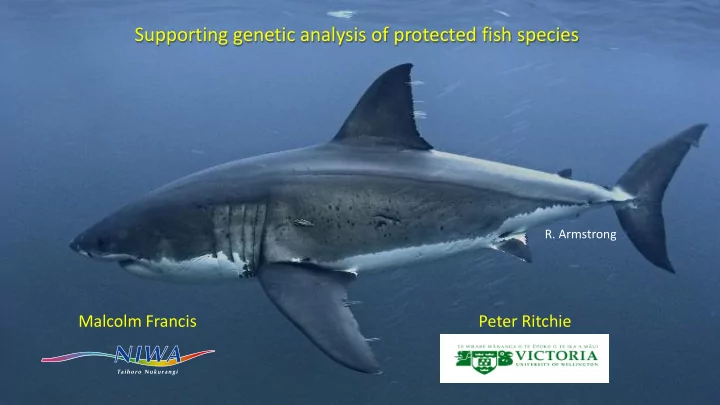
Supporting genetic analysis of protected fish species R. Armstrong - - PowerPoint PPT Presentation

supporting genetic analysis of protected fish species
SMART_READER_LITE
LIVE PREVIEW

Supporting genetic analysis of protected fish species R. Armstrong - - PowerPoint PPT Presentation

Supporting genetic analysis of protected fish species R. Armstrong Malcolm Francis Peter Ritchie Nine protected New Zealand fish species Giant manta ray White shark (R. Whale shark Armstrong) Basking shark (J. Stafford-Dietsch) Oceanic


slide-1
SLIDE 1

Malcolm Francis Peter Ritchie

Supporting genetic analysis of protected fish species

  • R. Armstrong
slide-2
SLIDE 2

Whale shark Giant manta ray White shark (R. Armstrong) Basking shark (J. Stafford-Dietsch) Deepwater nurse shark (K. Westerskov) Spinetail devilray (W. White) Spotted black grouper Giant grouper (R. Quinlan) Oceanic whitetip shark (W. White)

Nine protected New Zealand fish species

slide-3
SLIDE 3

Whale shark Giant manta ray White shark (R. Armstrong) Basking shark (J. Stafford-Dietsch) Deepwater nurse shark (K. Westerskov) Spinetail devilray (W. White) Spotted black grouper Giant grouper (R. Quinlan) Oceanic whitetip shark (W. White)

Residents

Nine protected New Zealand fish species

slide-4
SLIDE 4

Whale shark Giant manta ray White shark (R. Armstrong) Basking shark (J. Stafford-Dietsch) Deepwater nurse shark (K. Westerskov) Spinetail devilray (W. White) Spotted black grouper Giant grouper (R. Quinlan) Oceanic whitetip shark (W. White)

Tropical migrants

Nine protected New Zealand fish species

slide-5
SLIDE 5

POP2015-07 Objectives

  • To establish a repository for genetic samples of protected fish

species

  • To conduct a stock take of complete, current and planned genetic

analyses internationally, in relation to New Zealand’s [nine protected] fish species

  • To provide recommendations on the most appropriate methods of

furthering genetic analyses in order to inform management of New Zealand’s protected fish species in relation to fisheries bycatch

The wide distributions of most species, and the broad expanses of ocean between New Zealand and other population centres of all nine species, raise the possibility that some

  • r all of the species may have multiple, isolated, geographic populations. Understanding

population structure is important for managing the New Zealand populations of these nine species. Even though the species are protected within the New Zealand EEZ, they may be subjected to fishing and environmental impacts elsewhere if they form part of more extensive geographic populations.

slide-6
SLIDE 6

Methods - Repository

  • NIWA (and formerly MAF Fisheries) has been collecting tissue samples from white

shark since 1991, from basking shark since 1997, and from spinetail devilray since 2013 (in conjunction with a DOC study on bycatch in purse seine fisheries).

  • Many tissue samples have been contributed to international studies on the population

genetics of the three species.

  • Sub-samples of the tissues are held at NIWA in Wellington and/or one or more
  • verseas laboratories.
  • NIWA’s tissue samples form the nucleus of a new library of protected species tissue

samples.

  • Tissues were transferred to fresh 95% ethanol in 2 ml vials with O-ring sealed caps,

provided with new labels containing unique specimen numbers, and recorded on a

  • database. Vials were deposited in a secure, frozen, fire-proof facility approved for

ethanol storage (NIWA Invertebrate Collection, Greta Point, Wellington).

  • New Zealand and overseas researchers and genetics laboratories were canvassed to

identify New Zealand tissue samples of the nine species held by other organisations. In most cases, those tissues remain in their current location and their details were recorded on the new database.

slide-7
SLIDE 7

Methods – Review of genetics studies

  • Previous studies with international collaborators provided many important sources of

information and contacts that provided information to feed into the current review

  • We also carried out a new literature search to locate additional and recent published

genetic studies on the nine species

  • Personal contacts and international listservers were used to identify other researchers

working on these species with the aim of compiling an exhaustive list of past, ongoing and planned genetics studies

slide-8
SLIDE 8

Species Tissues held worldwide Tissues held in NIWA repository White shark 102 18 Basking shark 53 23 Whale shark Deepwater nurse shark Oceanic whitetip shark 1* Spinetail devilray 11 10 Giant manta ray Spotted black grouper 9 1 Giant grouper 1 * Includes tissues from each of 6 embryos

Tissue repository

Number of New Zealand tissue samples of nine protected fish species held worldwide and in the NIWA tissue repository Non-NIWA specimens (main holdings): White shark: CSIRO, Australia; University of Colorado; University of Aberdeen Basking shark: Durham University; University of Aberdeen; Nova Southeastern University, Florida Spinetail devilray tissues: University

  • f Queensland; University of

California Santa Cruz Spotted black grouper: Museum of New Zealand (Te Papa)

slide-9
SLIDE 9

Species References White shark Pardini et al. (2001), Chapman et al. (2003), Jorgensen et al. (2010), Tanaka et al. (2011), Gubili et al. (2011, 2012), Blower et al. (2012), O'Leary et al. (2015), Oñate-González et al. (2015), Andreotti et al. (2016) Basking shark Hoelzel et al. (2001, 2006), Noble et al. (2006), Magnussen et al. (2007), Lieber et al. (2013), Hester et

  • al. (2015)

Spinetail devilray Poortvliet (unpubl. data)

List of genetic studies known to have incorporated tissue samples from New Zealand protected species

slide-10
SLIDE 10

Species Institution Researcher White shark Flinders University, Bedford Park, South Australia Charlie Huveneers White shark CSIRO, Hobart, Australia Barry Bruce White shark College of Charleston, South Carolina, USA Gavin Naylor Basking shark University of Aberdeen, Aberdeen, Scotland Lilian Lieber, Les Noble, Cath Jones Whale shark Marine Megafauna Foundation, Tofo Beach, Mozambique Simon Pierce, Alex Watts Deepwater nurse shark College of Charleston, South Carolina, USA; Moss Landing Marine Laboratories, California, USA Gavin Naylor, Dave Ebert Oceanic whitetip shark Nova Southeastern University, Florida, USA Mahmood Shivji Devil and manta rays Bangor University, Wales Jane Hosegood Devil and manta rays Center for Fisheries, Aquaculture, & Aquatic Sciences, Carbondale, Illinois, USA Tom Kashiwagi Devil and manta rays Marine Megafauna Foundation, Tofo Beach, Mozambique Andrea Marshall Devil and manta rays Charles Darwin University, Darwin, Australia Peter Kyne Devil and manta rays University of Queensland, Brisbane, Australia Mike Bennett, Jenny Ovenden Spotted black grouper ? Giant grouper ?

List of known ongoing or planned genetic studies of New Zealand's protected fish species

slide-11
SLIDE 11

Genetic studies of basking shark (see report for other species)

slide-12
SLIDE 12

Eighteen microsatellites have been described for basking sharks (Noble et al. 2006), and the entire mitochondrial genome of 16,670 base pairs has been sequenced (Hester et al. 2015). DNA can be extracted from mucus swabs collected from free-swimming sharks (Lieber et al. 2013). Identification of basking sharks from processed products has been reported (Hoelzel 2001, Magnussen et al. 2007, Fields et al. 2015). A nucleotide diagnostic (ND) method has been developed for uniquely identifying shark species, including basking shark (Wong et

  • al. 2009).

Basking sharks have very low genetic diversity (Hoelzel et al. 2006, Lieber et al. 2013) and no clear population structuring has been found on a global scale (Hoelzel et al. 2006, Noble et al. 2006, Lieber et al. 2013). Nevertheless, gene flow between the Northern and Southern hemispheres, and between the Pacific and Atlantic oceans, is low (Noble et al. 2006).

Example of review text accompanying database – basking shark

slide-13
SLIDE 13

Species with population genetics studies

  • Only 4 out of 9 species have population genetics studies - white

shark, basking shark, whale shark, spinetail devilray

  • No population genetics studies (yet) for oceanic whitetip shark,

deepwater nurse shark, giant manta ray, spotted black grouper, giant grouper

slide-14
SLIDE 14

Populations distinguished worldwide – white shark

Gubili et al. (2015)

slide-15
SLIDE 15

Populations distinguished worldwide – white shark sub-structuring

Blower et al. (2012) Eastern and southwestern Australia Oñate-González et al. (2015) California and Mexico

slide-16
SLIDE 16

Populations distinguished worldwide – spinetail devilray

Statistical parsimony network for 50 mtDNA (COX1 and NADH5) haplotypes of Mobula

  • japanica. Colors refer to sampling locations,

and are explained in the legend. Circle size is proportional to the number of sampled individuals with a given haplotype. Lines between haplotypes represent one mutational

  • step. New Zealand haplotypes are indicated

with dashed lines, and the number of individuals is indicated (1X or 3X). East Atlantic Ocean significantly different from most other sites. Others not different. The comparison between New Zealand (n= 6) and Atlantic samples was marginally significant, but not after correction for multiple tests. Poortvliet (unpubl. data)