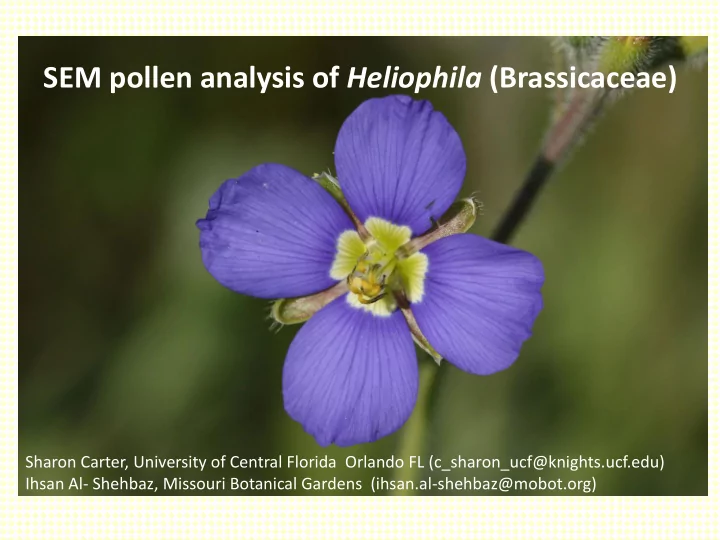
SEM pollen analysis of Heliophila (Brassicaceae) Sharon Carter, - - PowerPoint PPT Presentation

sem pollen analysis of heliophila brassicaceae
SMART_READER_LITE
LIVE PREVIEW

SEM pollen analysis of Heliophila (Brassicaceae) Sharon Carter, - - PowerPoint PPT Presentation

SEM pollen analysis of Heliophila (Brassicaceae) Sharon Carter, University of Central Florida Orlando FL (c_sharon_ucf@knights.ucf.edu) Ihsan Al- Shehbaz, Missouri Botanical Gardens (ihsan.al-shehbaz@mobot.org) Introduction Brassicaceae


slide-1
SLIDE 1

SEM pollen analysis of Heliophila (Brassicaceae)

Sharon Carter, University of Central Florida Orlando FL (c_sharon_ucf@knights.ucf.edu) Ihsan Al- Shehbaz, Missouri Botanical Gardens (ihsan.al-shehbaz@mobot.org)
slide-2
SLIDE 2

Brassicaceae – Mustard Family

  • 320 genera
  • 3660 species
  • Easily identifiable

Introduction

Tetradynamous stamens Cruciform corolla Capsular fruits

slide-3
SLIDE 3

Draba verna

Floral Diversity

Stenopetalon Iberis Streptanthus glandulosus Stanleya pinnata Ornithocarpa torulosa Zerdana anchonioides Schizopetalon walkeri Lepidium lasiophyllum Lepidium oleraceum

slide-4
SLIDE 4

Heliophila

  • Endemic to South Africa,

especially the Cape Region

  • 88 species
  • High variability in fruit

morphology

  • Fynbos eco-region

Springbok

slide-5
SLIDE 5

FRUIT DIVERSITY

Scale = 1 cm

1 2 4 3 5 6 7 8 9 10 11 12 13 14 15 16 17 18 19 20 21 22 23 24 25 26 27 28 29 30

slide-6
SLIDE 6
  • 1. H. cornuta
  • 2. H. elongata
  • 3. H. cinerea
  • 4. H. callosa
  • 5. H. africana
  • 6. H. scoparia
  • 7. H. pendula
  • 8. H. descurva
  • 9. H. variabilis
  • 10. H. latisiliqua
  • 11. H. brachycarpa
  • 12. H. patens
  • 13. H. diffusa
  • 14. H. ephemera
  • 15. H. pusilla
  • 16. H. collina
  • 17. H. arenaria
  • 19. H. amplexicaulis
  • 20. H. cornellsbergia
  • 21. H. eximia
  • 22. H. concatenata
  • 23. H. crithmifolia
  • 24. H. scandens
  • 25. H. hurkana [formerly

Cycloptychis marlothii]

  • 26. H. maraisiana

[formerly Cycloptychis virgata]

  • 27. H. monosperma

[formerly Schlechtertia capensis]

  • 28. H. juncea [formerly

Brachycarpaea juncea]

  • 29. H. polygaloides

[formerly Silicularia polygaloides]

  • 30. H. suborbicularis

[formerly Thlaspaeocarpa capensis]

Heliophila fruits

slide-7
SLIDE 7

Objective

Determine pollen ornamentation in the genus Heliophila using SEM (scanning electron microscopy)

slide-8
SLIDE 8

Why Study Pollen?

slide-9
SLIDE 9

Pollen

Tricolpate 96.2% of Brassicaceae

Streptanthus carinatus

Pollen polycolpate Tribe Physarieae (3.8% of family)

Physaria gordonii

slide-10
SLIDE 10

Methods

  • Mount pollen from anthers to SEM stubs for all 62

taxa of Heliophila

  • Sputter Coat for 2 min at 35 mAmps
  • View using SEM
  • Measure polar, equatorial, and colpi length and

determine the P/E ratio

slide-11
SLIDE 11

Results

B C A

Spinulose Reticulate

Cladogram from Lysak et al. 2012 (Taxon 61, in press)

slide-12
SLIDE 12

Spinulose

  • 41 species
  • H. pusilla
  • H. coronopifolia
  • H. linearis
  • H. collina
slide-13
SLIDE 13

Reticulate: Coarse and Fine

  • 17 Species
  • H. brachycarpa
  • H. dregeana
  • H. glauca
  • H. macrosperma
slide-14
SLIDE 14

Spinulose with fine reticulation

  • 4 Species
  • H. arenosa
  • H. namaquana
  • H. suborbicularis
  • H. suavissima
slide-15
SLIDE 15

Conclusion

Pollen ornamentation types Major

  • Reticulate (coarse and fine):

Heliophila Clade B

  • Spinulose: Heliophila Clades A,C

Minor

  • Spinulose with fine reticulation:

Heliophila arenosa and H. namaquana (Clade A) Heliophila suborbicularis and H. suavissima (Clade C)

slide-16
SLIDE 16

Future Work

  • Use light microscopy and transmission electron microscopy

to analyze the anatomic structural basis of the pollen wall

  • Determine if the Spinulose type is present in other

genera of Brassicaceae

  • Study the flower pollinators to understand if the Spinulose type

has possible adaptive pollination values

slide-17
SLIDE 17

Acknowledgments

I would like to thank Dr. Ihsan Al-Shehbaz, REU Coordinators Dr. Sandra Arango-Caro and Dr. David Bogler, the Missouri Botanical Gardens (MBG) and the National Science Foundation (NSF). Their support and encouragement made this project possible. I would also like to thank Dr. Martin Lysak for providing the cladogram of Heliophila.

slide-18
SLIDE 18