
SLIDE 1
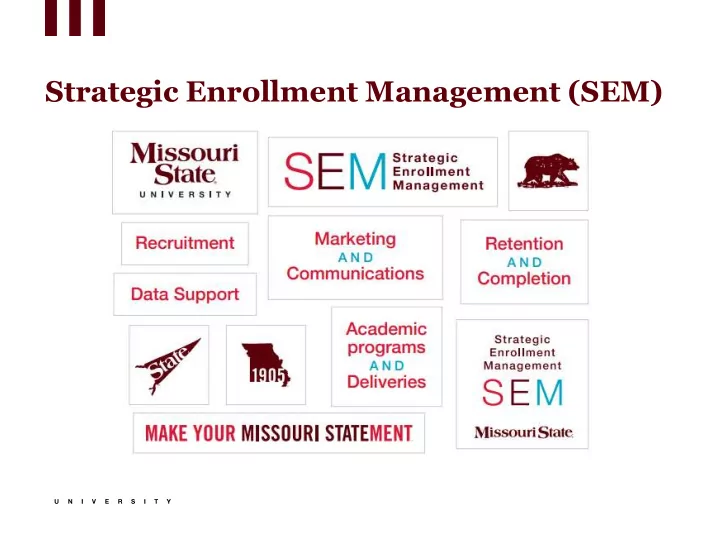
Strategic Enrollment Management (SEM) What is SEM? Strategic - - PowerPoint PPT Presentation
Strategic Enrollment Management (SEM) What is SEM? Strategic enrollment management (SEM) is a key concept in the administration of higher education institutions today. SEM provides a unique framework for improving student and institutional
Strategic enrollment management (SEM) is a key concept in the administration of higher education institutions today. SEM provides a unique framework for improving student and institutional outcomes by jointly enabling student access to and success in higher education, best business practices, and comprehensive institutional
Strategic enrollment management [SEM] is a crucial element of planning for new growth at a university or college as it concerns both academic program growth and facilities needs. SEM focuses on what is best for students' success while increasing enrollment numbers and stabilizing institutional revenues. (Wikipedia) Strategic enrollment planning is more than a long-term recruitment or retention plan. It is a data-informed process that aligns an institution’s fiscal, academic, co-curricular, and enrollment resources with its changing environment to accomplish the institution’s mission and ensure the institution’s long-term enrollment success and fiscal health. (Ruffalo Noel Levitz)
Support Team Subcommittees
SEM Steering Committee
Long-term enrollment goals, securing the approval of strategies through appropriate institutional channels, communication with President and Administrative Council Recruitment Council
Develop strategic goals and action plans for new student recruitment and outreach
Retention and Completion Council
Develop strategic goals and action plans for retention and graduation
Data Support Team
Environment scanning, student enrollment behavior research, enrollment models, provide data to councils as needed Ad Hoc Sub- Committees as needed
Academic Programs and Deliveries Council
Develop strategic goals and action plans regarding the development and alignment of academic programs and deliveries that meet the demands
Marketing and Communications Council
Develop strategic goals and action plans to raise the profile
and external marketing and communication Ad Hoc Sub- Committees as needed
Senior Leadership
Clif Smart, President; Dr. Frank Einhellig, Provost; Dr. Dee Siscoe, Vice President for Student Affairs. Overall management of SEM process and communication with Board of Governors
Community Involvement Subcommittee
First Name Last Name Area
1 Rob Hornberger (co-chair) Enrollment Management 2 Tammy Jahnke (co-chair) CNAS 3 Brad Bodenhausen * International Services 4 Jeff Coiner Information Services 5 Tom Dicke CHPA, Past Faculty Senate Chair 6 Lahi Dirie SGA 7 Steve Foucart Financial Services 8 Julie Masterson * Graduate College 9 Saibal Mitra CNAS, Faculty Senate Chair 10 Wes Pratt Diversity and Inclusion 11 Suzanne Shaw Marketing and Communications 12 Christina Simmers* COB 13 Kelly Wood * Center for Academic Success and Transition *Also a subcommittee co-chair
First Name Last Name Area
Recruitment Council Brad Bodenhausen (co-chair) International Programs Nechell Bonds (co-chair) Admissions (undergraduate) Retention and Completion Council Michele Smith (co-chair) Student Affairs and Multicultural Services Kelly Wood (co-chair) Center for Academic Success and Transition Academic Programs and Deliveries Council Julie Masterson (co-chair) Graduate College Dave Meinert (co-chair) COB Marketing and Communications Council Stacey Funderburk (co-chair) Marketing and Communications Christina Simmers (co-chair) COB Data Support Team
Theresa McCoy (co-chair) Computer Services Michelle Olsen (co-chair) Institutional Research
Community Involvement Subcommittee
Rachelle Darabi (co-chair) Provost’s Office, Center for Community Engagement Brent Dunn (co-chair) Advancement
workforce demands
student success.
PLENTY OF OPPORTUNITIES FOR INVOLVEMENT!!!