sed: Stream Oriented, Non- Interactive, Text Editor ! Line-oriented - - PDF document

sed stream oriented non interactive text editor
SMART_READER_LITE
LIVE PREVIEW

sed: Stream Oriented, Non- Interactive, Text Editor ! Line-oriented - - PDF document

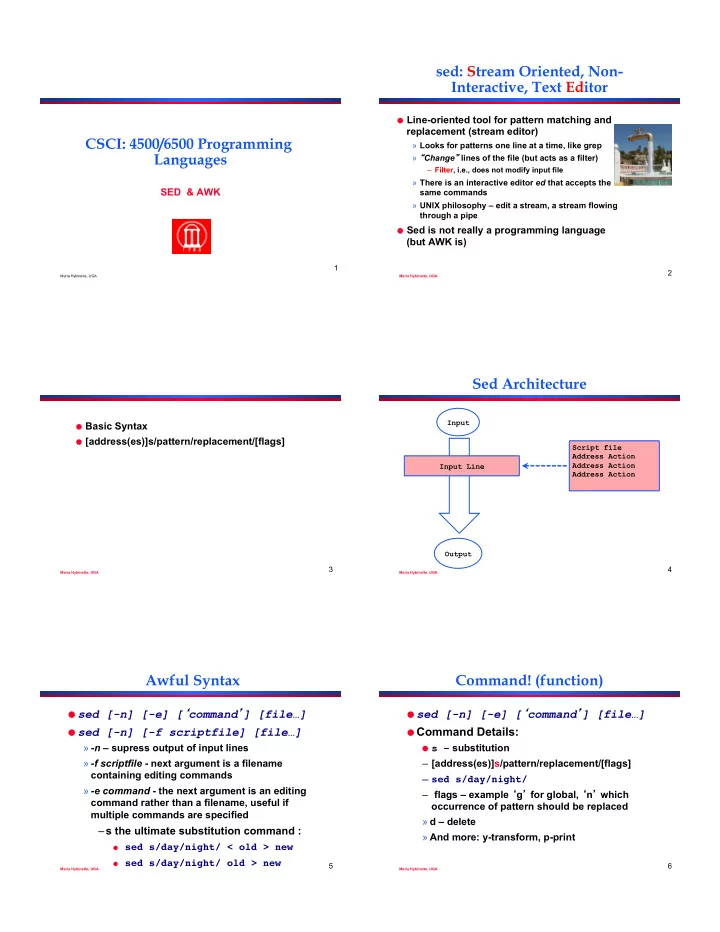
sed: Stream Oriented, Non- Interactive, Text Editor ! Line-oriented tool for pattern matching and replacement (stream editor) CSCI: 4500/6500 Programming Looks for patterns one line at a time, like grep Languages Change lines of


slide-1
SLIDE 1

Maria Hybinette, UGA

1

CSCI: 4500/6500 Programming Languages

SED & AWK

Maria Hybinette, UGA

2

sed: Stream Oriented, Non- Interactive, Text Editor

! Line-oriented tool for pattern matching and

replacement (stream editor)

» Looks for patterns one line at a time, like grep » “Change” lines of the file (but acts as a filter)

– Filter, i.e., does not modify input file

» There is an interactive editor ed that accepts the same commands » UNIX philosophy – edit a stream, a stream flowing through a pipe

! Sed is not really a programming language

(but AWK is)

Maria Hybinette, UGA

3 ! Basic Syntax ! [address(es)]s/pattern/replacement/[flags]

Maria Hybinette, UGA

4

Sed Architecture

Input Output Input Line Script file Address Action Address Action Address Action

Maria Hybinette, UGA

5

Awful Syntax

! sed [-n] [-e] [‘command’] [file…] ! sed [-n] [-f scriptfile] [file…]

» -n – supress output of input lines » -f scriptfile - next argument is a filename containing editing commands » -e command - the next argument is an editing command rather than a filename, useful if multiple commands are specified

– s the ultimate substitution command :

! sed s/day/night/ < old > new ! sed s/day/night/ old > new

Maria Hybinette, UGA

6

Command! (function)

! sed [-n] [-e] [‘command’] [file…] ! Command Details:

! s – substitution

– [address(es)]s/pattern/replacement/[flags] – sed s/day/night/ – flags – example ‘g’ for global, ‘n’ which

  • ccurrence of pattern should be replaced

» d – delete » And more: y-transform, p-print

slide-2
SLIDE 2

Maria Hybinette, UGA

7

More Warm-up Examples

! s/Tom/Dick/2

» Substitutes Dick for the second occurrence of Tom in the pattern space

! s/wood/plastic/p

» Substitutes plastic for the first occurrence of wood and outputs (prints) pattern space

Maria Hybinette, UGA

8

Constraining matches by addressing

! Commands can be constrained to accept only

single line addresses or ranges of address (or a pattern).

Maria Hybinette, UGA

9

! Diving In Example: » echo “The UNIX operating system” | sed 's/.NI./wonderful &/’

! Ouch!

» Special replacement/patterns – characters » & - replaced by the entire string matched in the regular expression for pattern

Maria Hybinette, UGA

10

Another Example

! sed [-n] [-e] [‘command’] [file…] ! Escape : \ ! . On character {saffron} cat first.txt first:second

  • ne:two

{saffron} sed 's/\(.*\):\(.*\)/\2:\1/' test1

Maria Hybinette, UGA

11

Another Example

! sed [-n] [-e] [‘command’] [file…] ! Escape, ! Marking patterns (up to 9): “\(“, \)” {saffron} cat test1.txt first:second

  • ne:two

{saffron} sed 's/\(.*\):\(.*\)/\2:\1/' test1 second:first two:one

Maria Hybinette, UGA

12

Address Example

! Address:

» delete lines 1-10: sed -e ' sed -e '1,10 1,10d‘

{h70-33-107-14:ingrid:919} sed -e ‘5,14d' afile.txt 1 2 3 4 {h70-33-107-14:ingrid:920}

slide-3
SLIDE 3

Maria Hybinette, UGA

13

More examples

! Convert unix to dos characters.

» sed -e 's/$/\r/' myunix.txt > mydos.txt sed -e 's/$/\r/' myunix.txt > mydos.txt

! Transform with y (by character position)

! echo

echo “maria hybinette maria hybinette” | sed -e | sed -e ’y/aie/xyz/ y/aie/xyz/’ ! s/Tom/Dick/2

» Substitutes Dick for the second occurrence of Tom in the pattern space

! s/wood/plastic/p

» Substitutes plastic for the first occurrence of wood and

  • utputs (prints) pattern space

Maria Hybinette, UGA

14

Append, Insert, and Change

Syntax for these commands is a little strange because they must be specified

  • n multiple lines

! append

[address]a\

text

! insert

[address]i\ text

! change

[address(es)]c\ text

! append/insert for single lines only, not

range

Maria Hybinette, UGA

15

Change Examples

! Remove mail headers,

ie; the address specifies a range of lines beginning with a line that begins with From until the first blank line.

» The first example replaces all lines with a single occurrence of <Mail Header Removed>. » The second example replaces each line with <Mail Header Removed> /^From: /,/^$/c\ <Mail Headers Removed> /^From: /,/^$/{ s/^From //p c\ <Mail Header Removed> }

Maria Hybinette, UGA

16

Sed Advantages

! Regular expressions ! Fast ! Concise

Maria Hybinette, UGA

17

Sed Drawbacks

! Hard to remember text from one line to

another

! Not possible to go backward in the file ! No way to do forward references

like /..../+1

! No facilities to manipulate numbers ! Cumbersome syntax

Maria Hybinette, UGA

18

Awk

Programmable Filters

slide-4
SLIDE 4

Maria Hybinette, UGA

19 Aho Weinberger Kernighan

Why is it called AWK?

Maria Hybinette, UGA

20

Awk Introduction

! A general purpose programmable filter that

handles text (strings) as easily as numbers

» This makes awk one of the most powerful of the Unix utilities

! awk processes fields while sed only processes

lines

! nawk (new awk) is the new standard for awk

» Designed to facilitate large awk programs » gawk is a free nawk clone from GNU

Maria Hybinette, UGA

21

Awk Input

! awk gets its input from

» files » redirection and pipes » directly from standard input

Maria Hybinette, UGA

22

AWK Highlights

! A programming language for handling

common data manipulation tasks with only a few lines of code

! awk is a pattern-action language, like sed ! Looks like C but automatically handles

input, field splitting, initialization, and memory management

» Built-in string and number data types » No variable type declarations

! awk is a great prototyping language

» Start with a few lines and keep adding until it does what you want

Maria Hybinette, UGA

23

Awk Features over Sed

! Convenient numeric processing ! Variables and control flow in the actions ! Convenient way of accessing fields within

lines

! Flexible printing ! Built-in arithmetic and string functions ! C-like syntax

Maria Hybinette, UGA

24 BEGIN {action} pattern {action} pattern {action} . . . pattern { action} END {action}

Structure of an AWK Program

! An optional BEGIN

segment

– For processing to execute prior to reading input ! pattern - action pairs – Processing for input data – For each pattern matched, the corresponding action is taken ! An optional END segment – Processing after end of input data

slide-5
SLIDE 5

Maria Hybinette, UGA

25

Review: What is AWK?

! Programming language used for manipulating

data and generating pretty reports.

» Job control too.

Maria Hybinette, UGA

26

Running an AWK Program

! There are several ways to run an Awk

program

» awk 'program' input_file(s)

– program and input files are provided as command-line arguments

» awk 'program'

– program is a command-line argument; input is taken from standard input (yes, awk is a filter!)

» awk -f program_file input_files

– program is read from a file

Maria Hybinette, UGA

27

Patterns and Actions

! Search a set of files for patterns. ! Perform specified actions upon lines or fields

that contain instances of patterns.

! Does not alter input files. ! Process one input line at a time ! So for this is similar to sed (except fields)

Maria Hybinette, UGA

28

Pattern-Action Structure

! Every program statement has to have a

pattern or an action or both

» Default pattern is to match all lines » Default action is to print current record ! Patterns are simply listed; » actions are enclosed in { } ! awk scans a sequence of input lines, or

records, one by one, searching for lines that match the pattern

» Meaning of match depends on the pattern

Maria Hybinette, UGA

29

Patterns

! A selector that determines whether action

is to be executed

! pattern can be:

» the special token BEGIN or END » regular expression (enclosed with //) » relational or string match expression » ! negates the match » arbitrary combination of the above using && ||

– /NYU/ matches if the string “NYU” is in the record – x > 0 matches if the condition is true – /NYU/ && (name == "UNIX Tools")

Maria Hybinette, UGA

30

BEGIN and END patterns

! BEGIN and END provide a way to gain control

before and after processing, for initialization and wrap-up.

» BEGIN: actions are performed before the first input line is read. » END: actions are done after the last input line has been processed.

slide-6
SLIDE 6

Maria Hybinette, UGA

31

Actions

! Action » list of one or more C like statements » arithmetic and string expressions and » assignments and multiple output streams. ! action is performed on every line that

matches pattern.

» If pattern is not provided, action is performed on every input

line » If action is not provided, all matching lines are sent to standard output.

Maria Hybinette, UGA

32

An Example

ls | awk ' BEGIN { print "List of html files:" } /\.html$/ { print } END { print "There you go!" } '

List of html files: index.html as1.html as2.html There you go!

Maria Hybinette, UGA

33

Awk examples

! Add up first column, print sum and average ! {s += $1 } ! END {print “sum is”, s, “average is”, s/NR} ! awk -f awkprogram awkfile

Maria Hybinette, UGA

34

Tutorials

! SED

» http://www.grymoire.com/Unix/Sed.html

– Great reference card available

» http://sed.sourceforge.net/grabbag/tutorials/

! AWK