sed: Stream Oriented, Non- Interactive, Text Editor Line-oriented - - PDF document

sed stream oriented non interactive text editor
SMART_READER_LITE
LIVE PREVIEW

sed: Stream Oriented, Non- Interactive, Text Editor Line-oriented - - PDF document

sed: Stream Oriented, Non- Interactive, Text Editor Line-oriented tool for pattern matching and CSCI: 4500/6500 Programming replacement (stream editor) Languages Looks for patterns one line at a time, like grep Change


slide-1
SLIDE 1

Maria Hybinette, UGA

1

CSCI: 4500/6500 Programming Languages

SED & AWK

Maria Hybinette, UGA

2

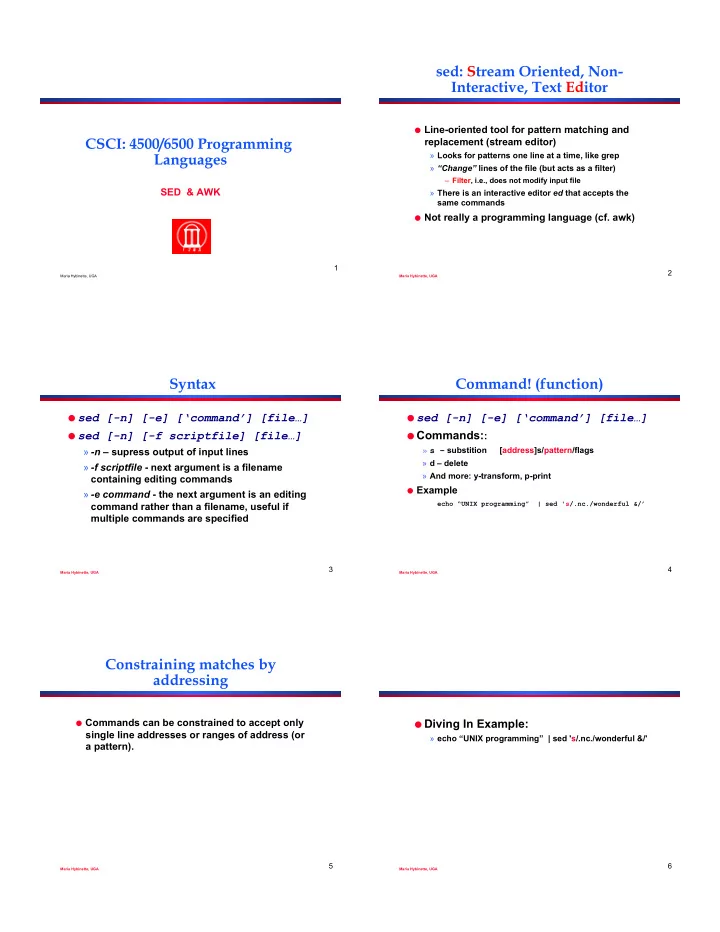
sed: Stream Oriented, Non- Interactive, Text Editor

Line-oriented tool for pattern matching and

replacement (stream editor)

» Looks for patterns one line at a time, like grep » “Change” lines of the file (but acts as a filter)

– Filter, i.e., does not modify input file

» There is an interactive editor ed that accepts the same commands

Not really a programming language (cf. awk)

Maria Hybinette, UGA

3

Syntax

sed [-n] [-e] [‘command’] [file…] sed [-n] [-f scriptfile] [file…]

»-n – supress output of input lines »-f scriptfile - next argument is a filename containing editing commands »-e command - the next argument is an editing command rather than a filename, useful if multiple commands are specified

Maria Hybinette, UGA

4

Command! (function)

sed [-n] [-e] [‘command’] [file…] Commands:: » s – substition [address]s/pattern/flags » d – delete » And more: y-transform, p-print

Example

echo “UNIX programming” | sed 's/.nc./wonderful &/’

Maria Hybinette, UGA

5

Constraining matches by addressing

Commands can be constrained to accept only

single line addresses or ranges of address (or a pattern).

Maria Hybinette, UGA

6

Diving In Example: » echo “UNIX programming” | sed 's/.nc./wonderful &/'

slide-2
SLIDE 2

Maria Hybinette, UGA

7

Another Example

sed [-n] [-e] [‘command’] [file…]\\ {saffron} cat test1.txt first:second

  • ne:two

{saffron} sed 's/\(.*\):\(.*\)/\2:\1/' test1

Maria Hybinette, UGA

8

Another Example

sed [-n] [-e] [‘command’] [file…]\\ {saffron} cat test1.txt first:second

  • ne:two

{saffron} sed 's/\(.*\):\(.*\)/\2:\1/' test1 second:first two:one

Maria Hybinette, UGA

9

Address Example

Address: delete lines 1-10: sed -e '

sed -e '1,10 1,10d‘ d‘

{h70-33-107-14:ingrid:919} sed -e ‘5,14d' afile.txt 1 2 3 4 {h70-33-107-14:ingrid:920}

Maria Hybinette, UGA

10

More examples

Convert unix to dos characters.

» sed -e 's/$/\r/' myunix.txt > mydos.txt sed -e 's/$/\r/' myunix.txt > mydos.txt!! !!

Transform (by character position)

echo “maria hybinette” | sed -e ’y/aie/xyz/’

echo “maria hybinette” | sed -e ’y/aie/xyz/’ s/Tom/Dick/2

» Substitutes Dick for the second occurrence of Tom in the pattern space

s/wood/plastic/p

» Substitutes plastic for the first occurrence of wood and

  • utputs (prints) pattern space!

Maria Hybinette, UGA

11

Append, Insert, and Change

Syntax for these commands is a little strange because they must be specified

  • n multiple lines

append

[address]a\

text

insert

[address]i\ text

change

[address(es)]c\ text

append/insert for single lines only, not

range

Maria Hybinette, UGA

12

Change Examples

Remove mail headers,

ie; the address specifies a range of lines beginning with a line that begins with From until the first blank line.

» The first example replaces all lines with a single occurrence of <Mail Header Removed>. » The second example replaces each line with <Mail Header Removed> /^From: /,/^$/c\ <Mail Headers Removed> /^From: /,/^$/{ s/^From //p c\ <Mail Header Removed> }

slide-3
SLIDE 3

Maria Hybinette, UGA

13

Sed Advantages

Regular expressions Fast Concise

Maria Hybinette, UGA

14

Sed Drawbacks

Hard to remember text from one line to

another

Not possible to go backward in the file No way to do forward references

like /..../+1

No facilities to manipulate numbers Cumbersome syntax

Maria Hybinette, UGA

15

Awk

Programmable Filters

Maria Hybinette, UGA

16 Aho Weinberger Kernighan

Why is it called AWK?

Maria Hybinette, UGA

17

Awk Introduction

A general purpose programmable filter that

handles text (strings) as easily as numbers

»This makes awk one of the most powerful of the Unix utilities

awk processes fields while sed only processes

lines

nawk (new awk) is the new standard for awk

»Designed to facilitate large awk programs »gawk is a free nawk clone from GNU

Maria Hybinette, UGA

18

Awk Input

awk gets its input from

»files »redirection and pipes »directly from standard input

slide-4
SLIDE 4

Maria Hybinette, UGA

19

AWK Highlights

A programming language for handling

common data manipulation tasks with only a few lines of code

awk is a pattern-action language, like sed Looks like C but automatically handles

input, field splitting, initialization, and memory management

»Built-in string and number data types »No variable type declarations

awk is a great prototyping language

»Start with a few lines and keep adding until it does what you want

Maria Hybinette, UGA

20

Awk Features over Sed

Convenient numeric processing Variables and control flow in the actions Convenient way of accessing fields within

lines

Flexible printing Built-in arithmetic and string functions C-like syntax

Maria Hybinette, UGA

21 BEGIN {action} pattern {action} pattern {action} . . . pattern { action} END {action}

Structure of an AWK Program

An optional BEGIN

segment

– For processing to execute prior to reading input pattern - action pairs – Processing for input data – For each pattern matched, the corresponding action is taken An optional END segment – Processing after end of input data

Maria Hybinette, UGA

22

Review: What is AWK?

Programming language used for manipulating

data and generating pretty reports.

» Job control too.

Maria Hybinette, UGA

23

Running an AWK Program

There are several ways to run an Awk

program

»awk 'program' input_file(s)

– program and input files are provided as command-line arguments

»awk 'program'

– program is a command-line argument; input is taken from standard input (yes, awk is a filter!)

»awk -f program_file input_files

– program is read from a file

Maria Hybinette, UGA

24

Patterns and Actions

Search a set of files for patterns. Perform specified actions upon lines or fields

that contain instances of patterns.

Does not alter input files. Process one input line at a time This is similar to sed

slide-5
SLIDE 5

Maria Hybinette, UGA

25

Pattern-Action Structure

Every program statement has to have a

pattern or an action or both

» Default pattern is to match all lines » Default action is to print current record Patterns are simply listed; » actions are enclosed in { } awk scans a sequence of input lines, or

records, one by one, searching for lines that match the pattern

»Meaning of match depends on the pattern

Maria Hybinette, UGA

26

Patterns

Selector that determines whether action is

to be executed

pattern can be:

»the special token BEGIN or END »regular expression (enclosed with //) »relational or string match expression »! negates the match »arbitrary combination of the above using && ||

– /NYU/ matches if the string “NYU” is in the record – x > 0 matches if the condition is true – /NYU/ && (name == "UNIX Tools")

Maria Hybinette, UGA

27

BEGIN and END patterns

BEGIN and END provide a way to gain control

before and after processing, for initialization and wrap-up.

» BEGIN: actions are performed before the first input line is read. » END: actions are done after the last input line has been processed.

Maria Hybinette, UGA

28

Actions

Action » list of one or more C like statements » arithmetic and string expressions and » assignments and multiple output streams. action is performed on every line that

matches pattern.

»If pattern is not provided, action is performed on every input

line » If action is not provided, all matching lines are sent to standard output.

Maria Hybinette, UGA

29

An Example

ls | awk ' BEGIN { print "List of html files:" } /\.html$/ { print } END { print "There you go!" } '

List of html files: index.html as1.html as2.html There you go!

Maria Hybinette, UGA

30

Awk examples

Add up first column, print sum and average {s += $1 } END {print “sum is”, s, “average is”, s/NR} awk -f awkprogram awkfile