SLIDE 1
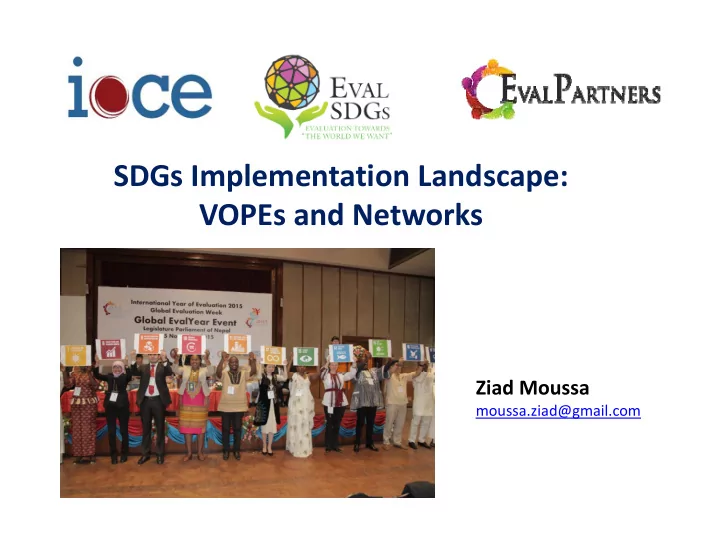
SDGs Implementation Landscape: VOPEs and Networks
Ziad Moussa
moussa.ziad@gmail.com
SLIDE 2
Trending influences in the SDGs debate: Rampant inequality
Staggering findings! The richest 1% of the world population captured twice the wealth created since 1980 than the poorest 50% of the population. The 49% in the middle (aka the middle class) saw its revenues stagnate or shrink (depending on the region) www.wid.world
SLIDE 3 Some implications of inequality
- 1. Return into favor of protectionism
SLIDE 4
SLIDE 5
- 2. The 4th Industrial Revolution
SLIDE 6
SLIDE 7
- 3. ODA is not anymore the single most important player
for developing countries
SLIDE 8
… and disaggregation is always enlightening
SLIDE 9
And then came Corona!
SLIDE 10
Lets now talk VOPEs
SLIDE 11
VOPEs = Voluntary Organizations for Professional Evaluation ‐ Keyword here is VOLUNTARY ‐ More than 130 national and 12 Regional VOPEs
SLIDE 12
- 2. Is membership in VOPEs open?
In principle yes! You can become a member of AEA in one click (and a credit card); it is context‐dependent elsewhere
SLIDE 13
- 3. What are the flagship activities of VOPEs?
‐ Conferences ‐ Capacity Development Activities ‐ Journals (especially the regional ones) ‐ Research & collaborations ‐ Etc….
SLIDE 14
‐ Tremendous human capital ‐ Finances always an issue ‐ Rarely support staff ‐ Very difficult to harness financing for evaluation capacity development
SLIDE 15
- 5. What is the natural “habitat” of VOPEs
National/regional/international evaluation ecosystem ‐ Evaluators ‐ Commissioners ‐ Academia ‐ Civil Society ‐ Government ‐ Parliamentarians ‐ Etc…
SLIDE 16 Individual Level
(skills, knowledge, experience)
Institutional Level
(policies, procedures, frameworks)
Enabling Environment
(policies, legislation, power relations, social norms)
A Systemic approach to National Evaluation Capacity Development
Demand Supply
- Tailored to the specific context of each country
- Country leadership and ownership
SLIDE 17
Putting the work of VOPEs in the context of the SDGs
Evaluations is:
Partly a social exercise Partly a political exercise Partly a technical exercise
The SDGs somehow reflect these 3 dimensions. VOPEs tend to focus on the technical part, but still
shy away particularly from the political part.
SLIDE 18
SDGs are the results of a global political consensus…
The 2030 Agenda emphasises a “robust, voluntary, effective, participatory, transparent and integrated follow‐up and review framework”. For the first time ever the evaluation profession has had such a high profile in a global level agreement.
SLIDE 19
Fresh from the press
Key word in successful SDG evaluation experiences is PARTNERSHIPS (in addition to political will, etc…) Personally, I think that the best entry point for VOPEs to the SDGs arena is by building partnerships and advocating for National Evaluation Capacity.
SLIDE 20
So lets DIALOGUE!
SLIDE 21 Five Take‐Away Messages
- 1. Think beyond individual policies, programmes and projects. The
integrated, interconnected nature of development means that the value of evaluating single interventions may be limited. Determining whether a set of policies or strategies work together sufficiently to address the root causes of a particular social problem bears higher value from an SDG perspective
- 2. Examine macro forces influencing success and failure. Evaluation
agendas must carefully consider political, economic, ideological, environmental, socio‐cultural and technological circumstances that affect the success or failure of a policy, strategy or program.
- 3. Take into account multiple definitions and measures of
‘success’. Even if an intervention or strategy achieves prescribed goals or targets, these could have been set unrealistically low (or high),
might have been developed without sufficient consideration of stakeholders’ perspectives on what ‘success’ looks like.
SLIDE 22 Five Take‐Away Messages
4. Recognize the importance of culture. The 2030 Agenda frequently refers to the importance of context in development. However, it fails to give the same recognition to culture. It is essential to prepare frameworks and toolkits that explain concepts, options and methods. Evaluators’ competencies in assessing cultural influences must also be strengthened.
- 5. Shift towards evaluative thinking and adaptive management.
Viewing development from a complex systems perspective requires a shift away from relying on ‘predict‐and‐act’ models. It also needs to develop capacities that can accommodate continuous cycles of experimentation, enable evidence‐informed learning, and adjust strategies and actions before too many resources have been wasted.
SLIDE 23
Thank You!