Literature for Landscape Management Inhalt 1. Landscape analyses, - - PDF document

literature for landscape management
SMART_READER_LITE
LIVE PREVIEW

Literature for Landscape Management Inhalt 1. Landscape analyses, - - PDF document

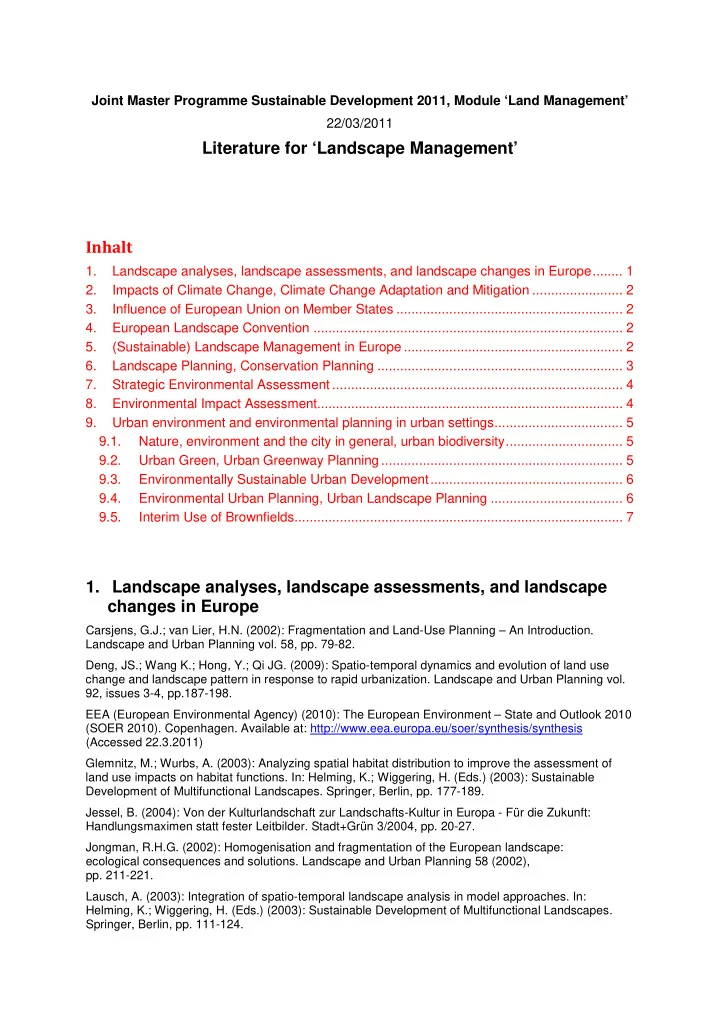
Joint Master Programme Sustainable Development 2011, Module Land Management 22/03/2011 Literature for Landscape Management Inhalt 1. Landscape analyses, landscape assessments, and landscape changes in Europe ........ 1 2. Impacts


slide-1
SLIDE 1

Joint Master Programme Sustainable Development 2011, Module ‘Land Management’ 22/03/2011

Literature for ‘Landscape Management’ Inhalt

1. Landscape analyses, landscape assessments, and landscape changes in Europe ........ 1 2. Impacts of Climate Change, Climate Change Adaptation and Mitigation ........................ 2 3. Influence of European Union on Member States ............................................................ 2 4. European Landscape Convention .................................................................................. 2 5. (Sustainable) Landscape Management in Europe .......................................................... 2 6. Landscape Planning, Conservation Planning ................................................................. 3 7. Strategic Environmental Assessment ............................................................................. 4 8. Environmental Impact Assessment ................................................................................. 4 9. Urban environment and environmental planning in urban settings .................................. 5 9.1. Nature, environment and the city in general, urban biodiversity ............................... 5 9.2. Urban Green, Urban Greenway Planning ................................................................ 5 9.3. Environmentally Sustainable Urban Development ................................................... 6 9.4. Environmental Urban Planning, Urban Landscape Planning ................................... 6 9.5. Interim Use of Brownfields ....................................................................................... 7

  • 1. Landscape analyses, landscape assessments, and landscape

changes in Europe

Carsjens, G.J.; van Lier, H.N. (2002): Fragmentation and Land-Use Planning – An Introduction. Landscape and Urban Planning vol. 58, pp. 79-82. Deng, JS.; Wang K.; Hong, Y.; Qi JG. (2009): Spatio-temporal dynamics and evolution of land use change and landscape pattern in response to rapid urbanization. Landscape and Urban Planning vol. 92, issues 3-4, pp.187-198. EEA (European Environmental Agency) (2010): The European Environment – State and Outlook 2010 (SOER 2010). Copenhagen. Available at: http://www.eea.europa.eu/soer/synthesis/synthesis (Accessed 22.3.2011) Glemnitz, M.; Wurbs, A. (2003): Analyzing spatial habitat distribution to improve the assessment of land use impacts on habitat functions. In: Helming, K.; Wiggering, H. (Eds.) (2003): Sustainable Development of Multifunctional Landscapes. Springer, Berlin, pp. 177-189. Jessel, B. (2004): Von der Kulturlandschaft zur Landschafts-Kultur in Europa - Für die Zukunft: Handlungsmaximen statt fester Leitbilder. Stadt+Grün 3/2004, pp. 20-27. Jongman, R.H.G. (2002): Homogenisation and fragmentation of the European landscape: ecological consequences and solutions. Landscape and Urban Planning 58 (2002),

  • pp. 211-221.

Lausch, A. (2003): Integration of spatio-temporal landscape analysis in model approaches. In: Helming, K.; Wiggering, H. (Eds.) (2003): Sustainable Development of Multifunctional Landscapes. Springer, Berlin, pp. 111-124.

slide-2
SLIDE 2

Mander, Ü.; Koduvere, E. (2003): Pressure, state and response indicators in landscape assessment: An attempt on nitrogen fluxes. In: Helming, K.; Wiggering, H. (Eds.) (2003): Sustainable Development

  • f Multifunctional Landscapes. Springer, Berlin, pp. 157-176.

Taylor, P.D. (2002): Fragmentation and cultural landscapes: tightening the relationship between human beings and the environment. Landscape and Urban Planning 58 (2002), pp. 93-99. Wiggering, H.; Müller, K.; Werner, A.; Helming, K. (2003): The concept of multifunctionality in sustainable land development. In: Helming, K.; Wiggering, H. (Eds.) (2003): Sustainable Development

  • f Multifunctional Landscapes. Springer, Berlin, pp. 3-18.

Yeh, CT.; Huang, SL. (2010): Investigating spatio-temporal patterns of landscape diversity in response to urbanization. Landscape and Urban Planning vol. 93, issues 3-4, pp. 151-162.

  • 2. Impacts of Climate Change, Climate Change Adaptation and

Mitigation

Bruse, M. (2003): Stadtgrün und Stadtklima. Wie sich Grünflächen auf das Mikroklima in Städten

  • auswirkungen. In: LÖDF-Mitteilungen, nr. 1, pp. 66-70. Available at: http://envi-

met.de/documents/papers/66_70_Bruse_pdf.pdf. (Accessed 14.3.2011) Meyer, B.C.; Rannow, S.; Loibl, W. (2010): Climate change and spatial planning. Landscape and Urban Planning vol. 98, issue 1, pp. 1-74. Rannow, S.; Loibl, W.; Greiving, S.; Gruehn, D.; Meyer, B. (2010): Potential impacts of climate change in Germany – Identifying regional priorities for adaptation activities in spatial planning. Landscape and Urban Planning vol. 98, issue 1, pp. 160-171. Ward Thompson, C. (2010): Linking landscape and health: The recurring theme. Landscape and Urban Planning vol. 99, issue 3-4, pp. 187-195.

  • 3. Influence of European Union on Member States

ARL (Academy For Spatial Research And Planning) (2008): The Territorial Cohesion Principles. Position paper to the EU Green Paper on Territorial Cohesion. Position paper from the ARL No. 78. Hannover.

  • 4. European Landscape Convention

Bruns, D. (2006): Die Europäische Landschaftskonvention - Bedarf es eines deutschen Sonderweges? Stadt und Grün 12/2006, pp. 14-19. Council of Europe (2000): European Landscape Convention, Florence, 20.X.2000, Council of Europe Treaty Series no. 176. Available at: http://conventions.coe.int/Treaty/Commun/QueVoulezVous.asp?NT=176&CL=ENG (Accessed 3.2.2011) Jessel, B. (2004): Von der Kulturlandschaft zur Landschafts-Kultur in Europa - Für die Zukunft: Handlungsmaximen statt fester Leitbilder. Stadt+Grün 3/2004, pp. 20-27.

  • 5. (Sustainable) Landscape Management in Europe

Antrop, M. (2006): Sustainable landscapes: contradiction, fiction or utopia? Landscape and Urban Planning, vol. 75, issues 3-4, pp. 187-197. Banski, J. (2003): Land management in Poland in a period of transformation. In: Helming, K.; Wiggering, H. (Eds.) (2003): Sustainable Development of Multifunctional Landscapes. Springer, Berlin,

  • pp. 217-228.

De Groot, R. (2006): Function-analysis and valuation as a tool to assess land use conflicts in planning for sustainable, multi-functional landscapes. Landscape and Urban Planning, vol. 75, issues 3-4, pp.175-186.

slide-3
SLIDE 3

Helming, K. (2003): Landscape Tomorrow: A Research Network for Sustainable Development of Multifunctional Landscapes – www.landscape-tomorrow.net. In: Helming, K.; Wiggering, H. (Eds.) (2003): Sustainable Development of Multifunctional Landscapes. Springer, Berlin, pp. 269-277. McHugh, M. (2003): A review of sustainable landscape management in the UK. In: Helming, K.; Wiggering, H. (Eds.) (2003): Sustainable Development of Multifunctional Landscapes. Springer, Berlin,

  • pp. 201-216.

Opdam, P.; Steingröver, E.; van Roij, S. (2006): Ecological networks: A spatial concept for multi-actor planning of sustainable landscapes. Landscape and Urban Planning, vol. 75, issues 3-4, pp. 322-332. Potschin, M.B.; Haines-Young, R.H. (2006): Landscapes and sustainability. Landscape and Urban Planning, vol. 75, issues 3-4, pp. 155-161. Potschin, M.B.; Haines-Young, R.H. (2006): “Rio+10, sustainability science and Landscape Ecology. Landscape and Urban Planning, vol. 75, issues 3-4, pp. 162-174. Wiggering, H.; Müller, K.; Werner, A.; Helming, K. (2003): The concept of multifunctionality in sustainable land development. In: Helming, K.; Wiggering, H. (Eds.) (2003): Sustainable Development

  • f Multifunctional Landscapes. Springer, Berlin, pp. 3-18.

Schanze, J. (2003): Sustainable development of European landscapes as a multidimensional environmental and societal issue. In: Helming, K.; Wiggering, H. (Eds.) (2003): Sustainable Development of Multifunctional Landscapes. Springer, Berlin, pp. 19-38.

  • 6. Landscape Planning, Conservation Planning

Ahern, J. (2002): Greenways as Strategic Landscape Planning: theory and application. Doctoral thesis Wageningen University & Research Centre. Wageningen, The Netherlands. Federal Agency for Nature Conservation (Ed.) (2002): Landscape planning for sustainable municipal

  • development. Leipzig. Available at:

http://www.bfn.de/fileadmin/MDB/documents/themen/landschaftsplanung/lp_broschuere_nachhaltige_ engl.pdf (Accessed 10.3.2011) Federal Agency for Nature Conservation (Ed.) (2008): Landscape planning - The basis of sustainable landscape development. Leipzig. Available at: http://www.bfn.de/fileadmin/MDB/documents/themen/landschaftsplanung/landscape_planning_basis.p df (Accessed 10.3.2011) Gordon, A.; Simondson, D.; White, M.; Moilanen, A.; Bekessy, S.A. (2009): Integrating conservation planning and land-use planning in urban landscapes. Landscape and Urban Planning, vo. 91, issue 4,

  • pp. 183-194.

Haaren, C.v. (2002): Landscape planning facing the challenge of the development of cultural

  • landscapes. Landscape and Urban Planning Volume 60, Issue 2, 30 July 2002, Pages 73-80.

Haaren, C. v. (Hrsg.) (2004): Landschaftsplanung, Ulmer UTB, Stuttgart. Jessel, B.; Tobias, K. (2002): Ökologisch orientierte Planung, Stuttgart. Lütz, M.; Bastian, O. (2002): Implementation of landscape planning and nature conservation in the agricultural landscape — a case study from Saxony. Agriculture, Ecosystems & Environment Volume 92, Issues 2-3, November 2002, Pages 159-170. Mönnecke, M. (2005): Landschaftsplanung. In: ARL (Hrsg.): Handwörterbuch der Raumordnung, Hannover, S. 587-594. Oppermann, B. (2008): Landschaftsplanung interaktiv! Folgerungen aus der wissenschaftlichen Begleitforschung zum Erprobungs- und Entwicklungsvorhaben "Interaktiver Landschaftsplan Königslutter am Elm“. Naturschutz und biologische Vielfalt H. 58. Münster. Pearson, R.G.;Dawson, T.P. (2005): Long-distance plant dispersal and habitat fragmentation: identifying conservation targets for spatial landscape planning under climate change. Biological Conservation Volume 123, Issue 3, June 2005, Pages 389-401. Schmid, W.A. (2001): The emerging role of visual resource assessment and visualisation in landscape planning in Switzerland. Landscape and Urban Planning Volume 54, Issues 1-4, 25 May 2001, Pages 213-221. Spannowsky, W.; Hofmeister A. (2007): Die Landschaftsplanung und ihr Beitrag für die räumliche

  • Planung. Heymann. Köln u.a.
slide-4
SLIDE 4

Sundell-Turner, N.M.; Rodewald, A.D. (2008): A comparison of landscape metrics for conservation

  • planning. Landscape and Urban Planning, vo. 86, issue 1, pp. 219-225.

Termorshuizen, J.W.; Opdam, P.; van den Brink, A. (2007): Incorporating ecological sustainability into landscape planning. Landscape and Urban Planning, vo. 79, issues 3-4, pp. 374-384. Tress, B.; Tress, G. ( ): Scenario visualisation for participatory landscape planning—a study from

  • Denmark. Landscape and Urban Planning Volume 64, Issue 3, 15 July 2003, Pages 161-178.

Van der Windt, H.J.; Swart, J.A.A.; Keulartz, J. (2007): Nature and landscape planning: Exploring the dynamics of valuation, the case of the Netherlands. Landscape and Urban Planning, vol. 79, issues 3- 4, pp. 218-228. Warren-Kretzschmar, B. (2007): Vrijlandt P.; Kerkstra, K. (1994): A strategy for ecological and urban development. In: Cook, E.A.; van Lier, H.N. (Eds.): Landscape Planning and Ecological Networks. ISOMUL Series 6F. Elsevier, Amsterdam, pp. 71-88. Leitfäden zur interaktiven Landschaftsplanung. Münster: BfN-Schr.-Vertrieb im Landwirtschaftsverlag, Leitfaden 8., Visualisierungen in der interaktiven Landschaftsplanung einsetzen ( + CD-ROM). Münster.

  • 7. Strategic Environmental Assessment
  • Environmental Impact Assessment Review (eiar; articles reviewed + journal ISI listet)

Journals

  • UVP-report (articles reviewed)

Arbter, K. (2007): Strategic Environmental Assessment and Sustainability Impact Assessment: two participatory assessment tools for sustainability. In: Schubert, U.; Störmer, E. (2007): Sustainable Development in Europe – Concepts, Evaluation and Applications. Edward Elgar, Cheltenham, UK, pp. 83-95. (comparison SEA # SIA) Dalal-Clayton, B.; Sadler, B. (2005): Strategic Environmental Assessment. A Sourcebook and Reference Guide to International Experience. Earthscan. London (overview, SEA in EU, Austria, Denmark, Finland, France, Germany, The Netherlands, Norway, UK; SEA in Countries in Transition; SEA in land use planning) Fischer, T.B. (2007): Theory and Practice of Strategic Environmental Assessment – Towards a more systematic approach. Earthscan. London. (Definiton of SEA, SEA processes, methods, techniques, EU-regulations, SEA in 11 countries: Bulgaria, Norway, Newly Independent States (NIS = former Soviet Republics) Jones, C.; Baker, M.; Carter, J.; Jay, M.; Short, M.; Wood, C. (eds.) (2005): Strategic Environmental Assessment and Land Use Planning - An International Evaluation. Earthscan. London. (SEA history, European SEA Directive, SEA process, SEA of land use plans (opportunities + constraints), Evaluation of SEA of Land Use Plans in Denmark, Germany, Hungary, Ireland, the Netherlands, Portugal, Sweden, UK) WEILAND, U. (2010): Strategic Environmental Assessment in Germany — Practice and open

  • questions. Environmental Impact Assessment Review Vol. 30 Issue 3, April 2010, pp. 211-217. Online

available at: http://dx.doi.org/10.1016/j.eiar.2009.08.010 WEILAND, U. (2009): SUP – Wo stehen wir sieben Jahre nach der Richtlinie? UVP-REPORT 23 · AUSGABE 1+2 | 2009, S. 39-46 Weiland, U. (1998): Strategische Umweltprüfung als Beitrag zu einer dauerhaft-umweltgerechten

  • Entwicklung. In: UVP-report 2+3/98, S. 74 – 76.
  • 8. Environmental Impact Assessment
  • Environmental Impact Assessment Review (EIAR; articles reviewed + journal ISI listet)

Journals

  • UVP-report (articles reviewed)

Cashmore, M. (2004): The role of science in environmental impact assessment: process and procedure versus purpose in the development of theory. Environmental Impact Assessment Review Volume 24, Issue 4, May 2004, Pages 403-426

slide-5
SLIDE 5

Jay, S.; Jones, C.; Slinn, P.; Wood, C. (2007): Environmental impact assessment: Retrospect and

  • prospect. Environmental Impact Assessment Review, Volume 27, Issue 4, May 2007, Pages 287-300.

Haapio, A.; Viitaniemi, P. (2008): A critical review of building environmental assessment tools. Environmental Impact Assessment Review, Volume 28, Issue 7, October 2008, Pages 469-482 Schmidt, M.; Glasson, J.; Emmelin, L.; Helbron, H. (eds.) (2008): Standards and Thresholds for Impact

  • Assessment. Environmental Protection in the European Union, Volume 3. Springer. Berlin, Heidelberg.

(German environmental law, environmental assessment in Ukraine, Sustainability indicators in Portugal, EIA quality management, indicators to assess efficiency of land consumption in Germany, critical loads and levels concept, standards for particulate matter, landscape protection in Poland, SIA for upper Elbe River Basin, Environmental quality objectives and environmental quality standards for SEA) Morris, P.; Theirvel, Riki (Eds.) (2003 ): Methods of Environmental Impact Assessment, 2nd edition, Spon Press, New York. Wood, C. (2003): Environmental Impact Assessment – A comparative review. 2nd edition, Pearson, Prentice Hall.

  • 9. Urban environment and environmental planning in urban settings

9.1. Nature, environment and the city in general, urban biodiversity

Benton-Short, L.; Short, J.R. (2008): Cities and Nature. Routledge Critical Introductions to Urbanism and the City. Routledge. London, New York. (history of environment in cities, hazards + disasters, urban ecology, water, air pollution garbage, environmental justice, SUD) Brand, P.; Thomas, M.J. (2005): Urban Environmentalism – Global Change and the mediation of local

  • conflict. Routledge. London, New York. (urbanization + environment, urban environmental agendas,

urban environmentalism in action (discourse, in Birmingham, participation in Lodz) Roberts, P.; Ravetz, J.; George, C. (2009): Environment and the City. Routledge. London, New York. (human urban environment, future city, eco-city, economic urban environment, lifestyle as social urban environment, methods and tools (monitoring, decision-making, environmental planning) Tratalos, J.; Fuller, R.A.; Warren, P.H.; Davies, R.G.; Gaston, K.J. (2007): Urban form, biodiversity potential and ecosystem services. Landscape and Urban Planning, vo. 83, issue 4, pp. 308-317. 9.2. Urban Green, Urban Greenway Planning Baum, F.; Palmer, C. (2002): ‚Opportunity structures’: urban landscape, social capital and health promotion in Australia. In: Health Promotion International, vol. 17, no. 4, pp. 351-361. online available http:/heapro.oxfordjournals.org/cgi/reprint/17/4/351.pdf (14.3.2011) Baycan-Levent, T.; Vreeker, R.; Nijkamp, P. (2009): A Multi-CriteriaEvaluation of Green Spaces in European Cities. In: European Urban and Regional Studies, vol. 16(2), pp. 193-213. Available at: http://eur.sagepub.com/content/16/2/193.full.pdf+html (Accessed 22.3.2011) Bruse, M. (2003): Stadtgrün und Stadtklima. Wie sich Grünflächen auf das Mikroklima in Städten

  • auswirkungen. In: LÖDF-Mitteilungen, nr. 1, pp. 66-70. Available at: http://envi-

met.de/documents/papers/66_70_Bruse_pdf.pdf. (Accessed 22.3.2011) Bryant, M.M. (2006): Urban landscape conservation and the role of ecological greenways at local and metropolitan scales. Landscape and Urban Planning, vol. 76, issues 1-4, pp. 23-44. Fábos, J.G.; Ryan, R.L. (2006): An introduction to greenway planning around the world. Landscape and Urban Planning, vol. 76, issues 1-4, pp. 1-6. Finke, R. (2009): Grünflächen und Gesundheit. Erkenntnisse über Zusammenhänge aus internationaler empirischer Forschung. In: Stadt+Grün, H. 2, pp. 27-32. Haaren, C.v.; Reich, M. (2006): The German way to greenways and habitat networks. Landscape and Urban Planning, vol. 76, issues 1-4, pp. 7-22. Körner, S. (2008): Grund und Gesundheit. Literaturstudie. Available at: http://www.die-gruene- stadt.de/documents/EndGruenundGesundheit.pdf (Accessed 14.3.2011). Maller, C.; Townsend, M.; Pryor, A.; Brown, P.; Leger St, L.; (2005): Healthy nature healthy people: ‘contact with nature’ as an upstream health promotion intervention for population. In: Health Promotion International, Vol. 21, nr. 1, pp. 45-54. Available at: http://heapro.oxfordjournals.org/cgi/reprint/21/1/45.pdf (22.3.2011)

slide-6
SLIDE 6

O’Brian, E.A. (2005): Trees and woodlands: nature’s health service. Available at: http://www.forestry.gov.uk/pdf/FR_twnhs_book.pdf/$FILE/FR_twnhs_book.pdf (Accessed 14.3.2011) Reid, W.V. (2005): Ecosystems and human well-being. Synthesis: a report of the Millennium Ecosystem Assessment. Washington, DC: Island Press. Ribeiro, L.; Barão, T. (2006): Greenways for recreation and maintenance of landscape quality: five case studies in Portugal. Landscape and Urban Planning, vol. 76, issues 1-4, pp. 79-97. Steidle-Schwahn, A.; Hoffmann, M. (2005): Erholung in öffentlichen Freiräumen. Kriterien für die Entwicklung und Erhaltung von Qualität. In: Stadt+Grün, H. 1 pp. 45-50. Toccolini, A.; Fumagalli, N.; Senes, G. (2006): Greenways planning in Italy: the Lambro River Valley Greenway System. Landscape and Urban Planning, vol. 76, issues 1-4, pp. 98-111. Turner, T. (2006): Greenway Planning in Britain: recent work and future plans. Landscape and Urban Planning, vol. 76, issues 1-4, pp. 240-251. Walmsley, A. (2006): Greenways: multiplying and diversifying in the 21st century. Landscape and Urban Planning, vol. 76, issues 1-4, pp. 252-290. WHO (2005): Ecosystems and human well-being. Health Synthesis. Millennium Ecosystem

  • Assessment. Available at: http://www.who.int/globalchange/ecosystems/ecosys.pdf (Accessed

22.3.2011) Ziman Scudo, K. (2006): The Greenways of Pavia: innovations in Italian landscape planning. Landscape and Urban Planning, vol. 76, issues 1-4, pp. 112-133.

9.3. Environmentally Sustainable Urban Development

Camagni, R.; Capello, R.; Nijkamp, P. (2001): Managing Sustainable Urban Environments. In: Paddison, R. (ed.) (2001): Handbook of Urban Studies. Sage Publications, London et al.; pp. 124-139. (externalities, urban sustainability, environmental problems, role of time - irreversibility) McGranahan, G.; Satterthwaite, D. (2002): The Environmental Dimensions of Sustainable Development for Cities. In: Geography, Vol. 87(3), pp. 213-226. Girardet, H. (1998): Sustainable Cities – A contradiction in terms? Source: Journal of the Scottish Association of Geography Teachers (1998) 27: 50-57. Reprint in: Pacione, M. (ed.) (2002): The City – Critical Concepts in the Social Sciences, Routledge, London and New York, pp. 595-610. (urban age, London’s footprint, metabolism of cities, environmental policies for sustainability) Haughton, G. (1999): Environmental Justice and the Sustainable city. In: Journal of Planning, Education and Research 18:233-243. Roseland, M. (1997): Dimensions of the Eco-city. Source: Cities (1997): 14(4): 197–202. Reprint in: Pacione, M. (ed.) (2002): The City – Critical Concepts in the Social Sciences, Routledge, London and New York, pp. 611-622. Saunders, P. (2001): Urban Ecology. In: Paddison, R. (ed.) (2001): Handbook of Urban Studies. Sage Publications, London et al.; pp. 36-51. (social evolution and biological reductionism, human ecology) Simon, D. (2007): Cities and global environmental change: exploring the links. The Geographical Journal, vol. 173, no. 1, pp. 75-79.

9.4. Environmental Urban Planning, Urban Landscape Planning

Beatley, T. (2003): “Green Urbanism and the Lessons of European Cities: ‘The Vision of Green Urbanism’ and ‘Creating Green and Sustainable Cities in the United States: Lessons from Europe’” from Green Urbanism: Learning from European Cities (2000). Reprint in: LeGates, R.T.; Stout, F. (2003): The City Reader, Third Edition. Routledge, London, New York: 399-408 (Central Park, E. Howard’s Garden City, Welwyn Garden City,Broadacre City) Cities Alliance (2007): Liveable Cities – The Benefits of Urban Environmental Planning, Washington, D.C. Available at: http://www.citiesalliance.org/index.html (Accessed 15.3.2011) (Verhältnis Stadt- Umwelt, Integration von Umweltaspekten in Planung, Bsp. für Umweltintegration: EcoCityPlanning EcoBudget, SEA etc.)

slide-7
SLIDE 7

Geneletti, D. (2008): Imcorporation biodiversity assets in spatial planning: Methodological proposal and development of a planning support system. Landscape and Urban Planning, vol. 84, issues 3-4,

  • pp. 252-265.

Matsuoka, R.H.; Kaplan, R. (2008): People needs in the urban landscape: Analysis of landscape and Urban Planning contributions. Landscape and Urban Planning vol. 84, issue 1, pp. 7-19. Rodiek, J. (2008): Protecting ecosystems and open spaces in urbanizing environments. Landscape and Urban Planning, vol. 84, issue 1, pp. 3-6.

9.5. Interim Use of Brownfields

Rall, E.L.; Haase, D. (2011): Creative intervention in a dynamic city: A sustainability assessment of an interim use strategy for brownfields in Leipzig, Germany. Landscape and Urban Planning, vol. 100, issue 3, pp. 189-201.