School&PBIS&Ignite&Session& - - PDF document

school amp pbis amp ignite amp session amp
SMART_READER_LITE
LIVE PREVIEW

School&PBIS&Ignite&Session& - - PDF document

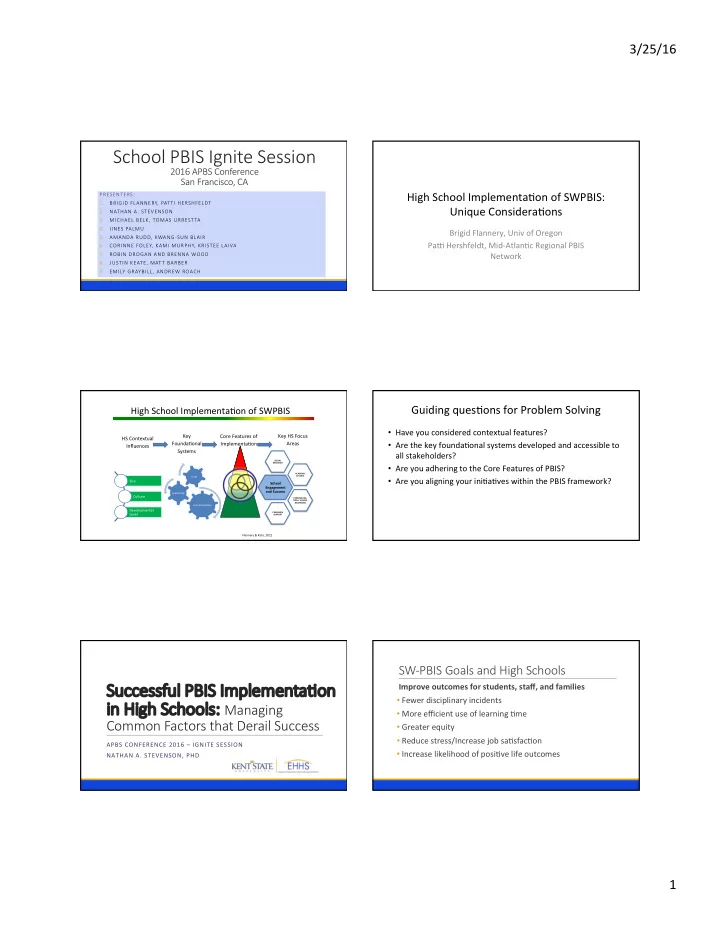
3/25/16' School&PBIS&Ignite&Session& 2016&APBS&Conference& San&Francisco,&CA High'School'Implementa7on'of'SWPBIS:'' PRESENTERS: 1. BRIGID&FLANNERY,&PATTI&HERSHFELDT Unique'Considera7ons' 2.


slide-1
SLIDE 1

3/25/16' 1'

School&PBIS&Ignite&Session&

2016&APBS&Conference& San&Francisco,&CA

PRESENTERS: 1. BRIGID&FLANNERY,&PATTI&HERSHFELDT 2. NATHAN&A.&STEVENSON 3. MICHAEL&BELK,&TOMAS&URRESTTA 4. IINES&PALMU 5. AMANDA&RUDD,&KWANGPSUN&BLAIR 6. CORINNE&FOLEY,&KAMI&MURPHY,&KRISTEE&LAIVA 7. ROBIN&DROGAN&AND&BRENNA&WOOD 8. JUSTIN&KEATE,&MATT&BARBER 9. EMILY&GRAYBILL,&ANDREW&ROACH

High'School'Implementa7on'of'SWPBIS:'' Unique'Considera7ons'

Brigid'Flannery,'Univ'of'Oregon' PaI'Hershfeldt,'MidKAtlan7c'Regional'PBIS' Network'

Core'Features'of' Implementa7on' Key'HS'Focus' Areas''

School& Engagement& and&Success&

SOCIAL& BEHAVIOR& ACADEMIC& SUCCESS& PERSONALIZA@ TION&/&SCHOOL& BELONGING& FRESHMEN& SUPPORT&

High'School'Implementa7on'of'SWPBIS'

HS'Contextual' Influences' Key' Founda7onal' Systems'

Size' Culture' Developmental' Level'

'' Communica7on '' Leadership ' ' Data Flannery'&'Kato,'2012'

Guiding'ques7ons'for'Problem'Solving''

  • Have'you'considered'contextual'features?'
  • Are'the'key'founda7onal'systems'developed'and'accessible'to'

all'stakeholders?''

  • Are'you'adhering'to'the'Core'Features'of'PBIS?'
  • Are'you'aligning'your'ini7a7ves'within'the'PBIS'framework?'

Suc Success ssful&PB ful&PBIS&I S&Imple mpleme mentaXo aXon& n& in&H in&High&Sc igh&Scho hools:& ls:&Managing&

Common&Factors&that&Derail&Success&

APBS'CONFERENCE'2016'–'IGNITE'SESSION' NATHAN'A.'STEVENSON,'PHD'

SWPPBIS&Goals&and&High&Schools

' Improve&outcomes&for&students,&staff,&and&families&

  • 'Fewer'disciplinary'incidents'
  • 'More'efficient'use'of'learning'7me'
  • 'Greater'equity'
  • 'Reduce'stress/Increase'job'sa7sfac7on'
  • 'Increase'likelihood'of'posi7ve'life'outcomes'
slide-2
SLIDE 2

3/25/16' 2'

5&RecommendaXons

1) Manage'expectaMons' 2) '' 3) '' 4) '' 5) ''

Behavior&change&in&children&and&adults

  • 'Long'term'behavior'change'is'gradual'and'recursive'–'oeen'

requires'progress'monitoring'and'reKteaching'

  • 'Equate'changing'behavior'prac7ces'to'changing'life'habits'(losing'

weight,'ea7ng'healthy,'quiIng'smoking'

  • 'Acknowledge'success'
  • 'Persist'when'setbacks'occur'

0' 10' 20' 30' 40' 50' 60' 70' 80' 0' 2' 4' 6' 8' 10' 12' 14'

Weekly'Progress'Monitoring'

5&RecommendaXons

1) Manage'expectaMons'carefully' 2) Acknowledge'differences& 3) '' 4) '' 5) ''

& ACKNOWLEDGE&DIFFERENCE

' '

Elementary& Secondary& Typical'course' structure' SelfKcontained' Mul7Kperiod/mul7Kteacher' Students'

≈30$per$class' ≈150$per$class'

Independence' Early'Learner' PreKadult' Reinforcers' s7ckers' parking'spot' Disposi7on' prep'for'next'year' prep'for'life'

RecommendaXons

1) Manage'expectaMons'carefully' 2) Acknowledge'differences& 3) Secure'support'of'building'leadership' 4) '' 5) ''

Securing&support&from&leadership

' Administra7on'–'Teacher'leaders'–'Office'staff'

  • 'If'you'don’t'have'a'PBIS'leadership'team,'get'one'
  • 'Develop'a'long'term'plan'
  • 'Document'success'
  • 'Protect'against'administrator'turnover'

(StricklandKCohen,'McIntosh,'&'Horner,'2014)'

slide-3
SLIDE 3

3/25/16' 3'

RecommendaXons

1) Manage'expectaMons'' 2) Acknowledge'differences& 3) Secure'support'of'building'leadership& 4) Ensure'fidelity& 5) ''

Fidelity

' SchoolKwide'behavioral'outcomes'are'not'likely'to'improve'un7l' fidelity'is'achieved'(e.g.'reduc7ons'in'ODRs).' ! 'Develop'and'teach'explicit'expecta7ons' ! 'Ensure'consequences'shape'behavior'posi7vely' ! 'Make'dataKbased'decisions' ! 'Principles'of'behavior'management'(ABC,'reinforcement,'etc.)' ! 'Check'fidelity'oeen'(TFI,'SAS,'SET,'etc.)'K'pbis.org;' pbisassessment.org'

RecommendaXons

1) Manage'expectaMons'carefully' 2) Acknowledge'differences& 3) Secure'support'of'building'leadership& 4) Ensure'fidelity& 5) Share'the'data&

Data

  • Share'data'every'2K4'weeks'
  • Ensure'you'include'trend'data'
  • Highlight'points'of'pride'
  • Don’t'hide'from'ugly'data'

Transparency'counts'

&5&RecommendaXons&–&mnemonic&

1) Manage'expectaMons'carefully' 2) Acknowledge'differences& 3) Secure'support'of'building'leadership& 4) Hold'fast'on'fidelity& 5) Share'the'data& ! Every&& ! Dad& ! Likes& ! Frosted& ! Doughnuts&

Thank&You!

' Nathan'A.'Stevenson,'Ph.D.' ' Assistant'Professor,'Special'Educa7on' ' Kent'State'University' ' 405'White'Hall' ' 150'Terrace'Drive' ' Kent,'OH'44242' ' nsteve15@kent.edu' ' '''''''@nsteve15'

slide-4
SLIDE 4

3/25/16' 4'

A HIGH SCHOOL’S TWO- YEAR JOURNEY IN IMPLEMENTING TIER ONE

SOUTH POINTE HIGH SCHOOL ROCK HILL, SOUTH CAROLINA MICHAEL BELK, ASSISTANT PRINCIPAL TOMAS URRESTTA, SPANISH TEACHER, DEPARTMENT CHAIR, PBIS TEAM MEMBER

A LITTLE BIT ABOUT OUR SCHOOL

  • ROCK HILL, SOUTH CAROLINA
  • SUBURB; SOUTH OF CHARLOTTE, NORTH

CAROLINA

  • URBAN AND RURAL SCHOOL
  • 1300 STUDENTS
  • 49% AFRICAN-AMERICAN
  • 46% WHITE
  • 2% HISPANIC
  • 2% TWO OR MORE RACES
  • 1% NATIVE AMERICAN
  • 50 % FREE OR REDUCED LUNCH STATUS

THE TOP TEN THINGS WE HAVE DONE TO IMPLEMENT TIER ONE

1.

SCHOOL-WIDE BANNERS OF EXPECTATIONS – THE SOUTH POINTE WAY! CLICK HERE TO VIEW OUR BANNERS OF EXPECTATIONS!

2.

RECOGNITION CARDS WITH TIERED INCENTIVES AND ANNOUNCMENTS/BULLETIN BOARD (START WITH THE POSITIVES!) CLICK HERE TO VIEW THE TIERED INCENTIVES

3.

I.C.E. COLD WINTER AND SPRING BASHES FOR ANY STUDENT IN THE 0-1 REFERRAL RANGE (FREE FOR ALL!) CLICK HERE TO VIEW A SPRING I.C.E. BASH FLYER

4.

SURVEY TO TEACHERS TO DISTINGUISH BETWEEN MINOR VERSUS MAJOR BEHAVIORS CLICK HERE TO VIEW THE GOOGLE SURVEY RESULTS

5.

CLASSROOM BEHAVIOR RUBRIC: DISTINGUISHING BETWEEN OFFICE MANAGED AND CLASSROOM MANAGED BEHAVIORS AND PROCEDURES FOR HANDLING CLASSROOM INCIDENTS CLICK HERE TO VIEW THE CLASSROOM BEHAVIOR RUBRIC

THE TOP TEN THINGS WE HAVE DONE TO IMPLEMENT TIER ONE

  • 6. WEEKLY VIDEOS AND DISCIPLINE DIRECTION IN OUR WEEKLY

NEWSLETTER (STALLION STAMPEDE)

  • 7. FOCUS ON DISCIPLINE DATA AND CELEBRATE SUCCESSES!
  • 8. THE SOUTH POINTE WAY FOR TEACHERS! WHAT DO TEACHERS

EXPECT OF THEIR PEERS WHEN IT COMES TO DEALING WITH THE DISCIPLINE OF STUDENTS?

  • 9. TIME! FOCUSING ON INSTRUCTIONAL COST: MORE ALTERNATIVES

FOR DISCIPLINE (DETENTIONS); ISS FOR OFFENDING BLOCK, LOOKING AT THE STUDENT HANDBOOK AND ENSURING IT MATCHES PHILOSOPHY!

  • 10. BUILDING RELATIONSHIPS! CAPACITY FOR BUILDING CULTURAL

PROFICIENCY! (EMPHASIS MOVING FORWARD)

HOW HAVE THE FOLLOWING STEPS IMPACTED OUR DISCIPLINE DATA?

CATEGORY 2012-2013 2013-2014 2014-2015 2015-2016 (FALL) TOTAL REFERRALS 4726 3999 2673 FALL: 1553 SPRING: 1123 1085 CUTTING CLASS 842 613 405 77-FALL CELL PHONE 536 787 328 149-FALL REFUSAL TO OBEY 371 334 212 108-FALL DISRUPTING CLASS 371 337 193 104-FALL CONFRONTA TIONS 49 71 82 49-FALL FIGHTING 61 51 40 17-FALL OSS 911 1140 608 204-FALL

HOW DOES THIS RELATE TO GRADUATION RATE, SLO’S, TIME

  • INSTRUCTIONAL COST:
  • 2012-2013: 1010 DAYS
  • 2013-2014: 1138 DAYS
  • 2014-2015: 947 DAYS
  • 2015-2016 (FALL): 233.6 DAYS; 429 DAYS AT END OF 3RD NINE

WEEKS

  • SLO’S (STUDENT LEARNING OBJECTIVES; NEW EVALUATION IN SOUTH

CAROLINA; MEASURING STUDENT GROWTH)

  • HIGH STAKES TEST RESULTS (END OF COURSE, ACT, WORK KEYS,

ETC)

  • GRADUATION RATE
slide-5
SLIDE 5

3/25/16' 5'

Iines Palmu 2016 24.3 APBS-conference San Francisco

The Hen or the Egg – Do Externalizing Behavior Problems Precede Academic Underachievement?

SW-PBIS since 2013

http://www.4eb.org.au/finnish

Competing models in previous research

  • 1. Underachievement

externalizing behavior

  • 2. Externalizing behavior

underachievement

  • 3. The relationship is reciprocal
  • 4. Underlying, antecedent variables result in both

problem domains

(Hinshaw, 1992)

" To examine the longitudinal relation between academic attainment and externalizing behavior problems (competing models) " During school transition to secondary school (grade 6th 7th) " Considering child- and family-related covariates " Mplus structural equation modeling program was used to test all cross-lagged models

The aim of the study Data

  • Data was collected 2010–2013
  • N=311(52% female)
  • 12–13-year-olds
  • Between grades: transition to

secondary school – new school new teachers

Measures

  • Externalizing behavior: Goodman’s (1997) Strengths &

Difficulties Questionnaire (SDQ), teacher ratings

  • Combined externalizing scale (
  • Separate conduct disorder (

and hyperactivity/ inattention ( scales

  • Academic performance: general grade point average

(

  • Child-related covariates: gender, special education

support status, standardized reading scores, standardized math test scores

  • Family-related covariates: maternal and paternal

education level, family form

slide-6
SLIDE 6

3/25/16' 6'

Baseline model

Palmu 2016

GPA 6 GPA 7 EXT 6 EXT 7 .70

  • .58
  • .40

.65

  • .13

Externalizing behavior in general predicts lower GPA.

Differences between externalizing subscales

32.

GPA 6 GPA 7 CD 6 CD 7 .78

  • .44
  • .29

.40

  • .18

32. Palmu 2016

GPA 6 GPA 7 H/I 6 H/I 7 .68

  • .60
  • .41

.66

  • .15

Conduct disorder. Hyperactivity/Inattention Low academic achievement predicts predicts lower GPA.

33. Palmu 2016

Conduct problems: child- and family- related covariates added to the model

GPA 6 GPA 7 CD 6 CD 7 .76

  • .36
  • .29

.39

When these covariates are controlled, there is no cross-lagged association!

Associated with: GPA 6: reading comprehension, SNE- status, math test score and gender, paternal education level CD 6: SNE-status, gender Maternal education level: reading comprehension and SNE-status

Hyperactivity/inattention: child- and family-related covariates added to the model

GPA 6 GPA 7 H/I 6 H/I 7 .63

  • .42
  • .35

.66

  • .23

When these covariates are controlled, the cross-lagged association strengthens!

Associated with: GPA 6: reading comprehension, SE-status, math, gender, paternal education level H/I 6: SNE-status, math, gender Maternal education level: SNE- status and reading comprehension

Results & Conclusions

  • Externalizing, especially H/I-type behavior, precedes

loss in academic performance over time

  • The stability of these problems
  • Subscales differ in relation to academic performance
  • These students are at risk for academic problems
  • Without interventions behavior problems may

escalate during secondary school, impact the student’s general academic achievement and future education

Conclusions

  • Research-based behavior assessment and support is needed in schools on

individual, group and school level

  • Especially H/I-group could benefit from more individual interventions

" Future research: gender differences in CD and H/I in relation to academic performance, school transition and behavior problems

slide-7
SLIDE 7

3/25/16' 7'

§

THANK YOU! KIITOS!

Implementation of the Bully Prevention in Positive Behavior Support (BP-PBS) Program in an Urban Elementary School

Amanda Rudd & Kwang-Sun Blair University of South Florida

Bullying

! Survey of 512 students in 2002

  • 52% of students knew someone who would be

considered a bully

  • 61% of students reported witnessing bullying at

least once per day ! Approximately 28% of students in the United

States have experienced bullying while in grades 6-12

! Approximately 70% of school staff have

reported to witness bulling by a young person in the school

Good, McIntosh & Gietz (2011) Facts About Bullying (2014)

BP-PBS

! Implemented within SWPBS system ! Focuses on decreasing bullying behavior and

teaching appropriate responses to bullying for victims, bystanders, and educators

! BP-PBS teaches students:

  • School-wide expectations and rules
  • Three-step response (Stop, Walk, and Talk)
  • Responding to three-step response

(Good et al., 2011; Ross & Horner, 2009; 2014)

Purpose of the Study

  • Further test the potential efficacy of BP-PBS intervention in

addressing bullying in a public elementary school implementing SWPBS

  • Examine the extent to which BP-PBS incorporated with FBA

can:

" Decrease bullying of students with peer attention maintained problem behavior " Increase active response to bullying and positive perceptions and attitudes on bullying in student victims

Method

! Participants

  • Six students (3 perpetrators and 3 victims) from three grades

4-5 classrooms

  • Local urban public elementary school
  • Recruited through teacher nomination

! Setting

  • Conducted at the elementary school
  • During normal school hours

" Classroom activities, specials, lunch

slide-8
SLIDE 8

3/25/16' 8'

Experimental Design and Procedures

! Multiple probe design across participants (Kazdin, 2011) ! Functional Behavior Assessment (FBA) ! Teacher and Student Training ! BP-PBS ! Follow-Up

Figure 1. Frequency of bullying across experimental phases, settings, and participants (perpetrators). Figure 2. Percentage of passive responding across experimental phases, settings, and participants (victims). **Blank data spaces = no opportunity** Figure 3. Percentage of intervals of active responding across experimental phases, settings, and participants (victims). **Blank data spaces = no opportunity**

Discussion

! FBA- function peer attention ! BP-PBS

  • Reduction in bullying behavior
  • Increase in appropriate responding
  • Increase feeling of safety/respect at school

! Teacher Fidelity ! Follow-Up

Positive, Predictable, But Not Entirely Routine: Early Childhood PBIS

Corinne Foley, Program Manager Kami Murphy, PBIS Coordinator Kristee Laiva, PBIS Specialist When you fish for love, bait with your heart, not your brain.

  • Mark Twain
slide-9
SLIDE 9

3/25/16' 9'

Phelan State Preschool Snowline JUSD

Universal Promotion Secondary Prevention Tertiary Intervention

Early Childhood PBIS Pyramid

Caring adults using evidence-based teaching practices

Key Steps of Early Childhood PBIS (EC-PBIS)

  • 1. Establish a PBIS Team
  • 2. Develop a brief statement of behavioral purpose
  • 3. Identify program-wide behavioral expectations
  • 4. Develop procedures for teaching behavioral

expectations

  • 5. Develop a continuum of procedures for encouraging

children's’ use of behavioral expectations

  • 6. Develop a continuum of procedures for discouraging

children's violations of behavioral expectations

  • 7. Develop data-based procedures for monitoring

implementation

Phelan Preschool Pilot

slide-10
SLIDE 10

3/25/16' 10'

Tools and Strategies for Positive Behavior

Tier 1 Implementation Pre-SET Results =90%

slide-11
SLIDE 11

3/25/16' 11'

SWIS and TIPS

(School Wide Information System and Team Initiated Problem Solving)

Tier 2 CICO

WHAT DO SECONDARY OR TARGETED SUPPORTS LOOK LIKE IN PRESCHOOL SETTINGS?

TIER 2 SUPPORTS APBS 2016 BY: ROBIN DROGAN AND BRENNA WOOD BLOOMSBURG UNIVERSITY OF PENNSYLVANIA AND LEHIGH UNIVERSITY

ESTABLISHING THE NEED

  • SIGNIFICANT NUMBER OF YOUNG CHILDREN PRESENTING

CHALLENGING BEHAVIORS IN PRESCHOOL SETTINGS

  • HIGHER RATES OF SUSPENSION/EXPULSION IN PRESCHOOL

COMPARED SCHOOL AGED SETTINGS

  • PROGRAM-WIDE PBIS HAS BEEN IDENTIFIED AS A EFFECTIVE

STRATEGY FOR ADDRESSING THESE CONCERNS

slide-12
SLIDE 12

3/25/16' 12'

INITIAL SEARCH OF THE LITERATURE….

  • STUDIES OF PROGRAM-WIDE PBIS AND UNIVERSAL SUPPORTS
  • STUDIES OF SOCIAL EMOTIONAL CURRICULA
  • (PATHS; DOMITROVICH, CORTES, & GREENBERG, 2007)
  • FEW STUDIES OF TIER 2 FOR STUDENTS WHO ARE UNRESPONSIVE

TARGETED SUPPORTS: DEFINITION

  • INCLUDE SOCIAL EMOTIONAL REGULATION STRATEGIES
  • FOR STUDENTS WHO NEED MORE INTENSIVE OR EXPLICIT INSTRUCTION
  • FOR STUDENTS WHO MAY BE AT RISK FOR EMOTIONAL AND BEHAVIORAL DISORDERS
  • FOR STUDENTS WHO HAVE NOT RESPONDED TO UNIVERSAL SUPPORTS

(BREDEKAMP & COPPLE, 1997; HEMMETER, OSTORSKY, & FOX, 2006; WEBSTER-STRATTON, 1999)

TARGETED SUPPORT: STRATEGIES

  • SOCIAL EMOTIONAL STRATEGIES
  • EMOTIONAL LITERACY
  • EMPATHY
  • FEELINGS
  • PROBLEM SOLVING
  • SELF REGULATION STRATEGIES
  • TURTLE TECHNIQUE WITH PROBLEM SOLVING
  • ENHANCING/INTENSIFIED STRATEGIES
  • PRIMING

TURTLE TECHNIQUE

  • TIER 2 INTERVENTION IMPLEMENTED WITHIN A PBIS PRESCHOOL
  • IMPLEMENTED IN 15-MINUTE SESSIONS WITH THE TEACHER
  • MODELED
  • ROLE PLAY
  • PROBLEM SOLVE
  • READ
  • RESULTS SHOWED REDUCTION IN BEHAVIOR FOR THREE STUDENTS
  • DIRECT OBSERVATION DID NOT SHOW UTILIZATION OF THE STRATEGY

(DROGAN & KERN, 2014)

PRIMING

  • INTENSIFIED STRATEGY WITHIN A PRESCHOOL IMPLEMENTING UNIVERSAL SUPPORTS
  • INTERVENTION CONSISTED OF 10-MINUTE SESSIONS REVIEWING ACADEMIC CONTENT OR

BEHAVIORAL EXPECTATIONS ALTERNATELY BY DAY

  • REVIEWED INFORMATION (EXPECTATIONS OR THEME/CONTENT)
  • QUESTIONED STUDENT ON INFORMATION
  • ADDED INFORMATION THAT MAY HAVE BEEN MISSED BY STUDENT;
  • PRAISED FOR APPROPRIATE RESPONSES
  • RESULTS SHOWED A REDUCTION IN OFF-TASK BEHAVIOR

AFTER BEHAVIORAL PRIMING SESSIONS

SUMMARY

  • WITH UNIVERSAL SUPPORTS IN PLACE, TARGETED SUPPORTS CAN PRESENT ADDITIVE POSITIVE

AFFECTS

  • CONSIDERING THE UNIQUE FEATURES OF EARLY CHILDHOOD PROGRAMS (E.G., AGE GROUP,

ENVIRONMENTS, & STAFF), MORE RESEARCH IS NEEDED.

  • MORE RESEARCH IN WHAT IS CURRENTLY BEING USED IN CLASSROOMS
  • NEED TO BROADEN THE ARRAY OF TOOLS OR STRATEGIES TO ADDRESS STUDENTS WHO ARE

UNRESPONSIVE

slide-13
SLIDE 13

3/25/16' 13'

THANK YOU! QUESTIONS?

ROBIN DROGAN; RDROGAN@BLOOMU.EDU BRENNA WOOD; BKW209@LEHIGH.EDU

Creating)a)School)Wide)Tier)1) and)Tier)2)PBIS)Support) System)

One School’s Story

Creating)the)Right)Culture)

O Culture eats

strategy for breakfast – Peter Drucker

Establishing)a)Strong)Culture)

O Commo

mmon V n Vision n

O What behavior attributes are most critical in

helping our students succeed?

1.

Students must resp respect ect themselves and others

2.

Students must demonstrate respons nsibili lity y

3.

Students must show personal int ntegrity y

Establishing)a)Strong)Culture) Establishing)a)Strong)Culture)

O Colle

llective C Commi mmitme ment nts

O What must we be willing to do to ensure

students develop these behavioral attributes?

1.

Explicitly teach these behaviors during our instruction

2.

Recognize and reward positive behavior

3.

Remediate negative behavior in a positive way

slide-14
SLIDE 14

3/25/16' 14'

Explicitly)Teach)Respect)Responsibility) and)Integrity) Recognize)and)Reinforce)Student) Behavior)

O 80% of Full-time faculty have

recognized a student this year.

O Over 1/3 of students recognized

1st semester

O 50.2% Female 49.8% male

Remediating)Negative)Behavior)in)a) Positive)Way)

O As our Tier 1 PBIS program assimilated into our

school culture we saw the need for a Tier 2 solution.

O How do we teach Respect, Responsibility, and

Integrity to those students who don’t know or understand these character attributes?

O How do we address those 10-15% of students at the

Tier 2 level in a positive way who need more behavior intervention?

PBIS)Tier)2)–)School)of)Life)

O The S

e School o

  • f L

Life F e Foundation™ is committed to the social, moral and character development of youth.

O We donate our workbook, Lea

earn T To " "School" Y Your Toughes est O Opponen ent™, and accompanying training program to schools. The book offers life-guiding principles and values to help youth achieve s e straight A' A's in t the s e school o

  • f l

life™ e™.

O Many of our partner schools are implementing the

School of Life program as Tier 2 of their Positive Behavior Interventions & Supports (PBIS IS)system to enhance their school culture.

School)of)Life)News)Report) 2015)

PBIS)Tier)2)–)School)of)Life))

O School of Life is an after school character ed program used

as a positive behavior intervention.

O Students who complete the class and log 10 hours of service

receive .25 elective credit.

O Offer your students something better than punitive

  • consequences. Teach them better!
slide-15
SLIDE 15

3/25/16' 15'

All)students)benefit)from)Character)Ed.) training!))

O Who attends School of Life class? O The training may be used as a positive consequence for:

O Attendance issues O Behavior issues O Alternative to suspension O Senior students who are off track for graduation O Student leadership O YIC, Juvenile Justice students O General Tier 2 PBIS needs

Results)

O Increase in graduation rates: O Of those Senior students who entered the School of Life program off track to graduate, 88% went on the complete graduation. O Desert Hills High School Graduation rate: O bef efore School of Life, 78% O after er 5 years of implementation, 96% O Advancement in Grade Level: O Of those underclassmen that were not on track to advance to the next grade at the end of the school year, 91% went on to complete advancement.

Results)

O Increase in GPA O Increase in GPA scores recorded by 63% of the students with the average improvement being 12%. O Increase in character life skills and behavior recorded by 94% of

the students with the top five areas as follows:

O Overall increased happiness O Disposition towards facing challenges O Disposition towards planning O Disposition towards peer pressure O Disposition towards school attendance

Contact)Information)

O De

Desert H Hills lls H High S h Scho hool l

O Justin Keate, Assistant Principal Justin.keate@washk12.org O Matt Barber, Teacher Development Coach

Matthew.barber@washk12.org

O Scho

hool o l of L Life F Found ndation n

O Website: Schooloflifefoundation.org O Jack Rolfe, CEO/Founder School of Life:

Jack@schooloflifefoundation.org

O Phone: 435-632-2947

Preparing'Schools'to'Conduct' Universal'Screening'for'Mental'Health'

Dr.'Emily'Graybill'&'Dr.'Andrew'Roach' Center'for'Leadership'in'Disability' Georgia'State'University' egraybill1@gsu.edu'' ' UNIVERSAL SCREENING FOR MENTAL HEALTH As increased federal funding is dedicated to the integration of school and community mental health services, educators are examining ways to identify youth who could benefit from school- based mental health services. Mental health screening is ONE way to identify these youth. SCREENING READINESS

  • Administrator buy-in
  • Teacher buy-in
  • Parent buy-in
  • Resource mapping/Gap analysis

'

slide-16
SLIDE 16

3/25/16' 16'

RESOURCE MAPPING A resource mapping process was done at the school level to identify the mental health supports provided by the school for youth with different levels of need. Each school answered the following question:

  • What resources are currently in place in
  • ur school?
  • How do students access the resources?
  • How many students have been served by

those resources?

Resource'Mapping'

Tier of Support Name of Program Contact Person Schedule Grade Level Eligibility How to Access # Served

Tier'1' Tier'2' Tier'3' GAP ANALYSIS The gap analysis of the resource mapping data suggested the following trends. 1. Schools that had implemented SW-PBIS for longer periods of time had more supports in place for youth with social/emotional and mental health challenges 2. All schools lacked a range supports for youth who needed targeted (tier 2) and individualized supports (tier 3) 3. None of the schools incorporated the use of a tier 1 social/ emotional learning curriculum

Example Programs Considered to fill Gaps in Resources'

Name of Program Type of Program Tier of Intervention No Place for Hate Bully Prevention Tier 1 Sources of Strength Suicide Prevention Curriculum Tier 1 Ending the Silence Mental Health Awareness & Stigma Reduction Tier 1 Second Step Social Emotional Learning; Bully Prevention Tier 1 Staff Training on Universal Screening Screening and Detection; Staff Awareness and Buy-In Tier 1 Internalizing Curriculum for Classroom Guidance Mental Health/Social Emotional Learning Tier 1 Youth Mental Health First Aid Mental Health Awareness & Stigma Reduction Tier 2 Passport to Manhood/Smart Girls Ladies of Distinction Mentoring Tier 2 Discuss Individual Student-Level Data Individualized Supports Tier 3 Georgia Association for Positive Behavior Support Positive Behavior Support Tiers 1, 2, & 3

Including strands specifically designed for our Mental Health, Juvenile Justice, and Family/Community Partners!

PBIS: Systems for Enhancing Climate & Culture

Donald Stephens Convention Center Rosemont, IL This two-day forum for school, state, district and regional Leadership Teams and other professionals has been designed to increase the effectiveness of PBIS implementation. Sessions are organized by strands that support initial through advanced implementation in elementary, middle, and high schools as well as juvenile justice facilities: PBIS Foundations Classroom Applications Tier 2 Systems & Practices Tier 3 Systems & Practices Aligning Systems Juvenile Justice Mental Health Integration Equity Applied Evaluation Special Topics Visit the Upcoming Events page at www.pbis.org for more information 2016 National PBIS Leadership Forum