PBIS Frequently Asked Questions www.pbis.org Version November 26 - - PDF document

pbis frequently asked questions
SMART_READER_LITE
LIVE PREVIEW

PBIS Frequently Asked Questions www.pbis.org Version November 26 - - PDF document

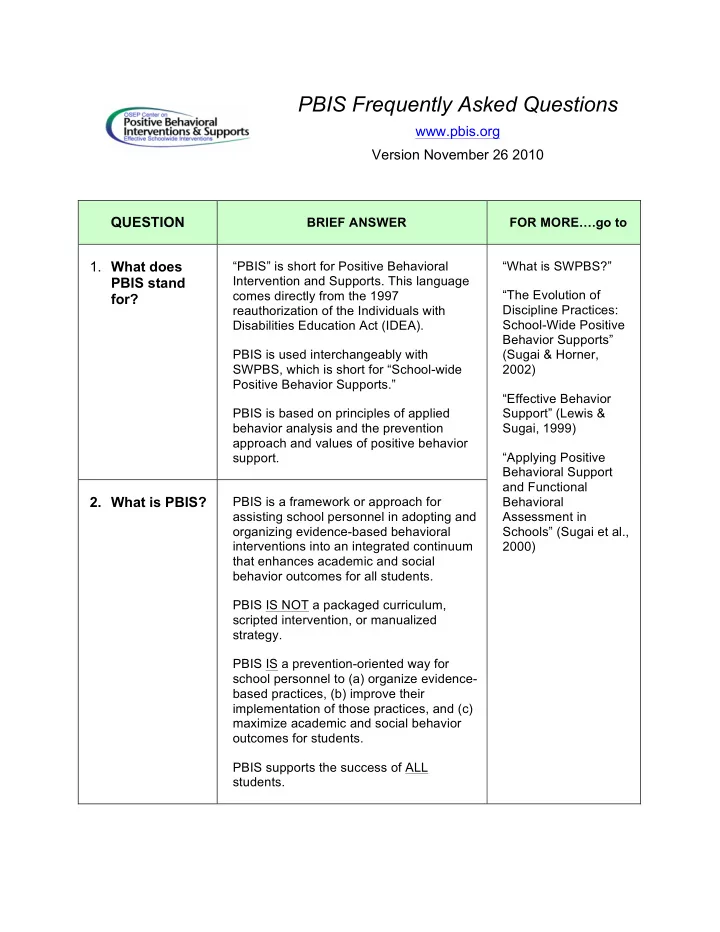
PBIS Frequently Asked Questions www.pbis.org Version November 26 2010 QUESTION BRIEF ANSWER FOR MORE .go to 1. What does PBIS is short for Positive Behavioral What is SWPBS? Intervention and Supports. This language PBIS stand


slide-1
SLIDE 1

PBIS Frequently Asked Questions

www.pbis.org Version November 26 2010 QUESTION

BRIEF ANSWER FOR MORE….go to

  • 1. What does

PBIS stand for?

“PBIS” is short for Positive Behavioral Intervention and Supports. This language comes directly from the 1997 reauthorization of the Individuals with Disabilities Education Act (IDEA). PBIS is used interchangeably with SWPBS, which is short for “School-wide Positive Behavior Supports.” PBIS is based on principles of applied behavior analysis and the prevention approach and values of positive behavior support. “What is SWPBS?” “The Evolution of Discipline Practices: School-Wide Positive Behavior Supports” (Sugai & Horner, 2002) “Effective Behavior Support” (Lewis & Sugai, 1999) “Applying Positive Behavioral Support and Functional Behavioral Assessment in Schools” (Sugai et al., 2000)

  • 2. What is PBIS?

PBIS is a framework or approach for assisting school personnel in adopting and

  • rganizing evidence-based behavioral

interventions into an integrated continuum that enhances academic and social behavior outcomes for all students. PBIS IS NOT a packaged curriculum, scripted intervention, or manualized strategy. PBIS IS a prevention-oriented way for school personnel to (a) organize evidence- based practices, (b) improve their implementation of those practices, and (c) maximize academic and social behavior

  • utcomes for students.

PBIS supports the success of ALL students.

slide-2
SLIDE 2
  • 3. What does the

OSEP Center

  • n PBIS do?

The primary functions of the Center on PBIS are to study, organize, and disseminate empirically-supported behavioral practices and interventions within the prevention-oriented framework

  • f PBIS systems. The Center mainly works

with school, district, and state leadership teams to improve the social culture and behavioral climate of classrooms and schools. www.pbis.org

  • 4. What are PBIS

“systems?”

PBIS emphasizes the establishment of

  • rganizational supports or systems that

give school personnel capacity to use effective interventions accurately and successfully at the school, district, and state levels. These supports include (a) team-based leadership, (b) data-based decision- making, (c) continuous monitoring of student behavior, (d) regular universal screening, and (e) effective on-going professional development. “SWPBS Implementation Blueprint and Self- Assessment” (PBIS Center, 2010) “SWPBS Professional Development Blueprint and Workbooks” (PBIS Center, 2010) “SWPBS Evaluation Blueprint” (PBIS Center, 2010) “Evidence-based Practices in Classroom Management: Considerations for Research to Practice” (Simonsen et al., 2008)

  • 5. What does

PBIS have to do with school discipline and classroom management?

Effective classroom management and preventive school discipline are essential for supporting teaching and learning. PBIS goes further by emphasizing that classroom management and preventive school discipline must be integrated and working together with effective academic instruction in a positive and safe school climate to maximize success for all students.

slide-3
SLIDE 3
  • 6. Where is the

best place for schools to access PBIS materials and information?

The Center is a great source for learning and obtaining information about PBIS, in particular, defining what PBIS is, what it looks like, how it can be established, what

  • utcomes are possible, etc. However,
  • ther sources (e.g., consultants,

publishers, universities, trainers) not formally associated with the Center also provide PBIS resources to schools. www.pbis.org

  • 7. How does the

Center include and involve family and community members?

The voices and perspectives of family and community members are involved directly in the PBIS process through active participation on, for example, leadership teams, practice implementation, and

  • utcome evaluations at the school, district,

and state levels. “SWPBS Implementation Blueprint and Self- Assessment” (PBIS Center, 2010)

  • 8. How is PBIS

related to “Response-to- Intervention” (RtI)?

The logic, tenets, and principles of PBIS are the same as those represented in RtI (e.g., universal screening, continuous progress monitoring, data-based decision making, implementation fidelity, evidence- based interventions). Literacy and numeracy implementation frameworks are examples of the application of RtI for academic behavior, and PBIS is an example of the application

  • f RtI for social behavior.

“Response-to- Intervention and PBIS” (PBIS Center, 2009)

  • 9. Does the

Center on PBIS endorse

  • r promote

commercial products, vendors, or businesses?

No, because of its federally directed mandate, purpose, and functions, the Center on PBIS identifies and recommends general research-based practices (e.g., active supervision, reinforcement, social skills instruction, behavioral contracting, self-management). Although these practices may be included within the products, curricula, etc. of other providers, the Center does not promote specific vendors or endorse commercial products. www.pbis.org

slide-4
SLIDE 4

10. How does PBIS respond to the use of punishment (e.g., detention, timeout, verbal reprimands), especially for students with serious problem behavior?

Although PBIS has no specific restrictions

  • n the use of consequence-based

strategies designed to reduce serious problem behavior, teaching-oriented, positive, and preventive strategies are emphasized for all students, to the greatest extent possible. The emphasis is on the use of the most effective and most positive approach to addressing even the most severe problem behaviors. Most students will succeed when a positive school culture is promoted, informative corrective feedback is provided, academic success is maximized, and use of prosocial skills is acknowledged. When student problem behavior is unresponsive to preventive school-wide and classroom-wide procedures, information about the student’s behavior is used to (a) understand why the problem behavior is occurring (function); (b) strengthen more acceptable alternative behaviors (social skills); (c) remove antecedents and consequences that trigger and maintain problem behavior, respectively; and (d) add antecedents and consequences that trigger and maintain acceptable alternative behaviors. ““Applying Positive Behavioral Support and Functional Behavioral Assessment in Schools” (Sugai et al., 2000)

slide-5
SLIDE 5

¡ 11. How does a school get training in PBIS?

An extensive PBIS network exists in connection with the National Center on

  • PBIS. Information about local and state

PBIS Coordinators and PBIS Center Partners can be found by going to “PBIS Network” at “Links” on the homepage of www.pbis.org. Regardless of information or training source, general guidelines for the selection

  • f a PBIS trainer and professional

development training are summarized in the “SWPBS Professional Development Blueprint.” To ensure a successful training experience, schools, districts, and states are encouraged to (a) use an existing or establish a new behavior leadership team, (b) examine their school data to define and specify the need, (c) secure an agreement from school staff (>80%) to move forward with PBIS, (d) confirm support and participation by school and district leadership, and (e) identify a person on the team who will facilitate or coach the implementation process. www.pbis.org “SWPBS Implementation Blueprint and Self- Assessment” (PBIS Center, 2010) “SWPBS Professional Development Blueprint and Workbooks” (PBIS Center, 2010) “SWPBS Evaluation Blueprint” (PBIS Center, 2010) “Evidence-based Practices in Classroom Management: Considerations for Research to Practice” (Simonsen et al., 2008)