Say: We did uniform pricing and price discrimination at individual - - PDF document

say we did uniform pricing and price discrimination at
SMART_READER_LITE
LIVE PREVIEW

Say: We did uniform pricing and price discrimination at individual - - PDF document

P1 SepOct 2012 Timothy Van Zandt Prices & Markets Page 1 Session 13 Imperfect competition Where are we? 1 Firms are price-takers Firms have market power (Perfect competition) (Imperfect competition) (Sessions 16)


slide-1
SLIDE 1

P1 Sep–Oct 2012 • Timothy Van Zandt • Prices & Markets Session 13 • Imperfect competition Page 1

1

Where are we?

(Sessions 1–6)

Firms are price-takers (Perfect competition) Firms have market power (Imperfect competition)

(Sessions 7–11)

Individual decisions

(Sessions 12–15)

Equilibrium

Say: We did uniform pricing and price discrimination at individual level, but we only bring uniform pricing to equilibrium.

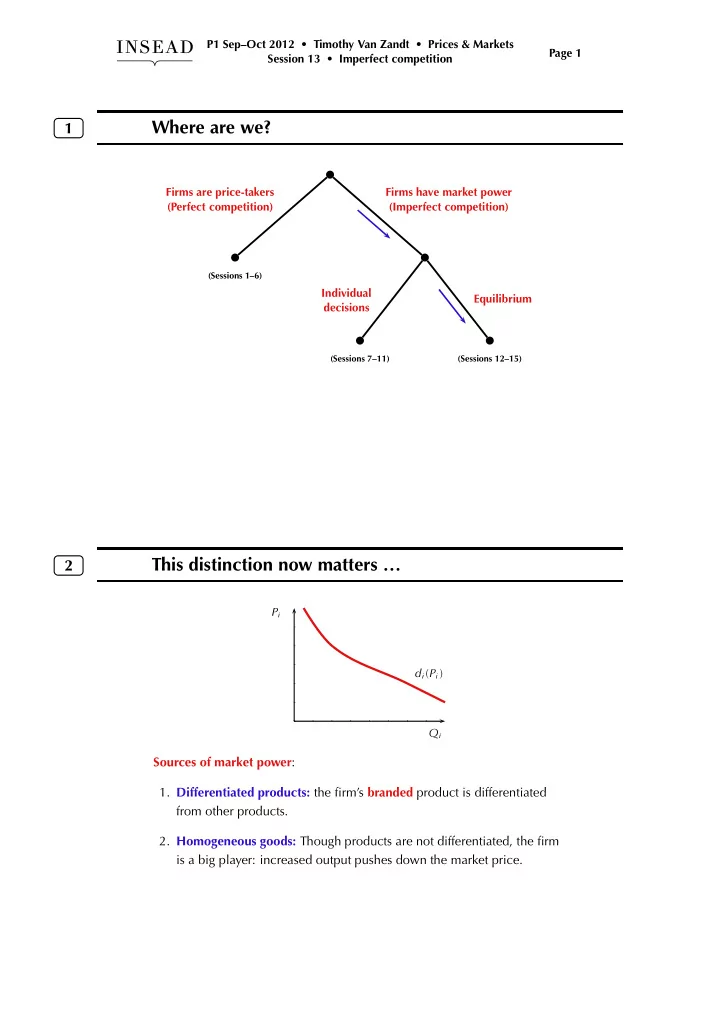
2

This distinction now matters …

Qi Pi di (Pi )

Sources of market power:

  • 1. Differentiated products: the firm’s branded product is differentiated

from other products.

  • 2. Homogeneous goods: Though products are not differentiated, the firm

is a big player: increased output pushes down the market price.

slide-2
SLIDE 2

P1 Sep–Oct 2012 • Timothy Van Zandt • Prices & Markets Session 13 • Imperfect competition Page 2

3

We begin with … Price competition with differentiated products

Recall the pricing game from Session 12:

Firm B Low Med High Low 19 20 18 25 10 31 Firm A Med 24 23 28 31 21 38 High 30 15 40 27 34 42

We extend this to a full range of prices.

4

Let’s use the same story

Recently appointed Recently appointed CEO of Firm A CEO of Firm B

slide-3
SLIDE 3

P1 Sep–Oct 2012 • Timothy Van Zandt • Prices & Markets Session 13 • Imperfect competition Page 3

5

Firm A’s pricing problem

6 12 18 24 30 36 −6 20 40 60 80 100

QA MRA dA MCA Q∗

A

P∗

A

This is “uniform pricing with market power”

(Sessions 8 and 9).

6

Nash equilibrium

6 12 18 24 30 36 −6 20 40 60 80 100

QA MRA dA MCA Q∗

A

P∗

A

6 12 18 24 30 36 −6 20 40 60 80 100

QB MRB dB MCB Q∗

B

P∗

B

slide-4
SLIDE 4

P1 Sep–Oct 2012 • Timothy Van Zandt • Prices & Markets Session 13 • Imperfect competition Page 4

7

Let’s use the numbers from Airbus-Boeing example

Demand functions: QA = 60 − 3PA + 2PB QB = 60 − 3PB + 2PA Both firms have constant MC = 12 .

8

Some best responses …

From the demand elasticity exercise

Firm A’s demand curve when PB = 24 and when PB = 30 :

PA QA

10 20 30 40 30 60 90 120

PB = 30 ⇒ QA = 120 − 3PA PB = 24 ⇒ QA = 108 − 3PA

slide-5
SLIDE 5

P1 Sep–Oct 2012 • Timothy Van Zandt • Prices & Markets Session 13 • Imperfect competition Page 5

9

In general: from Topic 9 on shifting demand …

Higher price by Firm B ⇒ Firm A’s demand curve shifts … Volume?

Higher

Elasticity?

Lower

⇒ Firm A’s profit-maximizing price goes

up

Thus, the pricing decisions are strategic

complements

10

So remember, with price competition …

When the goods are substitutes, the pricing decisions are strategic complements.

(Holds for linear demand, and usually in the real world.)

slide-6
SLIDE 6

P1 Sep–Oct 2012 • Timothy Van Zandt • Prices & Markets Session 13 • Imperfect competition Page 6

11 Firm A’s “residual” demand and best reply

QA = 60 − 3PA + 2PB Constant MC = 12

When Firm B charges PB , Firm A’s demand curve is:

QA = (60 + 2PB) − 3PA

⇒ Firm A’s choke price is:

20 + 2

3 PB

⇒ Firm A’s optimal price is:

20+ 2

3 PB+12

2

= 16 + 1

3 PB

Firm A’s reaction curve:

PA = 16 + 1

3 PB

12

Nash equilibrium

Prices (P∗

A, P∗ B) such that:

In words … As an equation … P∗

A is a best response by firm A to P∗ B

PA = 16 + 1

3 PB

P∗

B is a best response by firm B to P∗ A

PB = 16 + 1

3 PA

slide-7
SLIDE 7

P1 Sep–Oct 2012 • Timothy Van Zandt • Prices & Markets Session 13 • Imperfect competition Page 7

13

Illustrating Nash equilibrium graphically

5 10 15 20 25 30 35 40 45 50 55 5 10 15 20 25 30 35 40 45 50 55

PB PA PA = 16 + 1

3 PB

PB = 16 + 1

3 PA

14

Wrap up: Price competition with differentiated products

  • 1. Each firm’s decision is same as

“pricing with market power”: Topics 8&9.

  • 2. Goods are substitutes ⇒ prices are strategic complements.

(Always with linear demand; almost always in real life.)

  • 3. Interaction captured by Nash equilibrium.

Each firm’s price maximizes its own profit given price of the other firm.

slide-8
SLIDE 8

P1 Sep–Oct 2012 • Timothy Van Zandt • Prices & Markets Session 13 • Imperfect competition Page 8

15

Next we do … Quantity competition with homogeneous products

Also called Cournot competition

  • 1. Firms’ goods are perfect substitutes.
  • 2. So firm doesn’t set price; it chooses how much to sell.
  • 3. Market determines market-clearing price.
  • 4. But each firm’s output decision affects this price.

16

Corning and glass substrate

Corning has over 50% market share of glass substrate. There are different grades (“5G, 6G, …”), but for a particular grade the products of different suppliers are viewed as close substitutes. News item from December 2005 (for example): The aggressive capacity added by both Corning of the U.S., the world’s No. 1 substrate supplier, and AGC, the No. 2, will lead to price drops for glass substrates and will especially benefit TV panel makers …

slide-9
SLIDE 9

P1 Sep–Oct 2012 • Timothy Van Zandt • Prices & Markets Session 13 • Imperfect competition Page 9

17

Indonesian Cement Market

Three major players:

  • 45%: Semen Gresik

[State-owned]

  • 37%: Indocement

[Owned by HeidelbergCement since 2001]

  • 17%: Holcim Indonesia

[Owned by Holcim (Swiss) since 2006]

18

The protagonists

Indocement Semen Gresik

CEO of Indocement CEO of Semen Gresik

slide-10
SLIDE 10

P1 Sep–Oct 2012 • Timothy Van Zandt • Prices & Markets Session 13 • Imperfect competition Page 10

19

Nash equilibrium

6 12 18 24 30 36 −6 20 40 60 80 100

Q1 MR1 d1 MC1 Q∗

1

P∗

1

6 12 18 24 30 36 −6 20 40 60 80 100

Q2 MR2 d2 MC2 Q∗

2

P∗

2

20

Market demand curve vs. Indocement’s demand curve

MARKET DEMAND Q = 1500 − 50P

5 10 15 20 25 30 500 1000 1500

P Q

INDOCEMENT’S DEMAND When Qother = 500

5 10 15 20 25 30 500 1000 1500

P Qi

slide-11
SLIDE 11

P1 Sep–Oct 2012 • Timothy Van Zandt • Prices & Markets Session 13 • Imperfect competition Page 11

21

Indocement’s quantity decision (Constant MC = 10)

When Qother = 200

5 10 15 20 25 30 500 1000 1500

P Qi

When Qother = 500

5 10 15 20 25 30 500 1000 1500

P Qi

22

Nash equilibrium

200 400 600 800 1000 200 400 600 800 1000

Q2 Q1

slide-12
SLIDE 12

P1 Sep–Oct 2012 • Timothy Van Zandt • Prices & Markets Session 13 • Imperfect competition Page 12

23

Wrap up: Quantity competition with homogeneous goods

  • 1. Each firm’s output decision is same as

“pricing with market power”: Topics 8&9.

  • 2. Quantities are strategies substitutes.

(Always with linear demand; almost always in real life.)

  • 3. Use this model (rather than price competition)
  • for homogeneous products like oil, lycine, glass substrate,
  • to analyze investments in capacity.

24

Finally … Imperfect competition with exit/entry

slide-13
SLIDE 13

P1 Sep–Oct 2012 • Timothy Van Zandt • Prices & Markets Session 13 • Imperfect competition Page 13

25

Falafel vendors on the beach of Beirut

B e a c h

26

Numerical example: Cournot

See website for details, but you don’t have to be able to do this.

  • Market demand curve:

Q = 1500 − 50P

  • Constant MC = 10 .

Then I calculate the Nash equilibrium for any number N of firms.

slide-14
SLIDE 14

P1 Sep–Oct 2012 • Timothy Van Zandt • Prices & Markets Session 13 • Imperfect competition Page 14

27

Transition from monopoly to perfect competition

Number

  • f firms

Total Output Price Output per firm Profit per firm Q = 1500 - 50P || P = 30 - Q/50 1 500 20.00 500 5,000 2 667 16.67 333 2,222 3 750 15.00 250 1,250 4 800 14.00 200 800 5 833 13.33 167 556 6 857 12.86 143 408 7 875 12.50 125 313 8 889 12.22 111 247 9 900 12.00 100 200 10 909 11.82 91 165 11 917 11.67 83 139 12 923 11.54 77 118 13 929 11.43 71 102 14 933 11.33 67 89 15 938 11.25 63 78

28

So what happens if fixed costs are lower??

Lower fixed costs ⇒

slide-15
SLIDE 15

P1 Sep–Oct 2012 • Timothy Van Zandt • Prices & Markets Session 13 • Imperfect competition Page 15

29

Recall special case of “free entry”

All firms are identical, including unlimited pool of potential entrants. We focus on this case for simplicity. In reality, small or large differences between firms (competitive dis/advantage) determine who is in, and who is out.

30

How fixed cost affects entry and price

Number

  • f firms

Total Output Price Output per firm Profit per firm Q = 1500 - 50P || P = 30 - Q/50 1 500 20.00 500 5,000 2 667 16.67 333 2,222 3 750 15.00 250 1,250 4 800 14.00 200 800 5 833 13.33 167 556 6 857 12.86 143 408 7 875 12.50 125 313 8 889 12.22 111 247 9 900 12.00 100 200 10 909 11.82 91 165 11 917 11.67 83 139 12 923 11.54 77 118 13 929 11.43 71 102 14 933 11.33 67 89 15 938 11.25 63 78

FC 350 1000 N∗

6 3

P∗

12.86 15.00

slide-16
SLIDE 16

P1 Sep–Oct 2012 • Timothy Van Zandt • Prices & Markets Session 13 • Imperfect competition Page 16

31

Let’s try again, this time using insights from IC+FE

Q: Why do pharmaceutical companies charge so much for AIDS medicine? A: Because they have to recover R&D expenses.

Higher R&D expenses do lead to higher prices, but … Not because any firm takes them into account when setting prices. Instead, because the higher R&D expenses limit entry. The resulting lack of competition is what leads to higher prices.

32

Wrap up: Imperfect competition with free entry

  • 1. Entry has two effects on profit:
  • smaller market shares
  • greater competitive pressure on prices
  • 2. Higher FC ⇒ less entry ⇒ less intense competition ⇒ higher prices

(Even though no firm bases pricing on its fixed cost.)

slide-17
SLIDE 17

P1 Sep–Oct 2012 • Timothy Van Zandt • Prices & Markets Session 13 • Imperfect competition Page 17

33

What have we done today?

Firms are price-takers (Perfect competition) Individual decisions Equilibrium Firms have market power (Imperfect competition) Individual decisions Equilibrium

Price competition Quantity competition

  • Different firms’ goods are

substitutes or complements

  • Different firms’ goods are

perfect substitutes

  • Fixed set of firms

Entry and exit

34

What have we done today?

Price competition Quantity competition

  • Different firms’ goods are

substitutes or complements

  • Different firms’ goods are

perfect substitutes

  • Fixed set of firms

Calculations Main ideas Entry and exit Heuristic picture Interpret tables