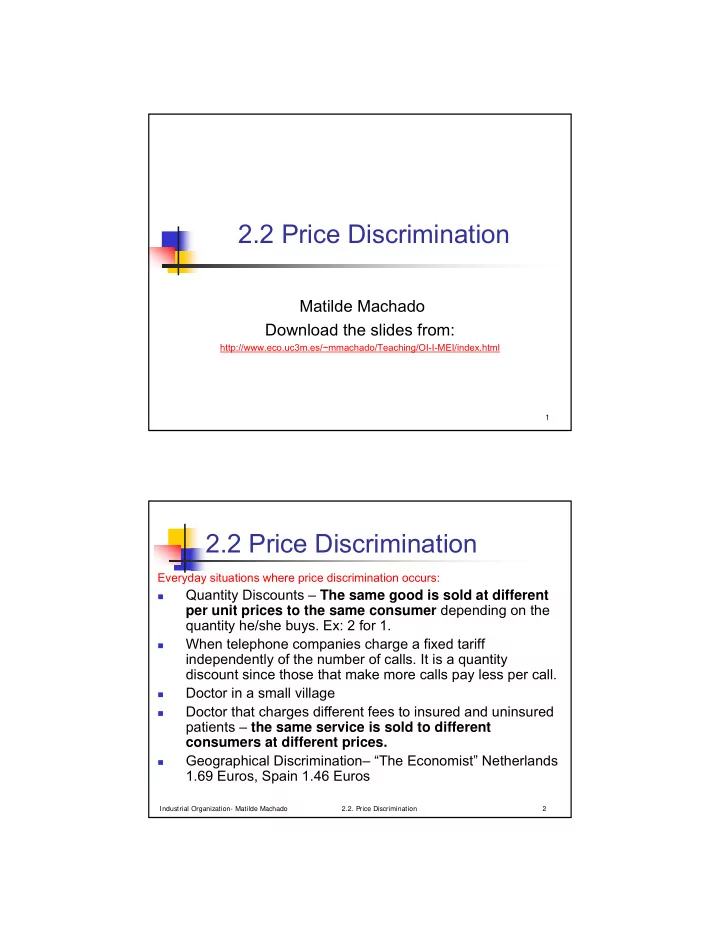
2.2 Price Discrimination Matilde Machado Download the slides from: - - PDF document

2 2 price discrimination
SMART_READER_LITE
LIVE PREVIEW

2.2 Price Discrimination Matilde Machado Download the slides from: - - PDF document

2.2 Price Discrimination Matilde Machado Download the slides from: http://www.eco.uc3m.es/~mmachado/Teaching/OI-I-MEI/index.html 1 2.2 Price Discrimination Everyday situations where price discrimination occurs: Quantity Discounts The same


slide-1
SLIDE 1

1

2.2 Price Discrimination

Matilde Machado Download the slides from:

http://www.eco.uc3m.es/~mmachado/Teaching/OI-I-MEI/index.html

Industrial Organization- Matilde Machado 2.2. Price Discrimination 2

2.2 Price Discrimination

Everyday situations where price discrimination occurs:

  • Quantity Discounts – The same good is sold at different

per unit prices to the same consumer depending on the quantity he/she buys. Ex: 2 for 1.

  • When telephone companies charge a fixed tariff

independently of the number of calls. It is a quantity discount since those that make more calls pay less per call.

  • Doctor in a small village
  • Doctor that charges different fees to insured and uninsured

patients – the same service is sold to different consumers at different prices.

  • Geographical Discrimination– “The Economist” Netherlands

1.69 Euros, Spain 1.46 Euros

slide-2
SLIDE 2

Industrial Organization- Matilde Machado 2.2. Price Discrimination 3

2.2 Price Discrimination

More examples …

  • Student Discounts
  • Tariffs varying with the time of the day (telephone,

electricity, etc)

  • “Speedy boarding” at EASYJET
  • Price of meals at restaurants (lunch is much cheaper

than dinner).

  • Frequent flyer programs
  • Also, similar programs at the Laundry, the hairdresser,
  • etc. offer loyalty cards where they mark the number of

services consumed. After X services, we get 1 for free.

  • Coupons – allow charging a lower price to those that

have more time or more elastic demands.

Industrial Organization- Matilde Machado 2.2. Price Discrimination 4

The carrier identifies the consumer’s willingness to pay by the number of days prior to the trip he/she buys the ticket

slide-3
SLIDE 3

Industrial Organization- Matilde Machado 2.2. Price Discrimination 5

2.2 Price Discrimination

… a true example from The NY times blog:

http://freakonomics.blogs.nytimes.com/2008/05/08/to-discriminate-you-need-to-separate/ “Other than the names on the packages and a bit of different description, the products are identical; and even the styles of the packages are identical. Putting advertisements for both packages in the same catalog is a poor way of creating market separation: If I had hair and needed to cut it, I would simply buy the Trim-a-Pet for my personal use and save the $5. This is a bad attempt at market separation.“

Industrial Organization- Matilde Machado 2.2. Price Discrimination 6

2.2 Price Discrimination

… another example from The NY times blog:

http://www.freakonomics.com/2011/02/14/a-gullible-american/

The Caffé Nero outlet in London I visited recently has different prices for take-out and in-store cups of coffee — £1.65 for take-out, £1.75 for in-store. Given the costs of space for tables to sit at, and the need to own and wash cups and saucers, the price difference must be way too small to make this cost- based price discrimination. But it can’t be demand-based price discrimination either — I don’t see why the demand elasticity should be lower for in-store than for take-out. My guess is that it is cost-based in part, but that the difficulty in separating the two markets leads to the small price

  • difference. The woman sitting at the next table is drinking coffee out of a

take-away cup, having clearly paid the lower price, but enjoying the in-store ambience (and free Wifi). I think it just doesn’t pay for the baristas to police table usage, so that knowledgeable customers pay the lower price — whereas a gullible American like me pays the higher price!

slide-4
SLIDE 4

Industrial Organization- Matilde Machado 2.2. Price Discrimination 7

2.2 Price Discrimination

  • Def: In general we say that a seller price

discriminates if 2 units of the same good are sold at different prices (either to the same or to different consumers). This definition, however, is incomplete:

  • Differences in prices at different locations may

simply reflect differences in costs.

Industrial Organization- Matilde Machado 2.2. Price Discrimination 8

2.2 Price Discrimination

  • And what if the good/service is not exactly the same,

does that mean we cannot talk about price discrimination? Sometimes there is price-discrimination although the good is not exactly the same (case in which the quality of the good/service is different e.g. Business versus Economy class in airplanes.) We say that there is price discrimination if the differences in prices do not correspond to the differences in costs. In the airplane example there is price-discrimination: 1) across classes (Business and Economy) where service is different but does not seem to be large differences in costs and also 2) within class where the service is the same, the only difference is the time at which consumers purchase their ticket.

slide-5
SLIDE 5

Industrial Organization- Matilde Machado 2.2. Price Discrimination 9

2.2 Price Discrimination

Why do firms engage in price discrimination? So far we have only seen the case where the monopolist sets a uniform price. This led to a situation where the consumer surplus was positive and there was a DWL

pM qM c

D DWL Consumer Surplus Monopolist’s Profits Price Discrimination allows the monopolist to appropriate part (or the whole) of the consumer surplus and the DWL

Industrial Organization- Matilde Machado 2.2. Price Discrimination 10

2.2 Price Discrimination

Firms may only price discriminate if arbitrage is not

  • possible. There are two types of arbitrage:
  • Linked to the transferability of the commodity
  • r Product Arbitrage – if transaction costs

between 2 consumers are low then it will be difficult to charge different prices to different

  • consumers. The consumer that buys the

commodity at a cheaper price would have an incentive to buy large amounts and resell it at a profit to the other consumers. In such cases price discrimination is not possible. In the case of a doctor, for example, the transaction costs are extremely high and therefore price discrimination is possible.

slide-6
SLIDE 6

Industrial Organization- Matilde Machado 2.2. Price Discrimination 11

2.2 Price Discrimination

Reasons that may prevent product arbitrage: 1. Services – The majority of services are not transferable across consumers 2. Product Warranties – The producer may limit the warranty of the product to the original purchaser. For example, in the case of cars, the warranty is attached to the original purchaser and owner. If the car is later sold to someone else the warranty is lost, the second

  • wner will not enjoy the warranty.

3. Product specificity – The producer may change the product to avoid

  • ther uses. For example what would be desirable to do in the CD

and DVD industry to avoid the reproduction of videos and music. 4. Transaction Costs – If the transaction costs are high enough this avoids the product resale and allows price discrimination. Two examples are: tariffs to imported goods and transportation costs both of which may allow different prices in different countries.

Industrial Organization- Matilde Machado 2.2. Price Discrimination 12

2.2 Price Discrimination

Reasons that may prevent product arbitrage (cont): 5. Contractual clauses – forbid the resale of the product. 6. Vertical Integration – A firm may sell the same good for two different uses. For example the sale of aluminium to produce cable or for plane parts. The firm would like to charge the airplane company a higher price for the aluminium but it must avoid the resale from the cable producers to the airplane company. The solution: to integrate the cable company and in this way avoid the resale. 7. Government Intervention – Until January 1, 2003, electricity consumers had distinct access to the market and therefore they had different tariffs depending on their consumption.

slide-7
SLIDE 7

Industrial Organization- Matilde Machado 2.2. Price Discrimination 13

2.2 Price Discrimination

Arbitrage linked to the Transferability of the

demand or Demand Arbitrage – In this case there is

no transfer of the good among consumers. It is the consumer who may alter his demand decisions. Ex-ante, the producer does not know which type of consumer you are (say Student or non-Student or Business and Economy class type). Suppose the producer offers two different prices, a lower one for students and a higher one for non-

  • students. If it wasn’t possible to show a student card than

everyone would claim to be a student in order to enjoy the

  • discount. In these situations the producer would offer a

lower price but also a somewhat lower quality (e.g. back sits in the theatre) such that the non-students are discouraged to buy the cheapest sits.

Industrial Organization- Matilde Machado 2.2. Price Discrimination 14

2.2 Price Discrimination

There are 3 types of price discrimination:

  • First-Degree price discrimination or Perfect Price
  • Discrimination. The monopolist manages to extract all

consumer surplus.

  • Second-Degree price discrimination – The monopolist

has incomplete information, he knows that there are different types of consumers and knows their tastes but cannot tell them apart ex-ante, i.e. before purchase. He must use self-selection devices to set the right price- quantity or price-quality packages.

  • Third-Degree – The monopolist can separate the

markets, he uses some signal (e.g. age, profession, location) in order to set different prices.

slide-8
SLIDE 8

Industrial Organization- Matilde Machado 2.2. Price Discrimination 15

2.2 Price Discrimination – 1st degree

First-Degree Price Discrimination – 1st case: the doctor in a small village The monopolist sets different prices for each consumer and for each unit they buy.

  • Information: The monopolist is able to identify

each consumer

  • Arbitrage: not possible
  • Prices: will be different to each consumer and

each unit

Industrial Organization- Matilde Machado 2.2. Price Discrimination 16

2.2 Price Discrimination – 1st degree

  • Unit demand {0,1}
  • vi is consumer i willingness to pay for 1 unit of

the good

  • Hence pi= vi
  • Each consumer pays a different price
  • The price each consumer pays is their maximum

willingness to pay for the good. The consumer is left without surplus, the monopolist is able to extract all the surplus.

  • Perfect discrimination leads to an efficient level
  • f output in the market (the same as in perfect

competition)

slide-9
SLIDE 9

Industrial Organization- Matilde Machado 2.2. Price Discrimination 17

2.2 Price Discrimination – 1st degree

P q Aggregate Demand = sum of all individual demands Note: there are no efficiency losses (no DWL)! The total quantity sold is the same as under perfect competition M C Uniform price pm p1 p2 Monopolist’s profit qM q’M=qC Total quantity sold under perfect discrimination

Industrial Organization- Matilde Machado 2.2. Price Discrimination 18

2.2 Price Discrimination – 1st degree

2nd case: N identical consumers

  • Suppose there are n identical consumers with

individual demand D(p)/n. In this case the monopolist may also extract all the consumer surplus using what is called two-part tariff.

T(q)=A+pq

total paid for q units

where A is fixed and paid independently of the quantity consumed and p is the variable part.

slide-10
SLIDE 10

Industrial Organization- Matilde Machado 2.2. Price Discrimination 19

2.2 Price Discrimination – 1st degree

Two-part tariffs: T(q)=A+pq Examples:

Electricity, water ,etc A=monthly fee p=Kwatt Polaroid photos A=camera p=film Amusement park A=entry fee p=each attraction Taxi A=fixed fee p=km Razor blades A=handle p=price of blade Disco A= entry p=drink

Access fee Unit fee When A>0, T(q) corresponds to a quantity discount

Industrial Organization- Matilde Machado 2.2. Price Discrimination 20

2.2 Price Discrimination – 1st degree

T A T(q)=A+pq q0 q1 The average price when consumer buys q1 is lower than when he buys q0: T(q1)/q1< T(q0)/q0 p T(q0)/q0 T(q1)/q1

slide-11
SLIDE 11

Industrial Organization- Matilde Machado 2.2. Price Discrimination 21

2.2 Price Discrimination – 1st degree

P q Aggregate Demand Note: There are no efficiency losses, no DWL! The total quantity sold is again the same as in perfect competition. p=pc maximizes the consumer surplus in order to be extract by the monopolist through the payment of A. MC Uniform price pm qM q’M=qC pc Sc A=Sc/n P=pc T(q)=Sc/n+pcq

Industrial Organization- Matilde Machado 2.2. Price Discrimination 22

2.2 Price Discrimination – 1st degree

How do we compute the net consumer surplus in order to set A? The Monopolist’s profit is given by:

[ ( ) ]

c

q c c

S p q p dq = −

( ) [ ( )] [ ( )] Total Welfare in perfect competition (uniform pricing) + − = + − = + − = > Π

c c c c c c c c c c c M

S nA p q C q n p q C q S p q C q n

slide-12
SLIDE 12

Industrial Organization- Matilde Machado 2.2. Price Discrimination 23

2.2 Price Discrimination – 1st degree

3rd case: individual tariffs- continuous demands

Consumers are not identical The monopolist knows each consumer’s individual

demand (not unit demand) and sets two-part tariffs specific to each consumer:

Ti(q)=Ai+pcq where pc=MC and Ai=Sic(consumer i’s surplus when p=pc)

The net consumer surplus is equal to zero as well in

this case.

Industrial Organization- Matilde Machado 2.2. Price Discrimination 24

2.2 Price Discrimination – 1st degree

Why don’t we see more real life examples of 1st degree price discrimination?

The information needed is too demanding and

costly

The possibility of arbitrage in many markets

hinders the chances of perfect discrimination even further.

slide-13
SLIDE 13

Industrial Organization- Matilde Machado 2.2. Price Discrimination 25

2.2 Price Discrimination – 3rd degree

3rd degree price discrimination: “Multi-market” Information: Monopolist may distinguish between groups of consumers Product Arbitrage: Only possible within each consumer group not across groups e.g. a middle-age person cannot own a discount card aimed for the elderly. Prices: May be different across consumer groups but must be the same within each

  • group. That is, within each market, the

monopolist cannot price-discriminate.

Industrial Organization- Matilde Machado 2.2. Price Discrimination 26

2.2 Price Discrimination – 3rd degree

  • This is the most typical form of price-discrimination
  • The seller is able to distinguish across different types
  • f consumers ex-ante and therefore is able to charge

them different prices.

  • The monopolist can distinguish consumer groups

through a signal (location, age, gender, etc.)

  • There is no arbitrage across groups
  • Examples: student discounts, senior discounts,

different prices according to the location

slide-14
SLIDE 14

Industrial Organization- Matilde Machado 2.2. Price Discrimination 27

2.2 Price Discrimination – 3rd degree

The monopolist produces a single good m different markets Linear (uniform) prices in each market {p1,p2,…pm}. {q1=D1(p1),…..qm=Dm(pm)} the demands in each market are independent i.e. they only depend on the price charged in that market not on other markets’ prices.

Industrial Organization- Matilde Machado 2.2. Price Discrimination 28

2.2 Price Discrimination – 3rd degree

We may write the monopolist’s problem as:

{ }

[ ]

1 2

, ,... 1 1 Aggregate Demand =Total production 1

( ) ( ) FOC: 0 for 1,... ( ) ( ) ( ) ( ) ( ) ( ( ) ( )

m

m m i i i i i p p p i i i m i i i i i i i i i i i i i i i i

p D p C D p i m p D p p D p C D p D p D p p C p C Q D p

Max

= = =

⎛ ⎞ − ⎜ ⎟ ⎝ ⎠ ∂Π = = ∂ ⎛ ⎞ ′ ′ ′ ⇔ + − = ⎜ ⎟ ⎝ ⎠ ′ − − ′ ⇔ − = ⇔ ′

∑ ∑ ∑

  • )

1 ( ( ))

i i i i

Q p D p ε =

Note: the problem may be interpreted as a multi-product monopolist

slide-15
SLIDE 15

Industrial Organization- Matilde Machado 2.2. Price Discrimination 29

2.2 Price Discrimination – 3rd degree

Alternatively the FOC may be written as: This condition means that the monopolist decides on prices (or quantities) such that marginal revenues are identical across markets which implies that if

Marginal Revenue

1 1 ( ) ( ( )) ε ⎡ ⎤ ′ − = ⎢ ⎥ ⎣ ⎦

i i i i i

p C Q D p

  • 1

2

MR MR ... MR ( )

m

C Q ′ = = = =

i j i j

p p ε ε > ⇒ <

Industrial Organization- Matilde Machado 2.2. Price Discrimination 30

2.2 Price Discrimination – 3rd degree

Conclusion: The optimal pricing policy for the monopolist is to charge a lower price to the those consumers with the higher demand-elasticity. This explains the typical discounts applied to students, seniors, as well as 1st time magazine subscribers. (Intuition: the monopolist may charge a higher price when demand elasticity is low because an increase in price leads to a lower reduction of demand.)

P Q

slide-16
SLIDE 16

Industrial Organization- Matilde Machado 2.2. Price Discrimination 31

2.2 Price Discrimination – 3rd degree

Welfare consequences of the 3rd-degree price discrimination: what happens if the regulator forced the monopolist to set the same price in all its markets?

  • The monopolist obviously obtains higher profits with 3rd degree price

discrimination since uniform pricing is always a particular case.

  • Consumers in the low-elasticity demand market will be worse off with

3rd-degree price discrimination since the price they face will typically be higher.

  • Consumers in the high-elasticity demand market benefit from third-

degree price discrimination because they will face a lower price.

  • When the 3rd-degree price discrimination allows a new market (e.g.

those markets where it would not be profitable for the monopolist to sell if forced to set the same price in all markets) then typically welfare increases.

  • A necessary condition for welfare to increase under 3rd-degree price

discrimination is that production should increase.

Industrial Organization- Matilde Machado 2.2. Price Discrimination 32

2.2 Price Discrimination – 2nd degree

2nd-degree price discrimination

  • Information: The monopolist knows the tastes or types of consumers but

cannot differentiate them ex-ante i.e. does not observe the willingness to pay of each consumer nor can he tell which type of consumer it is. The monopolist however must know the aggregate characteristics of the market (demand-elasticity of each type, size of the markets, etc).

  • Product arbitrage: not possible.
  • Consumers are heterogeneous
  • Now if the monopolist wants to charge different prices he must either
  • ffer quantity discounts (price-quantity packages) or differentiate the

product a bit (price-quality packages, e.g. business class, economy class, speedy boarding, etc.)

  • Not possible to perfect discriminate but the monopolist may set self-

selection mechanisms for consumers

  • Prices: may be different across consumers. Prices will change according

to the quantity (or quality) the consumer buys..

slide-17
SLIDE 17

Industrial Organization- Matilde Machado 2.2. Price Discrimination 33

2.2 Price Discrimination – 2nd degree

Examples: Insurance: Insurance companies usually offer a menu of contracts whereby high-risk types select the complete coverage contract and low-risk types the partial cover (Rothschild & Stiglitz, 1976). Bundling – prices are not proportional

Fixed Menus at restaurants vs “a la carte” Transport companies offer: one way tickets at more than half the price of roundtrip tickets. Season tickets versus individual tickets

  • http://economics.about.com/b/2008/01/02/real-life-price-discrimination-an-example.htm

Industrial Organization- Matilde Machado 2.2. Price Discrimination 34

2.2 Price Discrimination – 2nd degree

Let’s first look at non-linear tariffs, the most general and interesting case. When setting prices for the Business and Economy class sits for a particular route what restrictions should the monopolist

  • bserve?

(1)

Participation – The air company wants to make sure that all consumer types are willing to buy at those prices. This sets an upper bound on the Economy class ticket. This bound is binding. The Economy-type consumer (“poorer”) is left with no surplus.

(2)

Selection – The air company wants to make sure that the business- type consumer i.e. the one with highest willingness to pay does not want to travel Economy. How to achieve this? limit the price differential between the Business and the Economy class. Given that the price in the Economy class is given by (1) this imposes an upper bound on the Business class ticket. That is if the price of the Business ticket is too high then the client prefers Economy.

slide-18
SLIDE 18

Industrial Organization- Matilde Machado 2.2. Price Discrimination 35

2.2 Price Discrimination – 2nd degree

Example: In October 1996, One2One offers new plans. Among them are:

Plan: Bronze Gold Monthly fee £17,5 £36,0 Price per min 29p 18p

The firm wants those consumers that call more often to select the Gold plan and that those that call less select the bronze (instead of selecting another firm). Note in this example the firm uses two-part tariffs to engage in 3rd- degree price discrimination.

Industrial Organization- Matilde Machado 2.2. Price Discrimination 36

2.2 Price Discrimination – 2nd degree

Model:

  • 2 types of consumers, 1 and 2 in proportion λ and 1-λ,

respectively.

  • Marginal Cost = c independent of the quality

High Low Consumer type 1 20 10 Consumer typo 2 13 9

W i l l i n g n e s s t

  • P

a y Q u a l i t y

  • f

t h e P r

  • d

u c t

slide-19
SLIDE 19

Industrial Organization- Matilde Machado 2.2. Price Discrimination 37

2.2 Price Discrimination – 2nd degree

  • Suppose c=0 and λ=0,5 (share of high

types)

  • What prices and products may the

monopolist offer? 2 strategies:

  • 1. Offer a single product.

If we compare profits, the best thing to do under a single product strategy is to offer the high quality product to both types i.e. at price 13 and make a profit of 13×N

Industrial Organization- Matilde Machado 2.2. Price Discrimination 38

2.2 Price Discrimination – 2nd degree

  • Offer both products at different prices {(pA,qA),

(pB,qB)}. Such that the following holds:

  • Incentive compatibility: Both types of consumers

prefer to buy what has been thought for them then the other good. More precisely, consumers of type 1 prefer (pA,qA) and consumers of type 2 prefer (pB,qB)

  • Individual rationality: Both types prefer to buy

than not to buy

slide-20
SLIDE 20

Industrial Organization- Matilde Machado 2.2. Price Discrimination 39

2.2 Price Discrimination – 2nd degree

  • Formally:
  • Incentive compatibility: The surplus of consumer

type 1 when buying (pA,qA) has to be at least as large as when buying (pB,qB) and the reverse for consumer type 2: 20-pA ≥ 10-pB 9-pB ≥ 13-pA

Surplus of consumer type 1 when buying High quality Surplus of consumer type 1 when buying Low quality Surplus of consumer type 2 when buying Low quality Surplus of consumer type 2 when buying High quality

Industrial Organization- Matilde Machado 2.2. Price Discrimination 40

2.2 Price Discrimination – 2nd degree

  • Individual Rationality: Both consumers must have

non-negative surplus. 20-pA ≥ 9-pB ≥

slide-21
SLIDE 21

Industrial Organization- Matilde Machado 2.2. Price Discrimination 41

2.2 Price Discrimination – 2nd degree

  • Formally we have 4 restrictions :
  • Let’s put pB at its maximum value pB=9 (binding I.R. of type 2)
  • Then in this example (I.C. of individual 1 is binding):

≥ − − ≤ − = ⎧ ⎧ ⎪ ⎪ ≥ − − ≥ − = ⎪ ⎪ ⇔ ⎨ ⎨ ≥ ≤ ⎪ ⎪ ⎪ ⎪ ≥ ≤ ⎩ ⎩ 20 - 10 20 10 10 9- 13 13 9 4 20 - 20 9- 9

A B A B B A A B A A B B

p p p p p p p p p p p p 10 10 9 19 4 4 9 13 19 20 20 9 9

A B A A B A A A A B B

p p p p p p p p p p p ≤ + ≤ + = ⎧ ⎧ ⎪ ⎪ ≥ + ≥ + = ⎪ ⎪ ⇔ ⇒ = ⎨ ⎨ ≤ ≤ ⎪ ⎪ ⎪ ⎪ = = ⎩ ⎩

A constraint needed to avoid type 1 to prefer low quality A constraint needed to avoid type 2 to prefer high quality

Industrial Organization- Matilde Machado 2.2. Price Discrimination 42

2.2 Price Discrimination – 2nd degree

Note that if type 1 would value low quality as low as type 2 or less than I.C. of type 1 would not bind and the monopoly would extract all the surplus from type 1 consumer.

Intuitively what we want is that the low demand consumer does not stop buying and that the high demand consumer does not buy the package thought for the low-demand consumer. Hence in general these two conditions are binding: 20-pA = 10-pB (consumer type 1 is indifferent between the 2 packages, the firm charges

consumer 1 the highest price possible to meet the constraint)

9-pB = 0 (consumer type 2 is indifferent between buying and not buying, the

monopolist charges him the highest price possible, the consumer is left without surplus)

slide-22
SLIDE 22

Industrial Organization- Matilde Machado 2.2. Price Discrimination 43

2.2 Price Discrimination – 2nd degree

  • The equilibrium prices are:
  • pB = 9
  • pA = 19
  • The monopolist’s profit is:
  • Π=[0,5×(19-0)+0,5×(9-0)]=14N > than the

profit of selling a single product or package Therefore the firm prefers to offer the two products at these equilibrium prices.

Note: The monopolist extracts all the surplus from consumer type 2 (the low-demand consumer) and leaves consumer 1 with positive surplus : 20-19=1>0

Industrial Organization- Matilde Machado 2.2. Price Discrimination 44

2.2 Price Discrimination – 2nd degree

  • What would change if the willingness

to pay were? (key here is that the high demand

type values the low quality good less than the low- demand type)

High Low Consumer type 1 20 10 Consumer type 2 13 11