They Say, I Say: TEMPLATES FOR WRITING ABOUT RESEARCH They Say, I Say - - PowerPoint PPT Presentation

they say i say templates for writing about research
SMART_READER_LITE
LIVE PREVIEW

They Say, I Say: TEMPLATES FOR WRITING ABOUT RESEARCH They Say, I Say - - PowerPoint PPT Presentation

They Say, I Say: TEMPLATES FOR WRITING ABOUT RESEARCH They Say, I Say (Graff, Birkenstein, and Durst, 2012) shows students that writing well means entering a conversation, summarizing others (they say) to set up ones own argument (I say)


slide-1
SLIDE 1

Draxler 2013

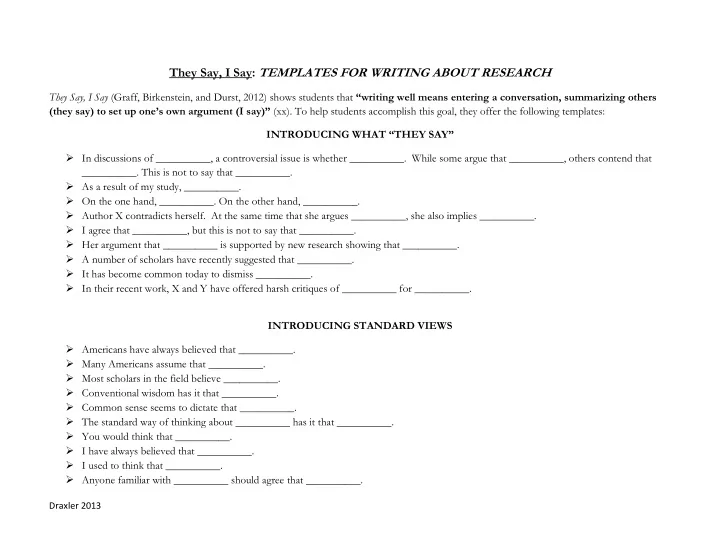
They Say, I Say: TEMPLATES FOR WRITING ABOUT RESEARCH

They Say, I Say (Graff, Birkenstein, and Durst, 2012) shows students that “writing well means entering a conversation, summarizing others (they say) to set up one’s own argument (I say)” (xx). To help students accomplish this goal, they offer the following templates: INTRODUCING WHAT “THEY SAY”

  • In discussions of __________, a controversial issue is whether __________. While some argue that __________, others contend that

__________. This is not to say that __________.

  • As a result of my study, __________.
  • On the one hand, __________. On the other hand, __________.
  • Author X contradicts herself. At the same time that she argues __________, she also implies __________.
  • I agree that __________, but this is not to say that __________.
  • Her argument that __________ is supported by new research showing that __________.
  • A number of scholars have recently suggested that __________.
  • It has become common today to dismiss __________.
  • In their recent work, X and Y have offered harsh critiques of __________ for __________.

INTRODUCING STANDARD VIEWS

  • Americans have always believed that __________.
  • Many Americans assume that __________.
  • Most scholars in the field believe __________.
  • Conventional wisdom has it that __________.
  • Common sense seems to dictate that __________.
  • The standard way of thinking about __________ has it that __________.
  • You would think that __________.
  • I have always believed that __________.
  • I used to think that __________.
  • Anyone familiar with __________ should agree that __________.
slide-2
SLIDE 2

Draxler 2013

INTRODUCING ASSUMPTIONS

  • Although I should know better by now, I cannot help thinking that __________.
  • X has often given me the impression that __________.
  • One implication of X’s treatment of __________ is that __________.
  • X apparently assumes that __________.
  • While they rarely admit as such, __________ often take for granted that __________.
  • In conclusion, then, as I suggested earlier, defenders of __________ can’t have it both ways. Their assertion that __________ is

contradicted by their claim that __________.

  • X tells us a great deal about __________. But can this work be generalized to __________?

INTRODUCING ONGOING DEBATE

  • In discussions of __________, one controversial issue has been __________. On the one hand, __________ argues __________. On the
  • ther hand, __________ contends __________. Others even maintain __________. My own view is __________.
  • In addressing the issue of __________, experts have considered several explanations for __________. X argues that __________.

According to Y and Z, another plausible explanation is __________.

  • When it comes to the topic of __________, most of us will readily agree that __________. Where this agreement usually ends, however, is
  • n the question of __________. Whereas some are convinced that __________, others maintain that __________.

INTRODUCING SUMMARIES AND QUOTATIONS

  • She advocates __________.
  • They celebrate the fact that __________.
  • He admits __________.
  • As the prominent __________ X puts it, “__________.”
  • According to X, “__________.”
  • In her book __________, X maintains that “__________.”
  • Writing in the journal __________, X complains that __________.
slide-3
SLIDE 3

Draxler 2013

  • In X’s view, “__________.”
  • X disagrees when he writes, “__________.”
  • X complicates matters further when she writes, “__________.”
  • Basically, X is warning that __________.
  • In other words, X believes __________.
  • In making this comment, X urges us to __________.
  • X is corroborating the age-old adage that __________.
  • X’s point is that __________.
  • The essence of X’s argument is that __________.
  • What is the effect of __________ on __________? Previous work on __________ by X, Y, and Z supports __________.

WAYS OF RESPONDING: AGREEMENT

  • She argues __________, and I agree because __________.
  • I sympathize with __________, because __________.
  • X tells a story about __________ to make the point that __________. My own experience with __________ yields a point that is similar.

What I take away from my experience with __________ is __________. As a result, I conclude __________.

  • I agree that __________ because my experience at __________ confirms it.
  • I wholeheartedly endorse what X calls __________.
  • These conclusions, which X discusses in __________, add weight to the argument that __________.
  • X is right about __________ because, as she may not be aware, recent studies have shown that __________.
  • X’s theory of __________ is useful because it sheds light on the difficult problem of __________.
  • Those unfamiliar with this school of thought may be interested to know that it basically boils down to __________.
  • I agree that __________, a point that needs emphasizing since so many people still believe __________.
  • If group X is right that __________, as I think they are, then we need to reassess the popular assumption that __________.
slide-4
SLIDE 4

Draxler 2013

WAYS OF RESPONDING: DISAGREEMENT

  • He says __________, and I disagree because __________.
  • X is mistaken because she overlooks __________.
  • X’s claim that __________ rests upon the questionable assumption that __________.
  • I disagree with X’s view that __________ because, as recent research has shown, __________.
  • X contradicts herself/can’t have it both ways. On the one hand, she argues __________. On the other hand, she also says __________.
  • X’s assertion that __________ doesn’t fit the facts.
  • X overlooks what I consider an important point about __________.
  • My own view is that what X insists is a __________ is in fact a __________.
  • By focusing on __________, X overlooks the deeper problem of __________.
  • I agree that __________, but that’s precisely why I oppose __________.
  • Of course some might object that __________. Although I concede that __________, I still maintain that __________.
  • X tells a story about __________ to make the point that __________. My own experience with __________ yields a point that is
  • different. What I take away from my experience with __________ is __________. As a result, I conclude __________.
  • Although some readers might think that this text is about __________, it is in fact about __________.
  • My view, however, contrary to what X has argued, is that __________.

WAYS OF RESPONDING: QUALIFIED AGREEMENT WITH A DIFFERENCE

  • He claims that __________, and I have mixed feelings about it. On the one hand, I agree that __________. On the other hand, I still

insist that __________.

  • Adding to X’s argument, I would point out that __________.
  • In recent discussions of __________, a controversial issue has been whether __________. On the one hand, some argue that

__________. From this perspective, __________. On the other hand, however, others argue that __________. In the words of __________, one of this view’s main proponents, “__________.” According to this view, __________. In sum, then, the issue is whether __________ or __________. My own view is that __________. Though I concede that __________, I still maintain that __________. For example, __________. Although some might object that __________, I would reply that __________. The issue is important because __________.

slide-5
SLIDE 5

Draxler 2013

  • X tells a story about __________ to make the point that __________. My own experience with __________ yields a point that is both

similar and different. What I take away from my experience with __________ is __________. As a result, I conclude __________.

  • Although I agree with X that __________, I cannot accept his conclusion that __________.
  • Although I agree with X that __________, I cannot accept his overriding assumption that __________.
  • Although I disagree with X’s claim that __________, I fully endorse his final conclusion that __________.
  • Though I concede that __________, I still insist that __________.
  • X is right that __________, but she seems on more dubious ground when she claims that __________.
  • While X is probably wrong when she claims that __________, she is right that __________.
  • Whereas X provides ample evidence that __________, Y and Z’s research on __________ and __________ convinces me that

__________ instead.

  • My feelings on the issue are mixed. I do support X’s position that __________, but I find Y’s argument about __________ and Z’s

research about __________ to be equally persuasive.

  • Experts studying __________ have argued that it is caused by __________. While __________ contributes to the problem, __________

is also an important factor.

  • Studies of __________ have indicated __________. It is not clear, however, that this conclusion applies to __________.

ENTERTAINING OBJECTIONS

  • At this point I would like to raise some possible objections; first, I could be accused of ignoring __________.
  • Some readers may challenge my views by insisting that __________.
  • Of course, many will probably disagree on the grounds that __________.
  • Here many __________ would probably object that __________.
  • Supporters of __________ would certainly take issue with the argument that __________.
  • Experts in __________ may want to question whether __________.
  • Followers/critics will probably suggest otherwise and argue that __________.
  • Although not all __________ think alike, some of them will probably dispute my claim that __________.
  • Participants in __________ are so diverse in their views that it’s hard to generalize about them, but some are likely to object on the

grounds that __________.

  • Yet is it necessarily true that __________? Is it always the case, as I have been suggesting, that __________?
slide-6
SLIDE 6

Draxler 2013

  • However, does the evidence I’ve cited prove conclusively that __________?
  • Some might say that I am reading the research selectively in concluding that __________.
  • Although I grant that __________, I still maintain that __________.
  • Proponents of X are right to argue that __________. But they exaggerate when they claim that __________.
  • While it is true that __________, it does not necessarily follow that __________.
  • __________ might object that __________.
  • Is my claim realistic? I have argued that __________, but readers may question __________.
  • My explanation accounts for __________ but does not explain __________. This is because __________.

“SO WHAT” ARGUMENT: WHY IT MATTERS

  • __________ used to think __________. But recently, experts suggest that __________.
  • This distinction is important because __________.
  • This interpretation challenges the work of those critics who have long assumed that __________.
  • These findings challenge the work of earlier researchers, who tended to assume that __________.
  • Recent studies like these shed new light on __________, which previous studies had not addressed.
  • These findings challenge the assumption that __________.
  • At first glance, you might assume __________. But on closer inspection, __________.
  • __________ is important because __________.
  • Although X may seem trivial, it is in fact crucial in terms of the concern over __________.
  • Ultimately, what is at stake here is __________.
  • These findings have important implications for the broader domain of __________.
  • The finding that __________ should be of interest to __________ because __________.
  • If we are right about __________, then major consequences follow for __________.
  • These conclusions will have significant applications in __________ as well as __________.
  • Although __________ may seem of concern to only a small group of __________, it should in fact concern anyone who cares about

__________.

slide-7
SLIDE 7

Draxler 2013

METACOMMENTARY: THE BIG PICTURE

  • What __________ really means is __________.
  • My point is not __________ but __________.
  • Ultimately, then, my goal is to demonstrate that __________.
  • Essentially, I am arguing not that __________ but that __________.
  • This is not to say __________, but rather __________.
  • X is concerned less with __________ than with __________.
  • Having just argued that __________, I now want to complicate the point by __________.
  • In sum, then, __________.
  • My conclusion, then, is that __________.
  • I believe __________. But let me back up and explain how I arrived at that conclusion: __________. In this way, I came to believe that

__________.

  • So far we have been talking about __________. But the real issue is __________.
slide-8
SLIDE 8

Draxler 2013

Other tips… Say more than “Say”: vary your verbs!  Verbs for making a claim: argue, assert, believe, claim, emphasize, insist, observe, remind us, report, suggest.  Verbs for expressing agreement: acknowledge, admire, agree, celebrate the fact that, corroborate, do not deny, endorse, extol, praise, reaffirm, support, verify  Verbs for questioning or disagreeing: complain, complicate, contend, contradict, deny, deplore the tendency to, qualify, question, refute, reject, renounce, repudiate  Verbs for making recommendations: advocate, call for, demand, encourage, exhort, implore, plead, recommend, urge, warn Connect the dots: use transitions effectively!  Addition: also, and, besides, furthermore, in addition, indeed, in fact, moreover, so too  Example: after all, as an illustration, for example, for instance, specifically, to take a case in point, consider  Elaboration: actually, by extension, in short, that is, in other words, to put it another way, to put it bluntly, to put it succinctly, ultimately  Comparison: along the same lines, in the same way, likewise, similarly  Contrast: although, but, by contrast, conversely, despite, even though, however, in contrast, nevertheless, nonetheless, on the contrary, on the other hand, regardless, whereas, while, yet  Cause and Effect: accordingly, as a result, consequently, hence, since, so, then, therefore, thus  Concession: admittedly, although it’s true, granted, naturally, of course, to be sure  Conclusion: as a result, consequently, hence, in conclusion, in short, in sum, therefore, thus, to sum up, to summarize