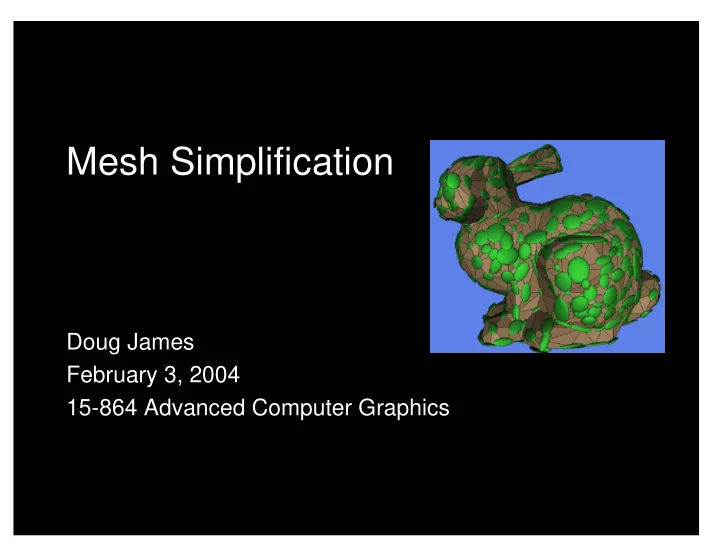
Mesh Simplification Doug James February 3, 2004 15-864 Advanced - - PowerPoint PPT Presentation

mesh simplification
SMART_READER_LITE
LIVE PREVIEW

Mesh Simplification Doug James February 3, 2004 15-864 Advanced - - PowerPoint PPT Presentation

Mesh Simplification Doug James February 3, 2004 15-864 Advanced Computer Graphics Motivation: Multiresolution Analysis (MRA) [Hoppe, 1995] Acknowledgement Tom Funkhouser many slides borrowed from Princeton C0S 526, Fall 2002 Mesh


slide-1
SLIDE 1

Mesh Simplification

Doug James February 3, 2004 15-864 Advanced Computer Graphics

slide-2
SLIDE 2

Motivation: Multiresolution Analysis (MRA)

[Hoppe, 1995]

slide-3
SLIDE 3

Acknowledgement

  • Tom Funkhouser

– many slides borrowed from Princeton C0S 526, Fall 2002

slide-4
SLIDE 4

Mesh Simplification

Triangles: Triangles: 41,855 41,855 27,970 27,970 20,922 20,922 12,939 12,939 8,385 8,385 4,766 4,766

Division, Viewpoint, Cohen

slide-5
SLIDE 5

Mesh Simplification

slide-6
SLIDE 6

Mesh Simplification Goals

  • Reduce number of polygons

– Faster rendering – Less storage – Simpler manipulation

  • Desirable properties

– Generality, efficiency, scalability – Produces “good” approximation

Stanford Graphics Lab

slide-7
SLIDE 7

Simplification Algorithms

  • Measure cost of possible decimation operations

according to error measure

  • Place operations in queue according to error
  • Perform operations in queue successively

– After each operation, re-evaluate error metrics

slide-8
SLIDE 8

Mesh Simplification Operations

  • General idea:

– Each operations simplifies model by small amount – Apply many operations in succession

  • Types of operations

– Vertex cluster – Vertex remove – Edge collapse – Vertex pair

slide-9
SLIDE 9

Vertex Cluster

  • Method

– Merge vertices based on proximity – Triangles with repeated vertices become edge or point

  • Properties

– General and robust – Not usually attractive

slide-10
SLIDE 10

Vertex Remove

  • Method

– Remove vertex and adjacent faces – Fill hole with new triangles (reduction of 2)

  • Properties

– Requires manifold surface around vertex – Preserves local topological structure – Typically more attractive

slide-11
SLIDE 11

Edge Collapse

  • Method

– Merge two edge vertices to one – Delete degenerate triangles

  • Properties

– Requires manifold surface around vertex – Preserves local topological structure – Typically more attractive – Allows smooth transition (Geomorph [Hoppe95])

slide-12
SLIDE 12

Operation Considerations

  • Topology considerations

– Attention to topology promotes better appearance – Allowing non-manifolds increases robustness and ability to simplify

  • Operation considerations

– Collapse-type operations allow smooth transitions – Vertex remove affects smaller portion of mesh than edge collapse

slide-13
SLIDE 13

Geometric Error Metrics

  • Motivation

– Promote accurate 3D shape preservation – Preserve screen-space silhouettes and pixel coverages

  • Types

– Vertex-Vertex Distance – Vertex-Plane Distance – Point-Surface Distance – Surface-Surface Distance

slide-14
SLIDE 14

Vertex-Vertex Distance

  • E = max( || v3-v1||, || v3-v2 || )
  • Appropriate during topology changes

– Rossignac and Borrel 93 – Luebke and Erikson 97

  • Loose for topology-preserving collapses

v v1

1

v v2

2

v v3

3

slide-15
SLIDE 15

Point-Surface Distance

  • Map point set to closest points on simplified surface
  • Compute sum of square distances
slide-16
SLIDE 16

Surface-Surface Distance

  • Bound maximum distance between input and simplified

surfaces

– Tolerance Volumes - Guéziec 96 – Simplification Envelopes - Cohen/Varshney 96 – Hausdorf Distance - Klein 96 – Mapping Distance - Bajaj/Schikore 96, Cohen et al. 97

slide-17
SLIDE 17

Vertex-Vertex != Surface-Surface

  • Error is zero at vertices and exterior edges
  • Error is non-zero everywhere else

– not captured by vertex-vertex or vertex-plane metrics

slide-18
SLIDE 18

Vertex-Plane Distance

  • Store set of planes with each vertex

– Error based on distance from vertex to planes – When vertices are merged, merge sets

  • Ronfard and Rossignac 96

– Store plane sets, compute max distance

  • Error Quadrics - Garland and Heckbert 96

– Store quadratic form, compute sum of square distances

a a b b c c a a b b c c

slide-19
SLIDE 19

Geometric Error Observations

  • Vertex-vertex and vertex-plane distance

– Fast – Low error shown after-the-fact, but not guaranteed by metric

  • Surface-surface distance

– Required to guarantee errors

Edge swap Edge swap

vertex-vertex != surface-surface

slide-20
SLIDE 20

Whiteboard: Quadric Error Metrics

Garland & Heckbert, 97

slide-21
SLIDE 21

Computing simplification error: Metro

  • Evaluates approximate Hausdorff distance
  • Metro: measuring error on simplified surfaces
  • P. Cignoni, C. Rocchini and R. Scopigno

Computer Graphics Forum, Blackwell Publishers, vol. 17(2), June 1998, pp 167-174

slide-22
SLIDE 22

Computing simplification error: Metro

  • Evaluates approximate Hausdorff distance
  • Metro: measuring error on simplified surfaces
  • P. Cignoni, C. Rocchini and R. Scopigno

Computer Graphics Forum, Blackwell Publishers, vol. 17(2), June 1998, pp 167-174

slide-23
SLIDE 23

Metro software available online

  • http://vcg.iei.pi.cnr.it/metro.html
  • Usage: Metro file1 file2 [opt]

where "file1" and "file2" are the input meshes in PLY or SMF format, and opt can be:

  • V disable vertex sampling
  • E disable edge sampling
  • F disable face sampling
  • Sx set the face sampling mode

where x can be: M montecarlo sampling (default) S subdivision sampling T similar triangles sampling

  • N# set the required number of samples (overrides -A, default: 10 x #faces)
  • A# set the required number of samples per area unit (overrides -N)
  • Hxxx.yyy save histogram of error values in the file xxx.yyy
  • By default vertex, edge and face sampling are enabled.
slide-24
SLIDE 24
  • Example:

Metro mesh1.ply mesh2.smf -SS -N50000 -E

  • compares the two input meshes using the subdivision method for face sampling with a sampling step of 12.5 samples/area_unit; edge sampling is

disabled.

  • The numerical results retuned are as follows:
  • Metro

release date: Nov 26 2002

  • reading the mesh 'mesh1.ply'...done

reading the mesh 'mesh2.smf'...done Mesh info: M1: 'mesh1.ply' vertices 5052 faces 10000 area 790329.3211 bbox (-256.5977 -399.9384 -1732.1525)-(210.8112 101.2027 -1472.8544) bbox diagonal 732.699854 M2: 'mesh2.smf' vertices 2031 faces 3999 area 789830.8269 bbox (-256.7550 -399.2310 -1732.2300)-(210.8110 101.1740 -1473.0200) bbox diagonal 732.265616 Forward distance (M1 -> M2): target # samples : 50000 target # samples/area : 0.063265 Vertex sampling Subdivision face sampling distance: max : 3.160912 (0.004042 with respect to bounding box diagonal) mean : 0.138594 RMS : 0.204879 # vertex samples 5052 # area samples 44947 # total samples 49999 samples per area unit: 0.063264 Backward distance (M2 -> M1): target # samples : 50000 target # samples/area : 0.063305 Vertex sampling Subdivision face sampling distance: max : 2.159845 (0.002762 with respect to bounding box diagonal) mean : 0.129528 RMS : 0.188315 # vertex samples 2031 # area samples 47967 # total samples 49998 samples per area unit: 0.063302 Hausdorff distance: 3.160912 (0.004042 with respect to bounding box diagonal) Computation time : 3174 ms # samples/second : 31504.725898

slide-25
SLIDE 25

Mesh Simplification Considerations

  • Type of input mesh?
  • Modifies topology?
  • Continuous LOD?
  • Speed vs. quality?
  • In-core or out-of-core?
slide-26
SLIDE 26

View-Dependent Simplification

  • Simplify dynamically according to viewpoint

– Visibility – Silhouettes – Lighting

Hugues Hoppe

slide-27
SLIDE 27

7,809 tris 3,905 tris 1,951 tris 488 tris 975 tris

Appearance Preserving Simplification

Caltech & Stanford Graphics Labs, UNC and Jonathan Cohen

slide-28
SLIDE 28

Out-of-Core Algorithms

  • Becoming increasingly important for huge meshes
  • Martin Isenburg and Stefan Gumhold, Out-of-Core Compression for

Gigantic Polygon Meshes, SIGGRAPH 2003

slide-29
SLIDE 29

Martin Isenburg, Peter Lindstrom, Stefan Gumhold, Jack Snoeyink Large Mesh Simplification using Processing Sequences, Visualization'03.

Also see out-of-core simplification work by [Lindstrom, 2000] and

  • thers…
slide-30
SLIDE 30

Next class…

  • More on progressive geometric representations &

representing 3D animations

  • Read: “Progressive Meshes,” Hoppe, SIGGRAPH 95
  • Coming soon… Point-based rendering