S AFETY AS A P ROJECT P RIORITIZATION F ACTOR presented to TRB - - PowerPoint PPT Presentation

s afety as a p roject
SMART_READER_LITE
LIVE PREVIEW

S AFETY AS A P ROJECT P RIORITIZATION F ACTOR presented to TRB - - PowerPoint PPT Presentation

MPO G UIDEBOOK FOR U SING S AFETY AS A P ROJECT P RIORITIZATION F ACTOR presented to TRB Tools of the Trade presented by Audrey Wennink September 13, 2016 Project Overview Literature on Transportation Safety Planning has noted deficiencies


slide-1
SLIDE 1

presented to presented by

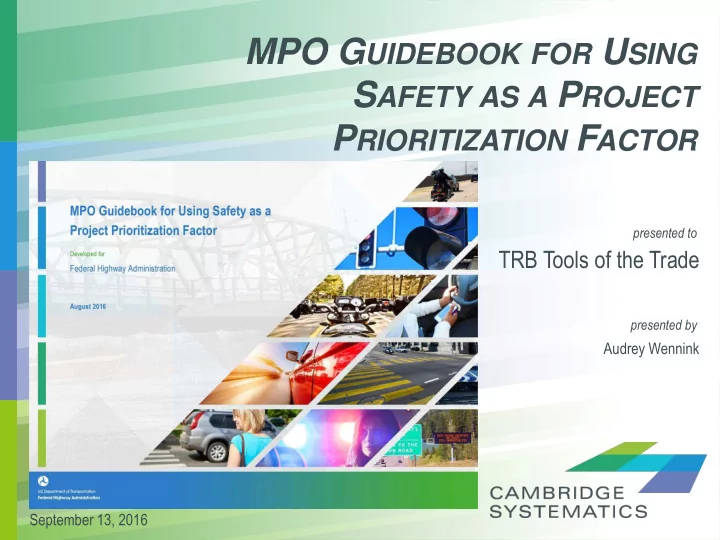
MPO GUIDEBOOK FOR USING SAFETY AS A PROJECT PRIORITIZATION FACTOR

TRB Tools of the Trade

September 13, 2016 Audrey Wennink
slide-2
SLIDE 2

Project Overview

Literature on Transportation Safety Planning has noted deficiencies in using safety as a project prioritization factor (NCHRP 811: Institutionalizing Safety in Transportation Planning Processes: Techniques, Tactics and Strategies) To identify state of the practice by MPOs this research conducted » Literature review of over 50 MPOs’ Long Range Transportation Plans/Transportation Improvement Programs » Interviews with 9 MPOs Defined approaches that incorporated best practices and developed new options building on current practice

2

slide-3
SLIDE 3

Legislative Context

The metropolitan transportation planning process shall be continuous, cooperative and comprehensive, and provide for consideration and implementation of projects, strategies, and services that will address the following factors, including:

3

Increase the safety of the transportation system for motorized and non-motorized users

slide-4
SLIDE 4

Legislative Context (continued)

According the Safety Performance Management Final Rule MPOs must…

Set annual safety targets for their planning areas or Plan and program projects that support adopted State safety targets

Five targets are required…

Fatality Number Fatality Rate Serious Injury Number Serious Injury Rate Number of nonmotorized fatalities and nonmotorized serious injuries

4

slide-5
SLIDE 5

Challenges to Using Safety as a Prioritization Factor

Belief that safety will be handled later – in project design phase Assumption that by following design references (i.e., AASHTO Green Book) roadways are optimized to reduce fatalities and serious injuries Lack of tool to predict safety benefits of future transportation projects in Travel Demand Models Lack of knowledge/experience using new tools such as » Highway Safety Manual » Crash Modification Factors Clearinghouse Prioritization methods are often siloed by mode or program and do not attempt to use safety as a factor for all projects

5

slide-6
SLIDE 6

Project Prioritization Approaches

6

Mode Specific Cross Modal

Funding Source Based Goals and Objectives Based Scenario- Based

Program- Based CMAQ ■ TAP ■ STP

slide-7
SLIDE 7

When to Address Safety in Project Prioritization?

7

Metropolitan Transportation Plan Transportation Improvement Program Corridor/Special Purpose Plans (Bicycle/Pedestrian/Freight)

slide-8
SLIDE 8

Common Approach

8

Typical Approach

Provide safety points for highway projects at high-crash locations

Limitations

Usually…

  • Does not include evaluation of specific safety problems
  • Does not quantify proposed project’s impact on safety

(positive or negative)

  • Does not identify how project will mitigate problems
  • Not multimodal
slide-9
SLIDE 9

Approaches for Prioritizing Projects Using Safety

Network Screening Systemic Countermeasure-Based Complete Streets Mode Shift Benefit-Cost Analysis

9

slide-10
SLIDE 10

Guidebook Contents by Approach

Sample criterion Analysis method for problem identification Analysis method for project development Data needed Level of complexity/ technical expertise Resources needed Pros Cons Considerations List of technical resources

10

slide-11
SLIDE 11

Countermeasure-Driven Approach

Draws upon body of known effective countermeasures Encourages sponsors of all types of transportation projects to integrate effective safety countermeasures as appropriate

11

FHWA Nine Proven Safety Countermeasures

slide-12
SLIDE 12

Countermeasure-Driven

12

Basic Intermediate Advanced Sample Criterion

  • Provide points for

projects that include

  • ne or more of the

FHWA 9 proven safety countermeasures or those in a State’s Strategic Highway Safety Plan or regional safety plan.

  • Provide points

for inclusion

  • f appropriate

proven effective safety countermeasures

  • Provide points for

proposed transportation projects with forecasted safety improvement using the Highway Safety Manual predictive method

slide-13
SLIDE 13

Other Considerations for Successfully Integrating Safety into Project Prioritization/Programming

Make sure projects maintain safety elements during project development process Conduct project evaluation so results can inform future project decisions

13

slide-14
SLIDE 14

Resources

14

The DOT may be able to provide MPOs with safety analysis Local Technical Assistance Program or DOT may be able to provide training

slide-15
SLIDE 15

GET THE GUIDEBOOK!

Guidebook available at:

Transportation Safety Planning webpage under Publications fhwa.dot.gov/planning/transportation_safety_planning/publications

slide-16
SLIDE 16

Contact

16

Audrey Wennink Cambridge Systematics awennink@camsys.com 312-665-0218 Dave Harris Office of Planning Federal Highway Administration Dave.Harris@dot.gov 202-366-2825