W ATER P ROJECT ITP Ten-year permit (2020-2030) Four covered - - PowerPoint PPT Presentation

w ater p roject itp
SMART_READER_LITE
LIVE PREVIEW

W ATER P ROJECT ITP Ten-year permit (2020-2030) Four covered - - PowerPoint PPT Presentation

I NCIDENTAL T AKE P ERMIT FOR L ONG - TERM O PERATION OF THE S TATE W ATER P ROJECT IN THE S ACRAMENTO -S AN J OAQUIN D ELTA J u l y 1 3 t h , 2 0 2 0 O VERVIEW OF S TATE W ATER P ROJECT ITP Ten-year permit (2020-2030) Four covered


slide-1
SLIDE 1

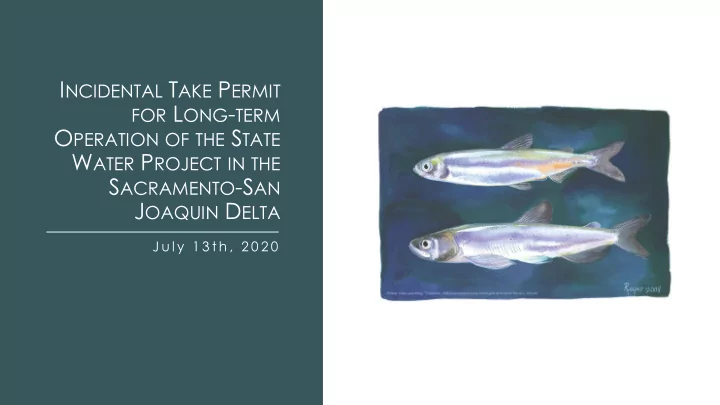
INCIDENTAL TAKE PERMIT

FOR LONG-TERM

OPERATION OF THE STATE WATER PROJECT IN THE SACRAMENTO-SAN JOAQUIN DELTA

J u l y 1 3 t h , 2 0 2 0
slide-2
SLIDE 2

OVERVIEW OF STATE WATER PROJECT ITP

  • Ten-year permit (2020-2030)
  • Four covered species: Delta smelt,

longfin smelt, winter- and spring-run Chinook salmon

  • CVP-coordinated protection for

steelhead and green sturgeon

  • Adaptive Management Program
  • Integrated with the Voluntary

Agreements

  • Key differences from 2019 Fed. BiOps
  • Decision-making structure
  • Single year and daily salmon loss

thresholds

  • Spring export curtailments and

blocks of water

slide-3
SLIDE 3

PROJECT AREA

  • Sacramento River from Feather

River confluence to I Street Bridge

  • Legal Delta
  • Suisun Marsh and Bay
slide-4
SLIDE 4

PROJECT FACILITIES

Includes only SWP facilities in the Delta and Suisun Marsh

  • Banks Pumping Plant
  • Skinner Fish Facility
  • Clifton Court Forebay (incl. predator control

and aquatic weed control and removal)

  • South Delta Temporary Barrier Program

(without the Head of Old River Barrier)

  • Operation of a migratory barrier at

Georgiana Slough

  • Barker Slough Pumping Plant and North Bay

Aqueduct

  • Roaring River Distribution System, Morrow

Island Distribution System, and Suisun Marsh Salinity Control Gates

slide-5
SLIDE 5

California Department of Fish and Wildlife Water Branch

REAL TIME OPERATIONS – OMR MANAGEMENT

  • Condition 8.3 – Onset of OMR management
  • Condition 8.3.1 – Integrated early winter pulse

protection

  • Condition 8.3.2 – Salmonid presence
  • Condition 8.3.3 – Adult longfin smelt entrainment

protection

  • Condition 8.8 – End of OMR management
  • Smelt: Clifton Court Forebay temperature
  • Salmon:
  • >95% of winter- and spring- run Chinook exited

the Delta, and

  • Temperature at Mossdale and Prisoner’s Point
slide-6
SLIDE 6

California Department of Fish and Wildlife Water Branch

HABITAT RESTORATION- MITIGATION REQUIREMENTS

Delta Smelt 9.1.1 Complete tidal marsh restoration targets from FWS 2008 Biological Opinions w/CDFW consistency (8,000 acres) within first 6 years of ITP issuance

  • 7,907 total acres under construction or planned
  • Restore an additional 396.3 acres of tidal marsh habitat

for Barker Slough Pumping Plant mitigation Longfin Smelt

  • 9.1.2 Complete tidal marsh restoration targets from 2009

CDFW ITP (800 acres) within 6 years of ITP issuance

  • 590 acres already completed and credited (Tule Red)

Restore an additional 396.3 acres of tidal marsh habitat as compensatory mitigation of the Project

slide-7
SLIDE 7

California Department of Fish and Wildlife Water Branch

9.2.2 Yolo Bypass Big Notch Project

HABITAT RESTORATION- MITIGATION REQUIREMENTS

  • Create critical floodplain habitat for juvenile

salmonids and other native fish (splittail, sturgeon)

  • Improve the migration corridor for adult fish

between the Sacramento River, floodplains of the Yolo Bypass, and the Sacramento-San Joaquin Delta

  • Construct a gated notch at Fremont Weir
  • Key permits were recently submitted for the CDFW

ITP, 1600, Clean Water Act Section 404, and Section 401 Water Quality Certification.

  • Flow Easement Acquisition and Construction should

be completed by the end of 2022

slide-8
SLIDE 8

REAL TIME OPERATIONS

Implementation of operating criteria founded on long-term monitoring

  • Real time operations teams: Smelt,

Salmon, WOMT

  • Weekly risk assessments and
  • peration advice
  • Relies upon current long-term monitoring
  • Development of salvage forecast models
  • Salvage and/or survey operations

criteria

  • FWMT, SLS, 20 mm, Chipps Island Trawl

and EDSM

slide-9
SLIDE 9

WILL REQUIRE CLOSE

COORDINATION WITHIN AND OUTSIDE THE DEPARTMENT

  • Relationship with long-term monitoring (CDFW,

IEP)

  • Adaptive management action implementation
  • CDFW and DWR, DWR/CDFW with Reclamation
  • O&M and Div. of Environmental Sciences
  • New science
  • Delta smelt and longfin smelt
  • Food web research
  • Winter- and spring-run Chinook salmon
  • New research facilities
slide-10
SLIDE 10

California Department of Fish and Wildlife Water Branch

RELATIONSHIP WITH IEP

LONG-TERM MONITORING

  • Key IEP sampling elements identified in Project

Description

  • EDSM
  • FMWT
  • 20 mm Survey
  • SKT
  • SLS
  • STN
  • Independent review of IEP programs that support ITP

implementation

  • CDFW 20 Survey and Smelt Larval Survey
  • Expansion of the Smelt Larval Survey (temporally

and spatially)

slide-11
SLIDE 11

PROCESS TO ADDRESS SCIENTIFIC UNCERTAINTY

“Adaptive management is a science-based approach to evaluate management actions and address uncertainties associated with those actions to achieve specified objectives and to inform subsequent decision making.”

  • DWR, CDFW, and State Water Contractors--

ability to expand membership and coordinate with other AM efforts

  • Structured-Decision Making Process

identified for key AM elements

  • Will build off science implemented by IEP,

CSAMP, and Delta Science Program

  • AM will allow for potential amendments to

permit elements (big check-in after 4 years)

slide-12
SLIDE 12

ADAPTIVE MANAGEMENT SUMMER-FALL ACTION

  • Annual planning process integrated with

Adaptive Management and SDM

  • Criteria:
  • X2 ≤ 80 km in September and

October of wet and above normal years

  • 60 days of gate operations in above

normal and below normal years

  • 30 days gate operations in dry years
  • 4 ppt salinity standard at Belden’s

Landing*

  • Improved monitoring in Grizzly Bay
slide-13
SLIDE 13

SCIENCE AND

MONITORING - SALMON

  • Condition 7.5 – Salmonid monitoring and

science requirements

  • 7.5.1 – Upstream monitoring during

water transfer window

  • 7.5.2 – New and ongoing monitoring

to develop a spring-run JPE

  • 7.5.3 – Additional salmon science

requirements

  • Pathology monitoring
  • Rearing habitat in the Bay-Delta
  • Spring-run life cycle model
  • Entrainment prediction tool
  • Condition 8.6.6 – Evaluate proactive

salmon entrainment minimization

slide-14
SLIDE 14

SCIENCE AND

MONITORING - SMELT

  • Condition 7.6 – Smelt monitoring and

science requirements

  • 7.6.1 – Longfin smelt December

larval surveys

  • 7.6.2 – Smelt larval entrainment

monitoring

  • 7.6.3 – Longfin smelt science

program

  • 7.6.4 – Delta smelt summer-fall

habitat

  • Condition 9.1.3.3 – New monitoring

stations in Grizzly Bay and Suisun Marsh

slide-15
SLIDE 15

LONGFIN SMELT SCIENCE

PROGRAM

Science priorities:

  • Develop a new life cycle model for

longfin smelt to test management alternatives (i.e, OMR actions, flow actions)

  • Complete longfin smelt lifecycle in

captivity at the FCCL

  • Characterize spawning substrate and

microhabitat

  • Distribution of spawning substrate in

Delta, Cache Slough, and Suisun Marsh

  • Improve understanding of adult

migration behavior and juvenile

  • utmigration behavior
slide-16
SLIDE 16

RIO VISTA ESTUARINE RESEARCH STATION

  • Requirement to provide 66% of the

funding required to construct the Rio Vista Estuarine Research Station (RVRS)

  • Constructed on the

decommissioned City of Rio Vista Army Base

  • Consolidate IEP staff into one

riverfront research facility

slide-17
SLIDE 17

QUESTIONS?