Rubric Mandarin Presentation Introduce a celebrity and his/her - - PowerPoint PPT Presentation

rubric mandarin presentation introduce a celebrity and
SMART_READER_LITE
LIVE PREVIEW

Rubric Mandarin Presentation Introduce a celebrity and his/her - - PowerPoint PPT Presentation

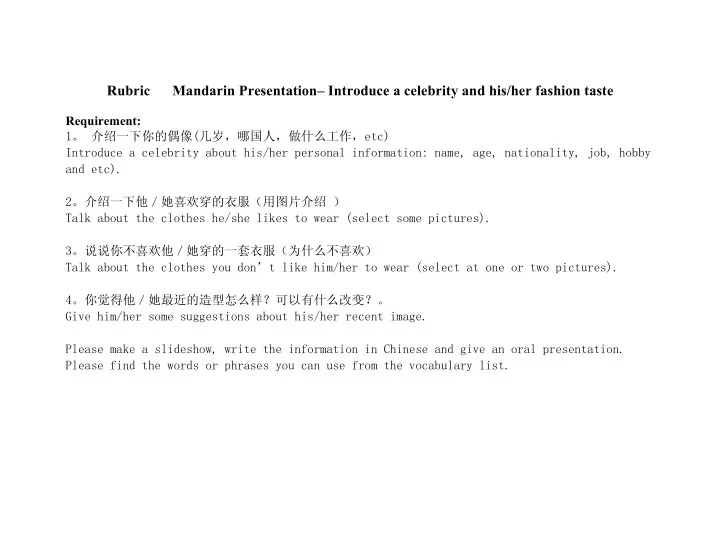
Rubric Mandarin Presentation Introduce a celebrity and his/her fashion taste Requirement: 1 (etc) Introduce a celebrity about his/her personal information: name, age,


slide-1
SLIDE 1

Rubric Mandarin Presentation– Introduce a celebrity and his/her fashion taste

Requirement: 1。 介绍一下你的偶像(几岁,哪国人,做什么工作,etc) Introduce a celebrity about his/her personal information: name, age, nationality, job, hobby and etc). 2。介绍一下他/她喜欢穿的衣服(用图片介绍 ) Talk about the clothes he/she likes to wear (select some pictures). 3。说说你不喜欢他/她穿的一套衣服(为什么不喜欢) Talk about the clothes you don’t like him/her to wear (select at one or two pictures). 4。你觉得他/她最近的造型怎么样?可以有什么改变?。 Give him/her some suggestions about his/her recent image. Please make a slideshow, write the information in Chinese and give an oral presentation. Please find the words or phrases you can use from the vocabulary list.

slide-2
SLIDE 2

10 points 20 points 30 points 40 points 50 points Summary Criteria The high number

  • f

spelling/calligrap hy mistakes makes the writing difficult to understand. Has difficulty in using basic words: these are

  • ften omitted or

misused. Has great problems in using the most basic grammatical structures effectively. There are frequent spelling/calligrap hy mistakes, which sometimes make understanding difficult. Uses some basic words well, although there are still errors. Be able to use some basic grammatical structures well. There are no successful attempts to use slightly complex structures. There are some spelling/calligrap hy mistakes, but these do not generally obstruct understanding. Has a good command of the basic vocabulary necessary to carry

  • ut the task.

Succeeds in the use of basic grammatical

  • structures. There

are some successful attempts at slightly complex structures. The spelling/calligraphy is generally good;

  • ccasional errors do

not normally affect understanding. The ability to use a limited range of vocabulary is good. Generally successful in the use of both basic and slightly complex grammatical structures. The spelling/calligraphy is generally good. The ability to use a limited range of vocabulary is very good. Be able to use both basic and slightly complex grammatical structures successfully. Total points

slide-3
SLIDE 3

Oral Criteria

Grade Language and Pronunciation Communication Interaction 50

  • Pronunciation and intonation

facilitate communication.

  • The ability to use a limited

range of vocabulary is very good.

  • Uses both basic and slightly

complex grammatical structures well.

  • The information

presented is relevant and thorough.

  • There is some awareness
  • f cultural elements in the

presentation.

  • There is a clear logical

argument in the presentation and it shows some insight

  • n the part of the student.
  • Understands both basic

and slightly complex information well.

  • Does not need

prompting and provides some personal input.

  • Uses appropriate

expressions and shows a good awareness of the context. 40

  • Pronunciation and intonation

generally facilitate communication.

  • The ability to use a limited

range of vocabulary is good.

  • Uses both basic, and slightly

complex grammatical structures, although there are some errors in the more complex structures.

  • The information

presented is relevant.

  • There is some awareness
  • f cultural elements in the

presentation.

  • There is a clear logical

argument in the presentation.

  • Understands both basic

and slightly complex information without repetition, although

  • ccasionally he/she

misunderstands a word or expression.

  • Needs little prompting.
  • Uses mostly appropriate

expressions and shows an awareness of the context. 30

  • Pronunciation and intonation

are generally clear, although there are mistakes.

  • Uses the appropriate basic

vocabulary well.

  • Uses basic grammatical

structures well. There are some successful attempts at slightly complex structures.

  • The information

presented is generally relevant.

  • There is evidence of a

logical argument. Although there are some gaps in information, which do not affect communication

  • Understands basic

information well. There are certain difficulties with slightly complex one and some repetition of these at a slow pace is needed.

  • Needs some prompting.
  • Occasionally uses

inappropriate expressions

slide-4
SLIDE 4

greatly. but shows some awareness

  • f the context.

20

  • There are frequent

pronunciation and intonation mistakes, some of which make understanding difficult.

  • Be able to use basic

vocabulary, although some errors lead to misunderstandings.

  • There are some errors in

basic grammatical structures, and these are repeated throughout the oral.

  • Some of the information

presented is not relevant.

  • There is some evidence
  • f a logical argument,

although this is often lost.

  • Has difficulty in

understanding some of the basic information or comments, and needs some repetition of basic questions.

  • Needs frequent

prompting.

  • Uses inappropriate

expressions at times and shows little awareness of the context. 10

  • Pronunciation and intonation

mistakes make understanding difficult throughout the individual oral.

  • Often unable to find the

words to elaborate a clear message.

  • There are errors in basic

grammatical structures.

  • The majority of

information presented is not relevant.

  • There is no evidence of a

logical argument, the student moves swiftly from

  • ne idea to the next without

an explanation or obvious link.

  • Has difficulty in

understanding, and needs frequent repetition.

  • Needs constant

prompting.

  • Often uses inappropriate

expressions. No achievement No achievement No achievement