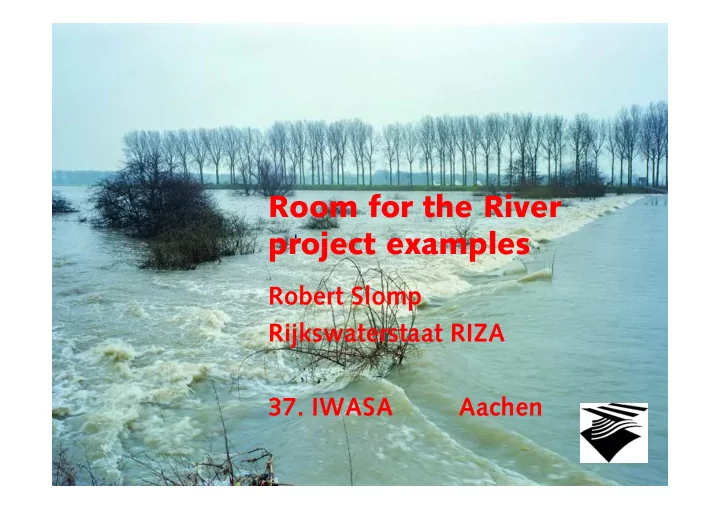
SLIDE 1 Room for the River project examples
Robert Slomp Rijkswaterstaat RIZA
SLIDE 2
Contents
~ some characteristics of the Netherlands ~ history / the flood of 1995 ~ the issues and goals ~ flood control policy ~ Spatial Planning Key decision ‘Room for the River’ (SPKD) 2001-2006 ~ Design and construction phase 2006-2015 ~ Mixed projects/ Fore-runners 1999 -2007 ~ RVR Projects brought forward: Overdiepse Polder, Noordwaard, Westerwolte
SLIDE 3
Netherlands Germany Switzerland France
Discharge at Lobith and Borgharen (border with Germany & Belgium): average: 2,200 m3/s /200 m3/s to: 12,000 m3/s / 3300 m3/s Design discharge (1/1250 per year): 16,000 m3/s / 3800 m3/s
Catchment area of rivers Rhine and Maas / Meuse
SLIDE 4 Netherlands
36,000 km2
16 million
North Sea North Sea Belg Belgium ium Germany Germany
Ne Netherlands therlands ~inhabitants 10 million
Flood prone areas in the Netherlands
SLIDE 5 IJssel Lek and Lower Rhine Waal Meuse/Maas Maaswerken Project Rhine and Maas Estuary
- - - - - - - - -
- - - - -
- - - - - - - - - - - - - -
- -
- -
- IJssel
delta
Maas and Rhine branches in the Netherlands
Vecht
SLIDE 6
Waal
SLIDE 7 dike groyne embankment flood plain
navigation channel
R3294 E000418n
Room for the Rhine branches
SLIDE 8
Contents
~ some characteristics of the Netherlands ~ history / the flood of 1995 ~ the problem ~ flood control policy ~ The Spatial Planning Key decision ‘Room for the River’ (SPKD) ~ Design and construction phase ~ Mixed projects/ Fore-runners 1999 -2007 ~ Projects brought forward: Overdiepse Polder, Noordwaard
SLIDE 9
Deltaplan for the Coast Delay for the rivers
~ After the coastal flood of 1953 (1835 casualties) new safety standards were introduced based on risk analysis The protection of the coastal area was improved with dams, storm surge barriers and dike reinforcement. Also the river dikes had to be improved ~ Delay in River Dike Reinforcements after ±1965 till 1996
SLIDE 10
Floods in ‘93 en ‘95
SLIDE 11
The 1995 flood
Facts:
~ in January high water levels on the rivers Rhine and Maas/Meuse ~ evacuation of 250 000 inhabitants ~ estimated damage: 200 million Euros (mainly along Meuse)
Result: In April 1995 acceptation of the Deltaplan Large Rivers by Parliament
SLIDE 12
Deltaplan Large Rivers (DGR)
Goals for 1996: all dikes with a risk higher than 1/100 per year must be improved new dikes for the Meuse river 1/50 Goals for later ~ all other dikes must be ready in 2000 ~ the deepening and widening of the river Meuse must be ready in 2005
SLIDE 13
2000 ~Dike reconstruction of the Deltaplan is completed ~Design discharges 15000 m3/s and 3650 m3/s ~2000-2007 Two projects remained (estuaries) ~IJsseldelta, city of Kampen 2002 ~Lek, Schoonhoven- Everdingen- 2007
SLIDE 14 What is the main issue?
extreme floods
~ In 2001: Higher Design Discharges Rhine -> 16000 m3/s (+ 1000 m3/s) Maas -> 3800 m3/s ( + 150 m3/s) In 2006 Maas -> 4000 m3/s (on average a 30 cm increase in water level) ~ Climate change
Discharge (height and duration) Sea level rise -> in 2100 + 60 cm Wind climate (duration, speed & direction)
~ Dike reinforcement will become more and more of a problem (raising the crest levels of the dikes)
SLIDE 15
Potential Increase of the Water level Long term (2100)
Discharges Rhine 18.000 m3/s Meuse 4600 m3/s Sea level rise 0.60 cm Sea level rise works twice => extra sedimentation
SLIDE 16 What is the problem?;
- 2. Improvement of overall
environmental conditions
~ Competitive spatial requirements in the flood
plain (urban and recreational pressure versus safety) ~ Decreasing quality of the landscape ~ Wish for new nature along the rivers ~ Improvement of the waterfront (cities) ~ Water recreation ~…………..
SLIDE 17
SLIDE 18
SLIDE 19
Contents
~ some characteristics of the Netherlands ~ history / the flood of 1995 ~ the problem ~ flood control policy ~ The Spatial Planning Key decision ‘Room for the River’ (SPKD) ~ Design and construction phase ~ Mixed projects/ Fore-runners 1999 -2007 ~ RVR Projects brought forward: Overdiepse Polder, Noordwaard, Westerwolte
SLIDE 20 Arnhem 1830 Arnhem 2000
In time less space for the river
SLIDE 21
Decisions in 1998-2006
~ Maintaining existing space / restriction of activities in the flood plain -> ~ Policy guidelines for the River in 2000 ~ When possible the old policy of dike reinforcements is abandoned in favour of ‘Room for the River” fore-runner projects (hydraulic constraints) 1998-2006 ~ Develop a plan to safely discharge 16000 m3/s and improve the overall environmental conditions -> Spatial Planning Key Decision (SPKD) in 2006 ~ Study the possibilities for damage control Government position paper in 2006
SLIDE 22
Contents
~ some characteristics of the Netherlands ~ history / the flood of 1995 ~ flood control policy ~ Spatial Planning Key decision ‘Room for the River’ (SPKD) ~ Design and construction phase ~ Mixed projects/ Fore-runners 1999 -2007 ~ RVR Projects brought forward: Overdiepse Polder, Noordwaard, Westerwolte
SLIDE 23
Integrated Approach
~ Involve all governmental levels * 5 Provinces * 16 Waterboards * 100 Municipalities ~ Consider all relevant aspects ~ Consider all possible measures ~ Use Policy Analysis as a tool ~ Mixed projects/ Fore-runners 1999 -2007 ~ RVR Projects brought forward: Overdiepse Polder, Noordwaard, Westerwolte
SLIDE 24 Room for the Rhine branches
E000323c
h ig h w a ter le v el 8
1
2 3 4 lo w erin g
ro y n es d ee p en in g lo w flo w c h a n n el re mo v in g h y d ra u lic
s ta c les lo w erin g flo
p la in s 5 6 7 8 loc a lly s e ttin g b a c k d ik es s ettin g b a c k d ik es
rg d eten tio n res erv
red u c tion latera l inflo w
7 1 1 2 lo w w ater le v el 5, 6 3
4
Possible Measures
SLIDE 25 Spatial Planning Key Decision ‚Room for the River‘
The document presents an integrated spatial plan with the main objectives of flood protection, physical planning and the improvement of overall environmental conditions. A package of about 40 projects to be completed before 2015, with a budget of 2.2 billion Euros.
and: ~ a long-term vision à reservation of areas ~ a plan that fits into the international agreements, such as the action plan for the Rhine
SLIDE 26
Basic Package of flood protection works (2015)
SLIDE 27
Long-term vision Physical planning
SLIDE 28
Long-term vision (reservations)
SLIDE 29
conclusions on the key planning decision
Important aspects are: ~ awareness of the real problem ~ triggers like a flood (and floods in neighbouring countries) ~ open communication ~ co-operation between national and regional authorities
SLIDE 30
Tools for policy evaluation
Planning kit Risk Analysis kit Optimilization tool
SLIDE 31
Planning Kit
SLIDE 32
Risk analyses kit – WV21 blokkendoos Veiligheid
What was the risk in 1950 1975 2000/2005 What will it be in 2015 (current measures) 2050 (spatial planning or/more protection measures, 2100 and climate change)
SLIDE 33 Optimisation tool – determining
- ptimal safety levels per dike ring
SLIDE 34
Contents
~ some characteristics of the Netherlands ~ history / the flood of 1995 ~ flood control policy ~ Spatial Planning Key decision ‘Room for the River’ (SPKD) ~ Design and construction phase ~ Mixed projects/ Fore-runners 1999 -2007 ~ RVR Projects brought forward: Overdiepse Polder, Noordwaard, Westerwolte
SLIDE 35
Design and construction phase 2006-2015
~ 40 projects ~ Project implementation by
~ Waterboards ~ Provinces (Overdiepse Polder) ~ Rijkswaterstaat (Noord waard) ~ Cities (Bypass Lent)
SLIDE 36 Design and construction phase 2006-2015
Challenges
– budget – objectives
– design water levels
- spatial planning
- improvement of overall environmental condition
Overall safety (often forgotten)
- since it is not an official objective
- Tools:
through the renewal of the guidelines for dike improvement including river measures knowledge management in the project (many measures are interdependent)
SLIDE 37
Contents
~ some characteristics of the Netherlands ~ history / the flood of 1995 ~ flood control policy ~ Spatial Planning Key decision ‘Room for the River’ (SPKD) ~ Design and construction phase ~ Mixed projects/ Fore-runners 1999 –2006/7 ~ RvR Projects brought forward: Overdiepse Polder, Noordwaard, Westerwolte
SLIDE 38
SLIDE 39 Dike relocation Bakenhof (Arnhem Zuid)
No regret projects 1998- 2006
SLIDE 40 Mixed projects DGR and RvR
Maaswerken (Borgharen to Boxmeer) 2000-2015/2020
- 200 km of dikes/levees at a safely level of 1/50 per
year brought to a level of 1/250 per year ( 40% floodplain closed off)
- Room for the river measures in the remaining flood
plain to make levees frequency 1/250 per year ( gravel excavation)
Cost 700 million euros (paid for by gravel extraction) Beneficiaries 10 000 people
SLIDE 41
Mixed projects DGR and RvR
Dike reinforcement 2000 - 2007 Lek dikes (frequency level 1/2000e per year) Lexmond to Fort Everdingen Room for the river measures in the flood plain ~ 30 km Costs € 16 million construction € 30 million total costs including planning and procurement of land
SLIDE 42
Everdingen dike reconstruction
Southern Lek dike reinforcement
SLIDE 43
Everdingen dike recontruction
125 ha nature development
SLIDE 44
Contents
~ some characteristics of the Netherlands ~ history / the flood of 1995 ~ flood control policy ~ Spatial Planning Key decision ‘Room for the River’ (SPKD) ~ Design and construction phase ~ Mixed projects/ Fore-runners 1999 -2007 ~ Projects brought forward: Overdiepse Polder, Noordwaard, Westerholte
SLIDE 45
Overdiepse Polder de-poldering
Bergsche Maas Side channel
SLIDE 46
De-poldering of Overdiepsche Polder
SLIDE 47 Overdiepse Polder In the Estuary
South shore: New dikes designed probabilisticly:
- 100 years of climate change
- 800 m3/s more discharge
- 60 cm of sea level rise
- Uncertainties in water levels and wind
SLIDE 48
Noordwaard Depoldering (In the Estuary)
Boven Merwede Bypass through a polder
SLIDE 49
De-poldering of the polders in the Biesbosch : Project Noordwaard
~ Very effective 60 cm drop in design water levels on the Boven Merwede and Beneden Merwede ~ Long term solution If design is correct
SLIDE 50
Westerwolte dike relocation and lowering of the Scheller en Olderneller flood plain IJssel river
SLIDE 51
Westerwolte dike relocation
Design is based on the principle that future climate change will be accomodated through more room for the rivers. Estimation of future water levels are made using probabilistic models as a check
SLIDE 52 New Tools for Design
MHW processor – for probabilistic dike design (estuaria) Hydra-models for dike assessment adapted for design Design table
combining mapping techniques and 2d modelling (upper river)
SLIDE 53
Danke