ROOM AIR DISTRIBUTION MSYS4480 1 Louvre Selection Issues 1. - - PDF document

room air distribution
SMART_READER_LITE
LIVE PREVIEW

ROOM AIR DISTRIBUTION MSYS4480 1 Louvre Selection Issues 1. - - PDF document

1/21/2019 ROOM AIR DISTRIBUTION MSYS4480 1 Louvre Selection Issues 1. Airflow versus water ingress Louvers 2. Minimizing pressure loss 3. Beware free area 4. Know your location 5. Controlling noise 6. Stick to the design 200 Water


slide-1
SLIDE 1

1/21/2019 1

ROOM AIR DISTRIBUTION

MSYS4480

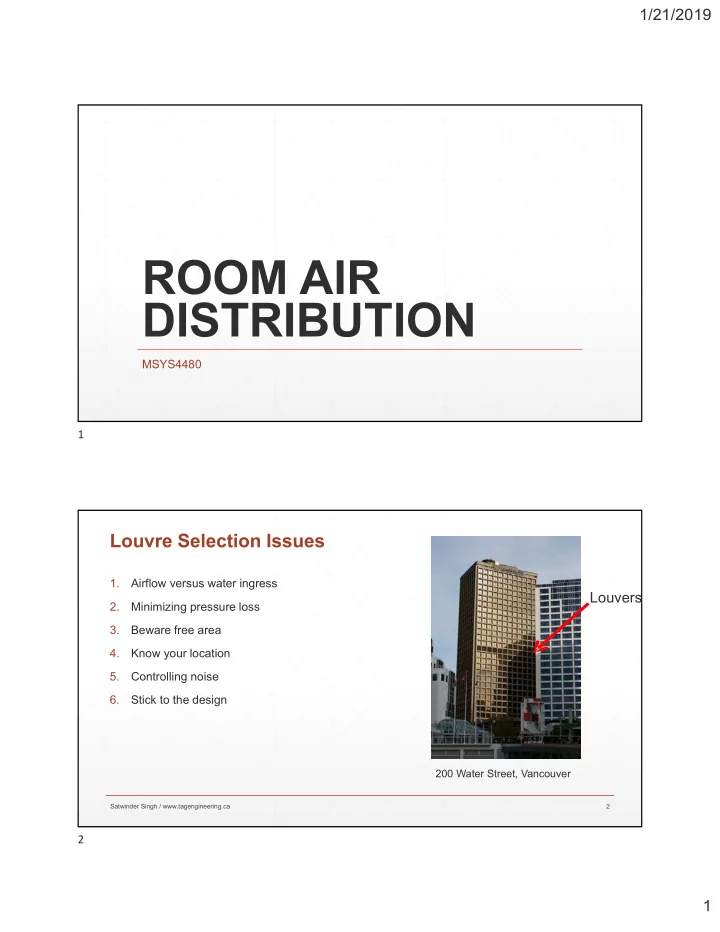
Louvre Selection Issues

1. Airflow versus water ingress 2. Minimizing pressure loss 3. Beware free area 4. Know your location 5. Controlling noise 6. Stick to the design

Louvers

200 Water Street, Vancouver

Satwinder Singh / www.tagengineering.ca 2

1 2

slide-2
SLIDE 2

1/21/2019 2

38

Louvres

39

Satwinder Singh / www.tagengineering.ca 3

Sloped Plenum Detail

Satwinder Singh / www.tagengineering.ca 4

3 4

slide-3
SLIDE 3

1/21/2019 3

  • Traditional louvres provide protection

from non-storm rain

  • Wind Driven Rain Resistant louver provide

storm condition protection

  • Let’s look at the differences…

Louvre Types

Satwinder Singh / www.tagengineering.ca 5

Traditional Louvres:

  • Horizontal blades
  • Drain Gutters
  • Wide Spacing
  • High free area
  • Low cost
  • Stops some rain
  • Not effective in storms

Louvres

Satwinder Singh / www.tagengineering.ca 6

5 6

slide-4
SLIDE 4

1/21/2019 4

Louvres

Traditional Louvre Sizing:

  • AMCA water penetration test – Beginning point of water

penetration free area velocity (FAV)

  • Determine design FAV considering AMCA test data
  • CFM/FAV = Total free area required
  • Reference louvre free area guide to determine appropriate

louvre size

Satwinder Singh / www.tagengineering.ca 7

.01 oz./ft,

  • f free

area

Water Penetration Graph

Satwinder Singh / www.tagengineering.ca 8

7 8

slide-5
SLIDE 5

1/21/2019 5

Air Performance Rating

Satwinder Singh / www.tagengineering.ca 9

Traditional Louvres

Where to use:

  • Properly drained applications
  • Sloped plenums & ductwork
  • Floor drains
  • Protected areas (overhangs, barriers,

interiors, non-prevailing wind elevations)

  • “Screen” applications (vision barriers)

Sizing

  • Use safety factor of 15 to 20%

Note

  • Does not stop storm rain

Satwinder Singh / www.tagengineering.ca 10

9 10

slide-6
SLIDE 6

1/21/2019 6 Wind Driven Rain Louvres

  • Horizontal or Vertical blades
  • Drain Gutters on horizontal
  • Hooks on vertical
  • Close spacing
  • Lower free area
  • Higher velocity
  • Effective in storms

New Louvres

Satwinder Singh / www.tagengineering.ca 11

Horizontal blade models Vertical Blade Models

40% - 50% free area 2” to 8” deep Class A @ 800 to 1200 fpm Moderate ∆p Traditional appearance 40% - 45% free area 3” to 7” deep Class A @ 1500 to 2100 fpm Low ∆p Best performance

Wind Driven Rain Louvres

Satwinder Singh / www.tagengineering.ca 12

11 12

slide-7
SLIDE 7

1/21/2019 7

Wind Driven Louvre Benefits

Prevent rain infiltration

  • Lessens interior water damage & mold growth
  • Helps keep walls & floors dry
  • Helps keep filters dry
  • Excellent for penthouses

Allow higher intake velocities

  • Use smaller louvres

Reduce future problems & liability

Satwinder Singh / www.tagengineering.ca 13

48” x 48” & 7,000 cfm

  • 6” Traditional

710 fpm

  • .07”

∆p 60% Wind Driven Rain Effectiveness (29 mph)

  • Cost 1.0
  • 5” Horizontal

1,002 fpm WDR

  • .16”

∆p 99.8% Wind Driven Rain Effectiveness (29 mph) Cost 1.7

  • 6” Vertical

1,030 fpm WDR

  • .09”

∆p 99.8% Wind Driven Rain Effectiveness (50 mph)

  • Cost 2.7
  • 48”

x 36” (25% smaller) 1,488 fpm

  • .18”

∆p 99.8% Wind Driven Rain Effectiveness (50 mph)

  • Cost 2.3

Sizing Example

Satwinder Singh / www.tagengineering.ca 14

13 14
slide-8
SLIDE 8

1/21/2019 8

Traditional style, allows rain penetration Wind Driven Rain Design, prevents rain penetration

Rooftop Intakes

Satwinder Singh / www.tagengineering.ca 15

What About Snow?

Prevent snow infiltration

  • Heated screens behind

louvres

  • Reasonable pressure drop
  • Relatively slow airflow – 350

FPM face velocity

Satwinder Singh / www.tagengineering.ca 16

15 16

slide-9
SLIDE 9

1/21/2019 9

Common Accessories

Bird and insect screens prevent louvres from becoming nests Insulated blank off plates are used when future capacity is planned but yet needed Acoustic Screens

Satwinder Singh / www.tagengineering.ca 17

Air Exhaust

Water Droplets Waterdrop Manifold Wetted Wall Manifold Test Unit

Air Entrained into chamber through louver

Air Flow Measurement Collection Zone Exhaust Fan “Still Air” Condition!

Standard 500-L Louvres

Satwinder Singh / www.tagengineering.ca 18

17 18

slide-10
SLIDE 10

1/21/2019 10

52

Wind/Rain Machine Test Louver Wind Driven Rain plus Air Entrained Into Chamber Through Louver Air Exhaust Exhaust Fan Collection Zone Rain Water Discharge Nozzles

Std 500-L Wind Driven Rain Test

5.11 Water Rejection Wind Driven Rain

Satwinder Singh / www.tagengineering.ca 19

  • Rejection EffectivenessClasses

A 99% to 100% B 95% to 98.9% C 94.9% to 80% D below 80% (std. louvers)

  • 3” rain/29 mph wind
  • 8” rain/50 mph wind

53

Std 500-L Wind Driven Rain Test

Satwinder Singh / www.tagengineering.ca 20

19 20

slide-11
SLIDE 11

1/21/2019 11

Rear view, 29 mph wind, 3”/hr rain, 2,000 fpm intake velocity

Satwinder Singh / www.tagengineering.ca 21

How Much Water Is Applied?

  • 3” Per Hour Rain On 1m X 1m
  • 21 Gallons Applied Over 1 Hr.

– Class A (99% or better) allows 27 fl. oz penetration – Class D (80% or worse) allows over 4 gallons – Std Louvers (60% or lower) - over 7 gallons

Satwinder Singh / www.tagengineering.ca 22

21 22

slide-12
SLIDE 12

1/21/2019 12 Test Conditions

  • 48” x 48” size
  • 15 minute intervals
  • Manifold (raindrops) - 4” per

hour (3.15 gal/15 min)

  • Wetted wall - .25 gpm (3.75

gallons/15 min)

  • Ventilation airflow only – no

wind

  • 1250 fpm max free area

velocity

Standard 500-L Louvres

Satwinder Singh / www.tagengineering.ca 23

AMCA “Still Air” Water Test

Satwinder Singh / www.tagengineering.ca 24

23 24

slide-13
SLIDE 13

1/21/2019 13

“Still Air” Test with Non-drainable Louvre

Satwinder Singh / www.tagengineering.ca 25

Traditional Drainable Louvre 29 mph wind, 3”/hr rain, 1,000 fpm intake velocity

Satwinder Singh / www.tagengineering.ca 26

25 26