Road Map Robert Gallagers Minimum Delay Routing Algorithm Using - - PowerPoint PPT Presentation

road map robert gallager s minimum delay routing
SMART_READER_LITE
LIVE PREVIEW

Road Map Robert Gallagers Minimum Delay Routing Algorithm Using - - PowerPoint PPT Presentation

Road Map Robert Gallagers Minimum Delay Routing Algorithm Using Introduction 1 Distributed Computation Model 2 Timo Bingmann and Dimitar Yordanov Algorithm 3 Decentralized Systems and Network Services Research Group Institute of


slide-1
SLIDE 1

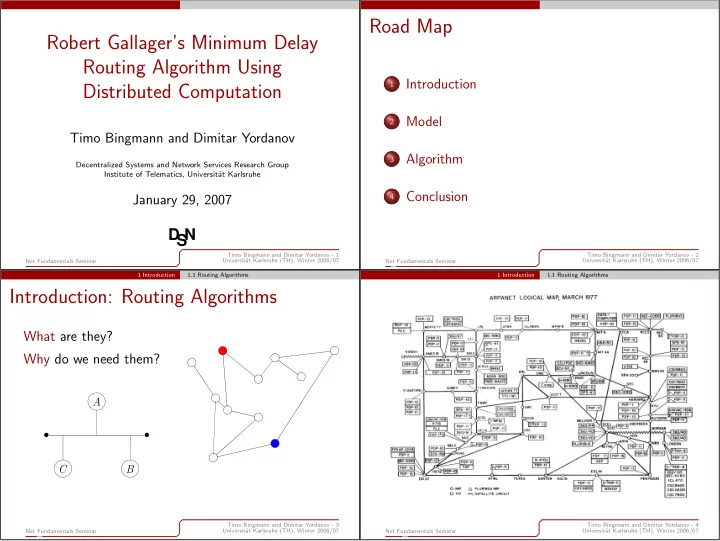
Robert Gallager’s Minimum Delay Routing Algorithm Using Distributed Computation

Timo Bingmann and Dimitar Yordanov

Decentralized Systems and Network Services Research Group Institute of Telematics, Universität Karlsruhe

January 29, 2007

Net Fundamentals Seminar Timo Bingmann and Dimitar Yordanov - 1 Universität Karlsruhe (TH), Winter 2006/07

Road Map

1

Introduction

2

Model

3

Algorithm

4

Conclusion

Net Fundamentals Seminar Timo Bingmann and Dimitar Yordanov - 2 Universität Karlsruhe (TH), Winter 2006/07 1 Introduction 1.1 Routing Algorithms

Introduction: Routing Algorithms

What are they? Why do we need them?

A B C

  • Net Fundamentals Seminar

Timo Bingmann and Dimitar Yordanov - 3 Universität Karlsruhe (TH), Winter 2006/07 1 Introduction 1.1 Routing Algorithms Net Fundamentals Seminar Timo Bingmann and Dimitar Yordanov - 4 Universität Karlsruhe (TH), Winter 2006/07

slide-2
SLIDE 2

1 Introduction 1.1 Routing Algorithms

Goals of Routing Algorithms

Primary Goal

Achieve “good” or even optimal routing. How to measure routing quality? → Routing metrics

Other Aims

little network overhead stability and reliablity adapt to changes quickly converge to optimal state scale well

Net Fundamentals Seminar Timo Bingmann and Dimitar Yordanov - 5 Universität Karlsruhe (TH), Winter 2006/07 1 Introduction 1.1 Routing Algorithms

Characteristics

Route Calculation Time

Static routing algorithms Dynamic routing algorithms Quasi-static routing algorithms

Net Fundamentals Seminar Timo Bingmann and Dimitar Yordanov - 6 Universität Karlsruhe (TH), Winter 2006/07 1 Introduction 1.1 Routing Algorithms

Characteristics

Other Characteristics

Single-Path vs. Multi-Path Algorithms Centralized vs. Distributed Algorithms User vs. System Optimization

Net Fundamentals Seminar Timo Bingmann and Dimitar Yordanov - 7 Universität Karlsruhe (TH), Winter 2006/07 2 Model 2.1 Model Development

Model

Net Fundamentals Seminar Timo Bingmann and Dimitar Yordanov - 8 Universität Karlsruhe (TH), Winter 2006/07

slide-3
SLIDE 3

2 Model 2.1 Model Development

Model

i j k l Set of n nodes enumerated by {1, 2, . . . , n} Set of links: L := {(i, j) is existing link}

Net Fundamentals Seminar Timo Bingmann and Dimitar Yordanov - 9 Universität Karlsruhe (TH), Winter 2006/07 2 Model 2.1 Model Development

Model

i j k l

ri(j) rl(j) ri(j)+rl(j)

Input traffic entering at i and destined for j: ri(j). e.g. in kbit/s

Net Fundamentals Seminar Timo Bingmann and Dimitar Yordanov - 9 Universität Karlsruhe (TH), Winter 2006/07 2 Model 2.1 Model Development

Model

i j k l

ri(j) φik(j)= 1

2

φil(j)= 1

2

φkj(j)= 2

3

φkl(j)= 1

3

φlj(j)=1 rl(j) ri(j)+rl(j)

Routing variables φik(j): Fraction of traffic destined for j travelling link (i, k).

Net Fundamentals Seminar Timo Bingmann and Dimitar Yordanov - 9 Universität Karlsruhe (TH), Winter 2006/07 2 Model 2.1 Model Development

Model

i j k

tk(j)

l

tl(j) ti(j)=ri(j) φik(j)= 1

2

φil(j)= 1

2

φkj(j)= 2

3

φkl(j)= 1

3

φlj(j)=1 rl(j) ri(j)+rl(j)=tj (j)

Sum over all traffic at node i destined for j: ti(j).

Net Fundamentals Seminar Timo Bingmann and Dimitar Yordanov - 9 Universität Karlsruhe (TH), Winter 2006/07

slide-4
SLIDE 4

2 Model 2.1 Model Development

Constraints on φ

1

No traffic on non-existing links and no loopback traffic φik(j) = 0 ∀ (i, j) / ∈ L or i = j

2

No loss of traffic is allowed.

n

  • k=1

φik(j) = 1 ∀ i, j

3

All nodes are inter-connected. φik(j) > 0, φkl(j) > 0, . . . , φmj(j) > 0 ∃ i, k, l, . . . , m, j ∀ i, j

Net Fundamentals Seminar Timo Bingmann and Dimitar Yordanov - 10 Universität Karlsruhe (TH), Winter 2006/07 2 Model 2.1 Model Development

Model

i j k

tk(j)=ti(j)φik(j)

l

tl(j)=rl(j)+ti(j)φil(j)+tk(j)φkl(j) ti(j)=ri(j) φik(j)= 1

2

φil(j)= 1

2

φkj(j)= 2

3

φkl(j)= 1

3

φlj(j)=1 rl(j) ri(j)+rl(j)=tj (j)

ti(j) = ri(j) +

n

  • l=1

tl(j)φli(j)

Net Fundamentals Seminar Timo Bingmann and Dimitar Yordanov - 11 Universität Karlsruhe (TH), Winter 2006/07 2 Model 2.1 Model Development

Variables

Set of n nodes enumerate by {1, 2, . . . , n} Set of links: L := {(i, j) is existing link} Input traffic set r := {ri(j)} Node flow set t := {ti(j)} Routing variable set φ := {φik(j)}.

Net Fundamentals Seminar Timo Bingmann and Dimitar Yordanov - 12 Universität Karlsruhe (TH), Winter 2006/07 2 Model 2.2 Markov Chain

Theorem 1

The routing variable set φ will actually guide the network’s flow. Formally: An input set r and a routing variable set φ uniquely define a network flow set t.

Net Fundamentals Seminar Timo Bingmann and Dimitar Yordanov - 13 Universität Karlsruhe (TH), Winter 2006/07

slide-5
SLIDE 5

2 Model 2.2 Markov Chain

Routing Variables

1 2

t2=?

3

t3=?

4

100 kbit/s =r1=t1 50 kbit/s=r3 t4=r1+r3=150 kbit/s φ12= 1

2

φ13= 1

2

φ24= 2

3

φ23= 1

3

φ34=1

Net Fundamentals Seminar Timo Bingmann and Dimitar Yordanov - 14 Universität Karlsruhe (TH), Winter 2006/07 2 Model 2.2 Markov Chain

Routing Variables

1 2 3 4

1 2 1 2 2 3 1 3

1

Net Fundamentals Seminar Timo Bingmann and Dimitar Yordanov - 14 Universität Karlsruhe (TH), Winter 2006/07 2 Model 2.2 Markov Chain

Routing Variables

1 2 3 4

1 2 1 2 2 3 1 3

1

Find steady state by introducing imaginary links which transfer traffic back to its source node.

Net Fundamentals Seminar Timo Bingmann and Dimitar Yordanov - 14 Universität Karlsruhe (TH), Winter 2006/07 2 Model 2.2 Markov Chain

Routing Variables

1 2 3 4

100 kbit/s 50 kbit/s 150 kbit/s

1 2 1 2 2 3 1 3

1

2 3 1 3

φji(j) := ri(j)

  • k rk(j)

Net Fundamentals Seminar Timo Bingmann and Dimitar Yordanov - 14 Universität Karlsruhe (TH), Winter 2006/07

slide-6
SLIDE 6

2 Model 2.2 Markov Chain

Markov Transition Matrix

Φ = (φik(j))i,k =     

1 2 1 2 0

0 0

1 3 2 3

0 0 0 1

2 3 0 1 3 0

     The second constraint on φ and φik(j) ≥ 0 are the defining properties of a stochastic matrix.

Net Fundamentals Seminar Timo Bingmann and Dimitar Yordanov - 15 Universität Karlsruhe (TH), Winter 2006/07 2 Model 2.2 Markov Chain

Markov Equation

With φji(j) :=

ri(j)

  • k rk(j) the aggregation equation

ti(j) = ri(j) +

n

  • l=1

tl(j)φli(j) can be contracted to ti(j) =

n

  • l=1

tl(j)φli(j) ⇔ ¯ t = ¯ tΦ

Net Fundamentals Seminar Timo Bingmann and Dimitar Yordanov - 16 Universität Karlsruhe (TH), Winter 2006/07 2 Model 2.2 Markov Chain

Equilibrium Distribution

¯ t = ¯ tΦ Is the equation of a Markov chain in an equilibrium state. From Markov chain theory: If the transition matrix is irreducible, then exactly one equilibrium distribution ¯ t exists.

Net Fundamentals Seminar Timo Bingmann and Dimitar Yordanov - 17 Universität Karlsruhe (TH), Winter 2006/07 2 Model 2.2 Markov Chain

Equilibrium in the Example

Φ =     

1 2 1 2 0

0 0

1 3 2 3

0 0 0 1

2 3 0 1 3 0

     lim

n→∞ Φn =

    

6 25 3 25 7 25 9 25 6 25 3 25 7 25 9 25 6 25 3 25 7 25 9 25 6 25 3 25 7 25 9 25

     ⇒ ¯ t′ =     

6 25 3 25 7 25 9 25

    

⇒ ¯ t =      100 50 1161

3

150     

kbit/s

Net Fundamentals Seminar Timo Bingmann and Dimitar Yordanov - 18 Universität Karlsruhe (TH), Winter 2006/07

slide-7
SLIDE 7

2 Model 2.2 Markov Chain

Equilibrium in the Example

1 2

t2=50 kbit/s

3

t3=116 1

3 kbit/s

4

r1=t1=100 kbit/s 50 kbit/s=r3 t4=r1+r3=150 kbit/s

1 2 1 2 2 3 1 3

1

2 3 1 3 Net Fundamentals Seminar Timo Bingmann and Dimitar Yordanov - 19 Universität Karlsruhe (TH), Winter 2006/07 2 Model 2.3 Marginal Delay

Delay

Currently the model only describes traffic flow. Now introduce delay. i

ti(j)

j k

tk(j)

l

tl(j) ri(j) φik(j) φil(j) φkj(j) φkl(j) φlj(j) rl(j) ri(j)+rl(j)

Net Fundamentals Seminar Timo Bingmann and Dimitar Yordanov - 20 Universität Karlsruhe (TH), Winter 2006/07 2 Model 2.3 Marginal Delay

Traffic and Delay

First define total traffic fik on a link (i, k) fik =

  • j

ti(j)φik(j)

Net Fundamentals Seminar Timo Bingmann and Dimitar Yordanov - 21 Universität Karlsruhe (TH), Winter 2006/07 2 Model 2.3 Marginal Delay

Traffic and Delay

Then calculate link delay Dik(fik) from the traffic. Only requirements of Dik: convex and increasing. For example Dik(fik) = fik Cik − fik with link capacity Cik.

0 0 Cik

i k

Net Fundamentals Seminar Timo Bingmann and Dimitar Yordanov - 22 Universität Karlsruhe (TH), Winter 2006/07

slide-8
SLIDE 8

2 Model 2.3 Marginal Delay

Total delay

Finally define total delay DT DT =

  • i,k

Dik(fik) Goal: Minimize DT by setting optimal φik(j). Use same general method as with maximizing rectangle area function in school.

Net Fundamentals Seminar Timo Bingmann and Dimitar Yordanov - 23 Universität Karlsruhe (TH), Winter 2006/07 2 Model 2.3 Marginal Delay

General Method

Problem: Find a, b = g(a) with maximum area A. Set first derivative to zero.

4 8 a b g(x) = −1

2x + 4

A

A(a) = a · b = a · g(a) = −1

2a2 + 4a

A′(a) = −a2 + 4 A′(a) = 0 for a = ± √ 4 ⇒ b = 5

4

  • 2

2

Net Fundamentals Seminar Timo Bingmann and Dimitar Yordanov - 24 Universität Karlsruhe (TH), Winter 2006/07 2 Model 2.3 Marginal Delay

Derivative of DT

Method: Determine the derivative of DT and find a root. But derive DT by which parameter? DT is the sum of all delays Dik. Each Dik is a function of the link traffic fik. fik is somehow determined by r, t and φ. D′

ik(fik) = dDik(fik)

dfik

Net Fundamentals Seminar Timo Bingmann and Dimitar Yordanov - 25 Universität Karlsruhe (TH), Winter 2006/07 2 Model 2.3 Marginal Delay

Partial Derivatives of DT

Easier: Determine partial derivative ∂DT ∂ri(j) How does more input traffic change total delay? i j k

εφik(j) ∂DT ∂rk(j)

l

εφil(j) ∂DT ∂rl(j) ri(j)+ε Dik(fik)+εφik(j)D′

ik(fik)

Dil(fil)+εφil(j)D′

il(fil)

ri(j)+ε

Net Fundamentals Seminar Timo Bingmann and Dimitar Yordanov - 26 Universität Karlsruhe (TH), Winter 2006/07

slide-9
SLIDE 9

2 Model 2.3 Marginal Delay

Partial Derivatives of DT

Partial derivative regarding input traffic: ∂DT ∂ri(j) =

  • k

φik(j)

  • D′

ik(fik) + ∂DT

∂rk(j)

  • Calculate marginal (incremental) delay in this

example: 1

∂DT ∂r1

2

∂DT ∂r2

3

∂DT ∂r3

4

∂DT ∂r4

r1 φ12= 1

2

D′

12=3

φ13= 1

2

D′

13=1

φ23= 3

4

D′

23=1

φ24= 1

4

D′

24=4

φ34=1 D′

34=3

r1

Net Fundamentals Seminar Timo Bingmann and Dimitar Yordanov - 27 Universität Karlsruhe (TH), Winter 2006/07 2 Model 2.3 Marginal Delay

Partial Derivatives of DT

Partial derivative regarding input traffic: ∂DT ∂ri(j) =

  • k

φik(j)

  • D′

ik(fik) + ∂DT

∂rk(j)

  • Calculate marginal (incremental) delay in this

example: 1

∂DT ∂r1 = 11 2

2

∂DT ∂r2 =4

3

∂DT ∂r3 =3

4

∂DT ∂r4 =0

r1 φ12= 1

2

D′

12=3

φ13= 1

2

D′

13=1

φ23= 3

4

D′

23=1

φ24= 1

4

D′

24=4

φ34=1 D′

34=3

r1

Net Fundamentals Seminar Timo Bingmann and Dimitar Yordanov - 27 Universität Karlsruhe (TH), Winter 2006/07 2 Model 2.3 Marginal Delay

Partial Derivatives of DT

However a future algorithm should change routing variables φik(j). So determine their change to delay:

∂DT ∂φik(j)

i k

εti(j) ∂DT ∂rk(j)

j

ti(j) φik(j)+ε Dik(fik)+εti(j)D′

ik(fik) Net Fundamentals Seminar Timo Bingmann and Dimitar Yordanov - 28 Universität Karlsruhe (TH), Winter 2006/07 2 Model 2.4 Necessary Condition

Finding a Root

∂DT ∂φik(j) = ti(j)

  • D′

ik(fik) + ∂DT

∂rk(j)

  • Find a stationary point of DT regarded as a function
  • f φik(j) in which all

∂DT ∂φik(j) = 0 (∇DT(φ) = 0).

However φ has the three constraints ⇒ Lagrange multipliers are required.

Net Fundamentals Seminar Timo Bingmann and Dimitar Yordanov - 29 Universität Karlsruhe (TH), Winter 2006/07

slide-10
SLIDE 10

2 Model 2.4 Necessary Condition

Lagrange Multipliers

Formalize the constraints into a function g(φ) = 0, with ∇g(φ) = 0. Introduce Lagrange multipliers λ and solve: ∇DT(φ) = −λg(φ) g(φ) = 0

Net Fundamentals Seminar Timo Bingmann and Dimitar Yordanov - 30 Universität Karlsruhe (TH), Winter 2006/07 2 Model 2.4 Necessary Condition

Lagrange Multipliers

Result: ∂DT ∂φik(j)

  • = λij,

φik(j) > 0 ≥ λij, φik(j) = 0 ∀ i = j ∀ (i, k) ∈ L Note that the λij do not depend on k. ⇒ All used links must have same marginal delay. Unused must have greater marginal delay.

Net Fundamentals Seminar Timo Bingmann and Dimitar Yordanov - 31 Universität Karlsruhe (TH), Winter 2006/07 2 Model 2.5 Sufficient Condition

Only Necessary

However this condition is not sufficient. Counter-example: 1

∂DT ∂r1 =3

2

∂DT ∂r2 =3

t2=0

3

∂DT ∂r3 =1

4

∂DT ∂r4 =0

r1 φ14=1 D′

14=3

φ12=0 D′

12=1

φ23=1 D′

23=2

φ24=0 D′

24=1

φ34=1 D′

34=1

r1

Net Fundamentals Seminar Timo Bingmann and Dimitar Yordanov - 32 Universität Karlsruhe (TH), Winter 2006/07 2 Model 2.5 Sufficient Condition

Sufficient Condition

Brilliant idea of Gallager: remove the factor ti(j) ∂DT ∂ri(j) ≤ D′

ik(fik) + ∂DT

∂rk(j) Intuitive reduction of delay: i

∂DT ∂ri(j)

k

∂DT ∂rk(j)

j

ti(j) ≤ D′

ik(fik) + Net Fundamentals Seminar Timo Bingmann and Dimitar Yordanov - 33 Universität Karlsruhe (TH), Winter 2006/07

slide-11
SLIDE 11

2 Model 2.5 Sufficient Condition

Sufficient Condition

Brilliant idea of Gallager: remove the factor ti(j) ∂DT ∂ri(j) ≤ D′

ik(fik) + ∂DT

∂rk(j) Intuitive reduction of delay (Contraposition): i

∂DT ∂ri(j)

k

∂DT ∂rk(j)

j

ti(j) > D′

ik(fik) + Net Fundamentals Seminar Timo Bingmann and Dimitar Yordanov - 33 Universität Karlsruhe (TH), Winter 2006/07 2 Model 2.5 Sufficient Condition

Transformation into Algorithm

∂DT ∂ri(j) ≤ D′

ik(fik) + ∂DT

∂rk(j) transformed into an iterative version useful for the future algorithm D′

ik(fik) + ∂DT

∂rk(j) ≥ min

(i,m)∈L

  • D′

im(fim) + ∂DT

∂rm(j)

  • Net Fundamentals Seminar

Timo Bingmann and Dimitar Yordanov - 34 Universität Karlsruhe (TH), Winter 2006/07 3 Algorithm 3.1 Algorithm Goal

The Algorithms Main Goal

Calculate new routing variables (φik)

◮ increase φik on links with small marginal delay ◮ decrease φik on links with large marginal delay

During iterative distributed computation:

◮ stable state is reached ◮ optimal solution is found ◮ no deadlock occurs Net Fundamentals Seminar Timo Bingmann and Dimitar Yordanov - 35 Universität Karlsruhe (TH), Winter 2006/07 3 Algorithm 3.1 Algorithm Goal

The Algorithm

1

Determine the necessary variables:

∂Dik ∂ri(j) and D′ ik(fik)

2

Calculate new routing variables φ1

◮ main challenge: keep φ loop free Net Fundamentals Seminar Timo Bingmann and Dimitar Yordanov - 36 Universität Karlsruhe (TH), Winter 2006/07

slide-12
SLIDE 12

3 Algorithm 3.2 Necessary Variables

Variables Available to a Specific Node

A node knows:

◮ its incoming and outgoing links ◮ its neighbors ◮ the amount of traffic flow (can be measured) ◮ its routing variables for all links and destinations Net Fundamentals Seminar Timo Bingmann and Dimitar Yordanov - 37 Universität Karlsruhe (TH), Winter 2006/07 3 Algorithm 3.2 Necessary Variables

Variables Available to a Specific Node

i k1 k2 k3 k4 k5 k6 s j

rs(j) fk3i ti(j) fik4 Dik5(fik5) D′

ik6(fik6)

rs(j)

Net Fundamentals Seminar Timo Bingmann and Dimitar Yordanov - 38 Universität Karlsruhe (TH), Winter 2006/07 3 Algorithm 3.2 Necessary Variables

Variables Available to a Specific Node

i k1 k2 k3 k4 k5 k6 s j

rs(j) fk3i ti(j) fik4 Dik5(fik5) D′

ik6(fik6)

rs(j) ∂DT ∂rk4 ∂DT ∂rk5 send ∂DT ∂rk6

Net Fundamentals Seminar Timo Bingmann and Dimitar Yordanov - 39 Universität Karlsruhe (TH), Winter 2006/07 3 Algorithm 3.2 Necessary Variables

Determine Marginal Delay

Dik can be calculated or measured D′

ik can be calculated from Dik

D′

ik more often measured

Still missing

∂Dik ∂ri(j)

Net Fundamentals Seminar Timo Bingmann and Dimitar Yordanov - 40 Universität Karlsruhe (TH), Winter 2006/07

slide-13
SLIDE 13

3 Algorithm 3.2 Necessary Variables

Downstream Concept

Each node becomes

∂Dik ∂ri(j) from its downstream

neighbors Node k is downstream from i with respect to destination j, if there is a path from i to j through k and all routing variables on the way down to j are positive (i.e. φil1(j) > 0 ... φlnj(j) > 0) i k j

φik(j)>0 φkj(j)>0

Net Fundamentals Seminar Timo Bingmann and Dimitar Yordanov - 41 Universität Karlsruhe (TH), Winter 2006/07 3 Algorithm 3.3 Routing Variables Calculation

Routing Variables Calculation

Calculate new variables in three steps. Determine the best link (lowest marginal delay) Difference between each link k and the best link: aik(j) = D′

ik(fik) + ∂DT

∂rk(j)

  • n link k

  • D′

ib(fib) + ∂DT

∂rb(j)

  • n the best link

Net Fundamentals Seminar Timo Bingmann and Dimitar Yordanov - 42 Universität Karlsruhe (TH), Winter 2006/07 3 Algorithm 3.3 Routing Variables Calculation

Routing Variable Reduction

∆ik(j): the reduction of routing variable φik(j) ∆ik(j) = min

  • φik(j),

η ti(j)aik(j)

  • with a small scale factor η.

Net Fundamentals Seminar Timo Bingmann and Dimitar Yordanov - 43 Universität Karlsruhe (TH), Winter 2006/07 3 Algorithm 3.3 Routing Variables Calculation

The New Routing Variables

φ1

ik(j) =

                         φik(j) − ∆ik(j), if (i, k) is not the best link φib(j) +

  • (i,m)∈L

m=b

∆im(j), if (i, k) is the best link and therefore k = b

Net Fundamentals Seminar Timo Bingmann and Dimitar Yordanov - 44 Universität Karlsruhe (TH), Winter 2006/07

slide-14
SLIDE 14

3 Algorithm 3.4 Loop Freedom

Blocked Set

Blocked set Bi(j): restrict flow from node i

◮ require: φik(j) = 0 ∀ k ∈ Bi(j)

Nodes included in Bi(j)

◮ nodes, which do not have link to node i ◮ neighbors, which have downstream paths containing

a loop

Net Fundamentals Seminar Timo Bingmann and Dimitar Yordanov - 45 Universität Karlsruhe (TH), Winter 2006/07 3 Algorithm 3.4 Loop Freedom

Improper Routing Variables

A routing variable φik(j) is defined as improper if φik(j) > 0 and ∂DT ∂ri(j) ≤ ∂DT ∂rk(j) 1

3= ∂DT

∂r1

3

∂DT ∂r3 =0

2

∂DT ∂r2 =2

improper if φ21>0

Net Fundamentals Seminar Timo Bingmann and Dimitar Yordanov - 46 Universität Karlsruhe (TH), Winter 2006/07 3 Algorithm 3.4 Loop Freedom

Blocked Set Definition

Formally Bi(j) includes all nodes k, for which φik(j) = 0 and k can route packets to j over a path that contains some link (l, m) with improper φlm(j) and φ1

lm(j) > 0.

Net Fundamentals Seminar Timo Bingmann and Dimitar Yordanov - 47 Universität Karlsruhe (TH), Winter 2006/07 3 Algorithm 3.4 Loop Freedom

Example

1

∂DT ∂r1(4)=4

2

∂DT ∂r2(4)=2

3

∂DT ∂r3(4)=3

4

∂DT ∂r4(4)=0

t1(4) D′

12=2

φ12(4)=1 D′

13=1

φ13(4)=0 D′

24=2

φ24(4)=1 D′

34=1

φ34(4)= 1

2

D′

31=1

φ31(4)= 1

2

(improper) t1(4)

Net Fundamentals Seminar Timo Bingmann and Dimitar Yordanov - 48 Universität Karlsruhe (TH), Winter 2006/07

slide-15
SLIDE 15

3 Algorithm 3.4 Loop Freedom

Theorem 5

For every D0 > 0 there exists a scale factor η for the algorithm A, such that if φ0 satisfies DT(φ0) ≤ D0, then lim

m→∞ DT(Am(φ)) = min φ DT(φ)

Proof is done via seven lemmas over four pages (of twelve) in the paper.

Net Fundamentals Seminar Timo Bingmann and Dimitar Yordanov - 49 Universität Karlsruhe (TH), Winter 2006/07 3 Algorithm 3.4 Loop Freedom

Outline of Proof

Say φ1 := A(φ) and f 1 the new link flow. First goal: calculate DT(φ1) − DT(φ). Gallager uses auxiliary function (0 ≤ λ ≤ 1): DT(λ) =

i,k Dik(f λ ik) with f λ ik = fik + λ(f 1 ik − fik)

and applies Taylor’s remainder theorem in Lagrange form: DT(φ1)−DT(φ) = dDT(λ) dλ

  • (0)+1

2 d2DT(λ) dλ2

  • (λ∗)

Net Fundamentals Seminar Timo Bingmann and Dimitar Yordanov - 50 Universität Karlsruhe (TH), Winter 2006/07 3 Algorithm 3.4 Loop Freedom

Outline of Proof

Lemmas 1 to 4 are used to upper bound dDT(λ)

and

d2DT(λ) dλ2

. Concluding in lemma 5: For D0 say M := max

i,k

max

f :Dik(f )≤D0 D′′ ik(f )

and let η := 1 Mn6, then DT(φ1) − DT(φ) ≤ − 1 2η(n − 1)3

  • i,j

∆2

i (j)t2 i (j)

Net Fundamentals Seminar Timo Bingmann and Dimitar Yordanov - 51 Universität Karlsruhe (TH), Winter 2006/07 3 Algorithm 3.4 Loop Freedom

Outline of Proof

In lemma 6 the last lemma is used to show a strict monotony criterion. Let φ be routing variables with DT(φ) < D0 but not the minimum. Then ∃ ε > 0 and m with 1 ≤ m ≤ n: ∀ φ∗ : |φ − φ∗| < ε : DT(Am(φ∗)) < DT(φ) Proof includes a detailed analysis of the algorithm’s steps for improper links and blocked nodes.

Net Fundamentals Seminar Timo Bingmann and Dimitar Yordanov - 52 Universität Karlsruhe (TH), Winter 2006/07

slide-16
SLIDE 16

3 Algorithm 3.4 Loop Freedom

Outline of Proof

Let Φ ⊆ Rn compact euclidean space of routing variables. Then algorithm is a mapping A : Φ → Φ, and DT : Φ → R a real function. Let Dmin minimum of DT over Φ and Φmin set of φ with DT(φ) = Dmin.

Net Fundamentals Seminar Timo Bingmann and Dimitar Yordanov - 53 Universität Karlsruhe (TH), Winter 2006/07 3 Algorithm 3.4 Loop Freedom

Outline of Proof

r r r r r r r

. . . . . . . . . . . . . . . . . . . . . . . . . . . . . . . . . . . . . . . . . . . . . . . . . . . . . . . . . . . . . . . . . . . . . . . . . . . . . . . . . . . . . . . . . . . . . . . . . . . . . . . . . . . . . . . . . . . . . . . . . . . . . . . . . . . . . . . . . . . . . . . . . . . . . . . . . . . . . . . . . . . . . . . . . . . . . . . . . . . . . . . . . . . . . . . . . . . . . . . . . . . . . . . . . . . . . . . . . . . . . . . . . . . . . . . . . . . . . . . . . . . . . . . . . . . . . . . . . . . . . . . . . . . . . . . . . . . . . . . . . . . . . . . . . . . . . . . . . . . . . . . . . . . . . . . . . . . . . . . . . . . . . . . . . . . . . . . . . . . . . . . . . . . . . . . . . . . . . . . . . . . . . . . . . . . . . . . . . . . . . . . . . . . . . . . . . . . . . . . . . . . . . . . . . . . . . . . . . . . . . . . . . . . . . . . . . . . . . . . . . . . . . . . . . . . . . . . . . . . . . . . . . . . . . . . . . . . . . . . . . . . . . . . . . . . . . . . . . . . . . . . . . . . . . . . . . . . . . . . . . . . . . . . . . . . . . . . . . . . . . . . . . . . . . . . . . . . . . . . . . . . . . . . . . . . . . . . . . . . . . . . . . . . . . . . . . . . . . . . . . . . . . . . . . . . . . . . . . . . . . . . . . . . . . . . . . . . . . . . . . . . . . . . . . . . . . . . . . . . . . . . . . . . . . . . . . . . . . . . . . . . . . . . . . . . . . . . . . . . . . . . . . . . . . . . . . . . . . . . . . . . . . . . . . . . . . . . . . . . . . . . . . . . . . . . . . . . . . . . . . . . . . . . . . . . . . . . . . . . . . . . . . . . . . . . . . . . . . . . . . . . . . . . . . . . . . . . . . . . . . . . . . . . . . . . . . . . . . . . . . . . . . . . . . . . . . . . . . . . . . . . . . . . . . . . . . . . . . . . . . . . . . . . . . . . . . . . . . . . . . . . . . . . . . . . . . . . . . . . . . . . . . . . . . . . . . . . . . . . . . . . . . . . . . . . . . . . . . . . . . . . . . . . . . . . . . . . . . . . . . . . . . . . . . . . . . . . . . . . . . . . . . . . . . . . . . . . . . . . . . . . . . . . . . . . . . . . . . . . . . . . . . . . . . . . . . . . . . . . . . . . . . . . . . . . . . . . . . . . . . . . . . . . . . . . . . . . . . . . . . . . . . . . . . . . . . . . . . . . . . . . . . . . . . . . . . . . . . . . . . . . . . . . . . . . . . . . . . . . . . . . . . . . . . . . . . . . . . . . . . . . . . . . . . . . . . . . . . . . . . . . . . . . . . . . . . . . . . . . . . . . . . . . . . . . . . . . . . . . . . . . . . . . . . . . . . . . . . . . . . . . . . . . . . . . . . . . . . . . . . . . . . . . . . . . . . . . . . . . . . . . . . . . . . . . . . . . . . . . . . . . . . . . . . . . . . . . . . . . . . . . . . . . . . . . . . . . . . . . . . . . . . . . . . . . . . . . . . . . . . . . . . . . . . . . . . . . . . . . . . . . . . . . . . . . . . . . . . . . . . . . . . . . . . . . . . . . . . . . . . . . . . . . . . . . . . . . . . . . . . . . . . . . . . . . . . . . . . . . . . . . . . . . . . . . . . . . . . . . . . . . .. . . . . . . . . . . . . . . . . . . . . . . . . . . . . . . . . . . . . . . . . . . . . . . . . . . . . . . . . . . . . . . . . . . . . . . . . . . . . . . . . . . . . . . . . . . . . . . . . . . . . . . . . . . . . . . . . . . . . . . . . . . . . . . . . . . . . . . . . . . . . . . . . . . . . . . . . . . . . . . . . . . . . . . . . . . . . . . . . . . . . . . . . . . . . . . . . . . . . . . . . . . . . . . . . . . . . . . . . . . . . . . . . . . . . . . . . . . . . . . . . . . . . . . . . . . . . . . . . . . . . . . . . . . . . . . . . . . . . . . . . . . . . . . . . . . . . . . . . . . . . . . . . . . . . . . . . . . . . . . . . . . . . . . . . . . . . . . . . . . . . . . . . . . . . . . . . . . . . . . . . . . . . . . . . . . . . . . . . . . . . . . . . . . . . . . . . . . . . . . . . . . . . . . . . . . . . . . . . . . . . . . . . . . . . . . . . . . . . . . . . . . . . . . . . . . . . . . . . . . . . . . . . . . . . . . . . . . . . . . . . . . . . . . . . . . . . . . . . . . . . . . . . . . . . . . . . . . . . . . . . . . . . . . . . . . . . . . . . . . . . . . . . . . . . . . . . . . . . . . . . . . . . . . . . . . . . . . . . . . . . . . . . . . . . . . . . . . . . . . . . . . . . . . . . . . . . . . . . . . . . . . . . . . . . . . . . . . . . . . . . . . . . . . . . . . . . . . . . . . . . . . . . . . . . . . . . . . . . . . . . . . . . . . . . . . . . . . . . . . . . . . . . . . . . . . . . . . . . . . . . . . . . . . . . . . . . . . . . . . . . . . . . . . . . . . . . . . . . . . . . . . . . . . . . . . . . . . . . . . . . . . . . . . . . . . . . . . . . . . . . . . . . . . . . . . . . . . . . . . . . . . . . . . . . . . . . . . . . . . . . . . . . . . . . . . . . . . . . . . . . . . . . . . . . . . . . . . . . . . . . . . . . . . . . . . . . . . . . . . . . . . . . . . . . . . . . . . . . . . . . . . . . . . . . . . . . . . . . . . . . . . . . . . . . . . . . . . . . . . . . . . . . . . . . . . . . . . . . . . . . . . . . . . . . . . . . . . . . . . . . . . . . . . . . . . . . . . . . . . . . . . . . . . . . . . . . . . . . . . . . . . . . . . . . . . . . . . . . . . . . . . . . . . . . . . . . . . . . . . . . . . . . . . . . . . . . . . . . . . . . . . . . . . . . . . . . . . . . . . . . . . . . . . . . . . . . . . . . . . . . . . . . . . . . . . . . . . . . . . . . . . . . . . . . . . . . . . . . . . . . . . . . . . . . . . . . . . . . . . . . . . . . . . . . . . . . . . . . . . . . . . . . . . . . . . . . . . . . . . . . . . . . . . . . . . . . . . . . . . . . . . . . . . . . . . . . . . . . . . . . . . . . . . . . . . . . . . . . . . . . . . . . . . . . . . . . . . . . . . . . . . . . . . . . . . . . . . . . . . . . . . . . . . . . . . . . . . . . . . . . . . . . . . . . . . . . . . . . . . . . . . . . . . . . . . . . . . . . . . . . . . . . . . . . . . . . . . . . . . . . . . . . . . . . . . . . . . . . . . . . . . . . . . . . . . . . . . . . . . . . . . . . . . . . . . . . . . . . . . . . . . . . . . . . . . . . . . . . . . . . . . . . . . . . . . . . . . . . . . . . . . . . . . . . . . . . . . . . . . . . . . . . . . . . . . . . . . . . . . . . . . . . . . . . . . . . . . . . . . . . . . . . . . . . . . . . . . . . . . . . . . . . . . . . . . . . . . . . . . . . . . . . . . . . . . . . . . . . . . . . . . . . . . . . . . . . . . . . . . . . . . . . . . . . . . . . . . . . . . . . . . . . . . . . . . . . . . . . . . . . . . . . . . . . . . . . . . . . . . . . . . . . . . . . . . . . . . . . . . . . . . . . . . . . . . . . . . . . . . . . . . . . . . . . . . . . . . . . . . . . . . . . . . . . . . . . . . . . . . . . . . . . . . . . . . . . . . . . . . . . . . . . . . . . . . . . . . . . . . . . . . . . . . . . . . . . . . . . . . . . . . . . . . . . . . . . . . . . . . . . . . . . . . . . . . . . . . . . . . . . . . . . . . . . . . . . . . . . . . . . . . . . . . . . . . . . . . . . . . . . . . . . . . . . . . . . . . . . . . . . . . . . . . . . . . . . . . . . . . . . . . . . . . . . . . . . . . . . . . . . . . . . . . . . . . . . . . . . . . . . . . . . . . . . . . . . . . . . . . . . . . . . . . . . . . . . . . . . . . . . . . . . . . . . . . . . . . . . . . . . . . . . . . . . . . . . . . . . . . . . . . . . . . . . . . . . . . . . . . . . . . . . . . . . . . . . . . . . . . . . . . . . . . . . . . . . . . . . . . . . . . . . . . . . . . . . . . . . . . . . . . . . . . . . . . . . . . . . . . . . . . . . . . . . . . . . . . . . .

Φmin Φ Φmin A(φ) = φ1 φ0

Net Fundamentals Seminar Timo Bingmann and Dimitar Yordanov - 54 Universität Karlsruhe (TH), Winter 2006/07 3 Algorithm 3.4 Loop Freedom

Outline of Proof

Because Φ is compact the sequence {Am(φ)} has a convergent subsequence {φl}. Let φ′ = liml→∞ φl, and since DT is continuous DT(φ′) = liml→∞ DT(φl). Left to prove: DT(φ′) = Dmin. Follows from DT(Am(φ)) < DT(φ).

Net Fundamentals Seminar Timo Bingmann and Dimitar Yordanov - 55 Universität Karlsruhe (TH), Winter 2006/07 4 Conclusion

Problems

First drawback: required scale parameter η How can the start state be determined? What if links or nodes are dropped or added? Adapting to changing input traffic statistics.

Net Fundamentals Seminar Timo Bingmann and Dimitar Yordanov - 56 Universität Karlsruhe (TH), Winter 2006/07

slide-17
SLIDE 17

4 Conclusion

Conclusion

Rigorous mathematical approach Well designed mathematical model:

◮ describe the minimum total delay problem ◮ conditions for achieving global optimization

Iterative, distributed routing algorithm

◮ proved in detail that the algorithm will always

progress into a network state with total minimum delay

209 citations on Google Scholar, 55 on Citeseer.

Net Fundamentals Seminar Timo Bingmann and Dimitar Yordanov - 57 Universität Karlsruhe (TH), Winter 2006/07