RNA and Gene Expression How does DNA determine our traits? By - - PowerPoint PPT Presentation
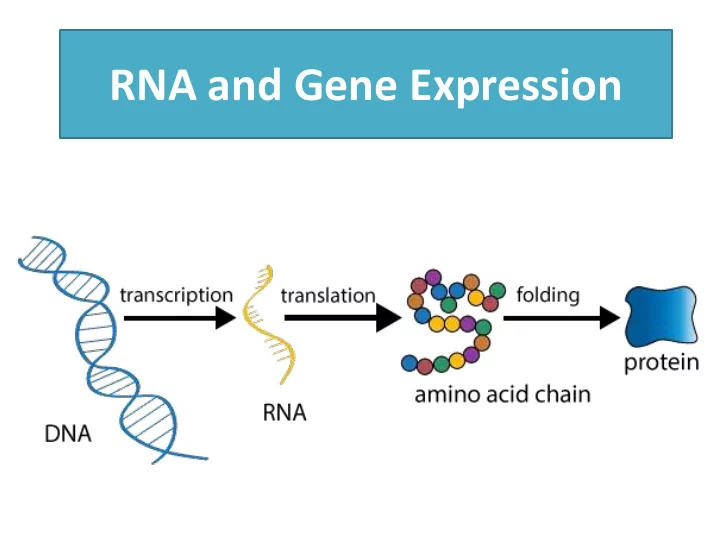
RNA and Gene Expression How does DNA determine our traits? By directing the synthesis of proteins Proteins represent functional genes Molecular flow of information is: DNA RNA Protein Gene Expression 1. Transcription Genetic
How does DNA determine our traits?
- By directing the synthesis of proteins
- Proteins represent functional genes
- Molecular flow of information is:
DNA RNA Protein
Gene Expression
- 1. Transcription – Genetic information is
transferred from DNA to mRNA
- 2. RNA Processing – enzyme-regulated
modifications to the mRNA transcript (eukaryotes only)
- 3. Translation – mRNA information is decoded
to synthesize proteins
“Unpacking” DNA
- Before a gene is
transcribed, the chromatin must relax and expose a gene – this is called “unpacking” the DNA
- The process of
transforming condensed chromatin into a more relaxed structure is accomplished by histone acetylation
ANIMATION
RNA (Ribonucleic acid)
- A nucleic acid
composed of ribose sugars, phosphates, and nitrogenous bases
- How does RNA
differ from DNA?
DNA RNA
- Double stranded
- Deoxyribose sugar
- Adenine, Cytosine,
Guanine, and Thymine
- Located in nucleus only
(side note – mitochondria and chloroplasts also contain DNA)
- Single stranded
- Ribose sugar
- Adenine, Cytosine,
Guanine and Uracil
- Nucleus, cytoplasm, and
ribosomes
What molecules are required for gene expression?
Gene Expression Molecules
- 1. mRNA
- 2. tRNA
- 3. rRNA
- 4. amino acids
- 5. ribosomes
mRNA (messenger)
- linear RNA that transfers genetic information
from DNA to ribosomes
tRNA (transfer)
- RNA (~80 nucleotides in length) twisted in
hairpin shape
- supplies the amino acids to ribosomes for
translation
rRNA (ribosomal)
- globular RNA that composes ribosomes, forms
the peptide bond between amino acids during protein synthesis
Amino Acids
- monomers of proteins
- linked together to form proteins during
translation
Ribosomes
- site of translation (third step of gene
expression)
Gene Expression Animation This animation will show you an
- verview of gene expression
ANIMATION
Eukaryotic Gene Structure
- Promoter
- Exon
- Intron
- Terminator
Gene Expression
- 1. Transcription
- 2. RNA Processing (eukaryotes only)
- 3. Translation
Transcription and RNA Processing
Transcription
Transcription – Virtual Cell HHMI Transcription
Transcription Animations
ANIMATIONS
RNA Processing
- Enzyme-mediated modifications to the mRNA
transcript
- 1. Addition of a GTP cap to 5’ end (protection,
bind to ribosome)
- 2. Addition of a poly-A tail to 3’ end (protection)
- 3. Excision (removal) of introns: non-coding
segments of DNA (RNA splicing)
- mRNA then exits the nucleus
ANIMATION
RNA Processing
Translation (Gene to Protein)
- Genetic information from a sequence of
nucleotides in a gene is used to produce a sequence of amino acids in a protein
- Occurs on ribosomes in the cytoplasm
Translation
- Initiation
- Elongation
- Termination
Translation Terminology
- Codon
- Start codon
- Ribosome
- Stop codon
- Anti-codon
- mRNA
- tRNA
- rRNA
Translation- Virtual Cell
ANIMATION
Genetic Code
HHMI Translation Animation
Translation Animation
ANIMATION
RNA interference (RNAi)
- Regulates gene expression at the level of
mRNA transcription
- Example of an RNAi molecule is microRNA
(miRNA) –Degrades the target mRNA OR –Blocks translation of the mRNA
ANIMATION
Phenotypes Are Determined Through Protein Activities
- Post translation protein modifications
determine the function of proteins: –Transport proteins –Catalytic proteins –Structural proteins