Traits Traits Inheritance of Traits Variation of Traits - - PDF document

traits
SMART_READER_LITE
LIVE PREVIEW

Traits Traits Inheritance of Traits Variation of Traits - - PDF document

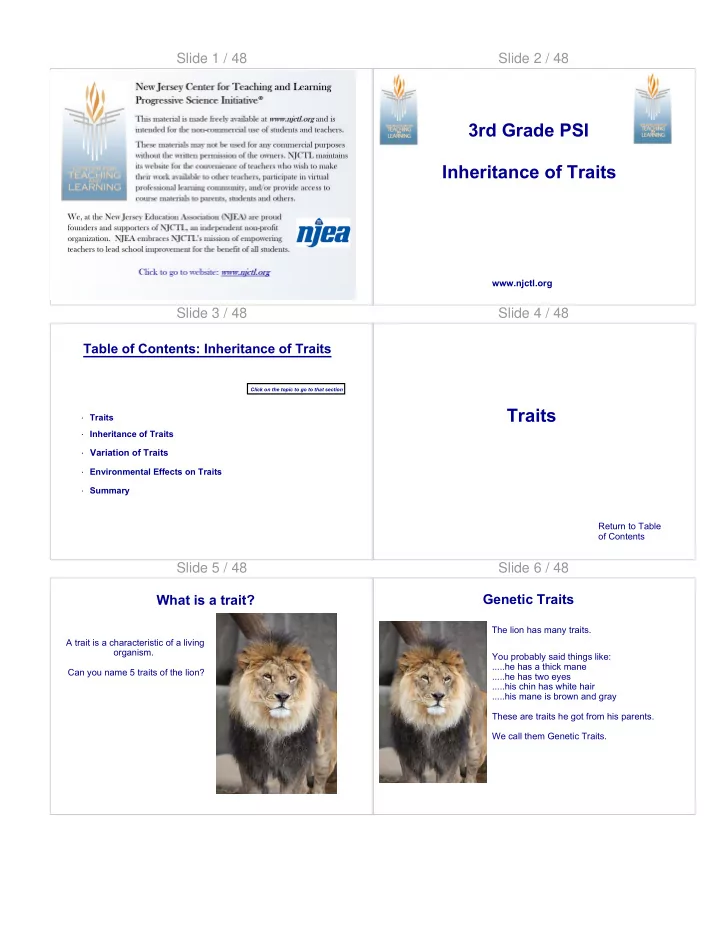
Slide 1 / 48 Slide 2 / 48 3rd Grade PSI Inheritance of Traits www.njctl.org Slide 3 / 48 Slide 4 / 48 Table of Contents: Inheritance of Traits Click on the topic to go to that section Traits Traits Inheritance of Traits Variation


slide-1
SLIDE 1

Slide 1 / 48 Slide 2 / 48

www.njctl.org

3rd Grade PSI Inheritance of Traits

Slide 3 / 48

· Traits · Variation of Traits

Table of Contents: Inheritance of Traits

Click on the topic to go to that section

· Inheritance of Traits · Environmental Effects on Traits · Summary

Slide 4 / 48

Traits

Return to Table

  • f Contents

Slide 5 / 48 What is a trait?

A trait is a characteristic of a living

  • rganism.

Can you name 5 traits of the lion?

Slide 6 / 48 Genetic Traits

You probably said things like: .....he has a thick mane .....he has two eyes .....his chin has white hair .....his mane is brown and gray These are traits he got from his parents. We call them Genetic Traits. The lion has many traits.

slide-2
SLIDE 2

Slide 7 / 48

How many traits can you name about this dog?

Genetic Traits Slide 8 / 48 Can you compare the traits of these dogs?

They have many traits in common, because they are all dogs. Do you think these dogs have the same parents? Why?

Slide 9 / 48

Instincts are traits that are passed to offspring. This puppy is very young, but it has an instinct to howl. An instinct is a useful behavior. Click on the image to listen to the puppy. What else do you notice the puppy doing when he is howling?

Instincts Slide 10 / 48

1 Which of the following would be a trait of this animal? A long whiskers B curly fur C mammal D pink eyes

Answer

Slide 11 / 48

2 Can an instinct be a trait? Yes No

Answer

Slide 12 / 48

3 An instinct is ____________ behavior. A a useful B not a useful

Answer

slide-3
SLIDE 3

Slide 13 / 48

4 A raccoon washing his food before he eats it is an example of __________. A a trait B an instinct C both a trait and an instinct

Answer

Slide 14 / 48 Mustard Seed Lab

Later in this unit, you will learn about how the environment can affect organisms. Right now, you will setup an experiment with mustard seeds that will study this concept. You will continue to observe your mustard seeds throughout the unit.

Slide 15 / 48

Inheritance of Traits

Return to Table

  • f Contents

Slide 16 / 48 Offspring

Living things reproduce and create offspring that are similar to themselves. Although there are many similarities, there may also be some

  • differences. Do you know why?

Slide 17 / 48 Traits are passed from parents to

  • ffspring

It is possible to look at traits and determine which baby belongs to which parent, because they have similar traits. Let’s look at a drawing of a cow to determine the important

  • traits. For example, the size of

the ears varies between types

  • f cows.

What are other characteristics do you think are important to look at?

Slide 18 / 48 Offspring are similar to their parents.

Can you match the parent to the offspring? Below are pictures of adult cows (top) and baby calves (bottom). Can YOU find each matching calf and mother or father? Look for details!! Draw a line from the parent to the offspring.

slide-4
SLIDE 4

Slide 19 / 48

5 Find the offspring of this mother dog. A B C D

Answer

Slide 20 / 48

6 Which is not a direct trait passed on from this bird's parents? A It has a long neck. B It has feathers. C It has long thin legs. D It is 3 years old.

Answer

Slide 21 / 48

7 Can a whale only have whale offspring? Yes No

Answer

Slide 22 / 48

Variation of Traits

Return to Table

  • f Contents

Slide 23 / 48 Are all offspring from the same parents exactly alike?

Look closely at these ducklings. They have the same

  • parents. There

are small differences between each duckling. Can you name some differences?

Slide 24 / 48

We call these differences variations. These puppies have the same parents, yet there is a lot of variation between these puppies. Can you describe the variations?

Variations

slide-5
SLIDE 5

Slide 25 / 48 Reasons For Variation

Some variation is because traits have many possibilities. This is called a "range of traits." These flowers are Petunias. There are many possible colors of Petunias. What flower colors do you see?

Slide 26 / 48 Human Hair Color

There is a large range of human hair color. Of course, only the natural colors are genetic traits.

Can you point out the hair color that is not genetic?

Slide 27 / 48

8 Which is NOT an example of a variation of traits? A A different shade of brown fur B Tall, medium and short plants C chosing to study hard D purple and pink flowers on the same plant

Answer

Slide 28 / 48

9 Offspring are usually _________ one another. A exactly alike B completely different from C similar to

Answer

Slide 29 / 48

10 In the diagram of human skin color, there are 36 possible colors shown. Does skin color have variation? Yes No

Answer

Slide 30 / 48 Variations of Traits Lab: Teacher Page

Obj: Students will determine the offspring of a set group of parents. Materials: What Kind of Slythy Tove activity sheet

  • 1. Give students a copy of the

What Kind of Slythy Tove activity sheet.

  • 2. Guide the students in following the directions on the lab sheet.
slide-6
SLIDE 6

Slide 31 / 48

Environmental Effects on Traits

Return to Table

  • f Contents

Slide 32 / 48 Environmental Effects on Traits Lab: Teacher Page

Obj: Students will observe environmental effects on a living organism's traits. Materials: Environmental Effect on the Growth of Mustard Seeds directions

  • 1. Guide the students in following the directions starting at Step 5.

Slide 33 / 48 The Environment Causes Variation

Often the environment an organism lives in limits how well it can develop. Salt is a poison for most plants. Near the ocean, salt is a "limiting factor." Grasses do not grow too close to the

  • cean because the salt water kills most
  • f them. Only the most hardy grasses

can grow near the sea.

Slide 34 / 48 The Environment Causes Variation

This tree lives in a windy environment. The normal trait would be for the tree to grow straight up. Can you tell which way the wind blows? Answer The seeds of this tree will not be affected. The trees which grow from them will grow up straight.

Slide 35 / 48 More Environmental Effects...

These deer are both White-tail Deer. The deer on the left lives in

  • Florida. The one on the right lives in the mountains. Why do you

think the hot climate deer are smaller? These deer weigh 25 to 34 kg (55–75 lb) and stand about 76 cm (30 in) tall at the shoulder. These deer weigh 60 to 130 kg (130 to 290 lb) and stand about 120 cm (47 in) tall at the shoulder.

Slide 36 / 48

The environment these deer live in affects their traits. The Florida deer must lose heat, so they tend to grow small. If Florida deer grew too large, they would overheat. The mountain deer need a larger body mass in the winter to stay warm. If they were too small they would not survive winter

  • storms. Deer do not make a nest or home. They bed down in

the forest and wait for the storm to pass.

Environmental Selection

slide-7
SLIDE 7

Slide 37 / 48 Environmental Selection

Size is a genetic trait. All the Florida White-tail Deer are small, and all the mountain White-tail Deer are large. In this case, the environment has affected the genetic traits of the

  • deer. This is environmental selection.

Temperature limits the size range of the deer in different climates.

Slide 38 / 48 More Environmental Effects - Malnutrition

This horse, chick and person suffer from malnutrition. Malnutrition is not having the correct nutrients, or enough food energy (calories) to allow proper growth. The traits their parents gave them can not be fully expressed. With proper nutrition, they can often heal fully.

Slide 39 / 48 More Environmental Effects - Lack of Water

The hill in this picture is not far away. The soil is very poor and does not hold enough water for the trees to grow fully. They are the same kind of trees as the ones in front, but their growth is stunted.

Slide 40 / 48 Environmental Effects - Harmful Substances

Some substances in the environment affect your traits as well, sometimes permanently. Lead is a poison if it is swallowed. All the places in this picture are affected. The brain is affected the most by

  • lead. People lose the ability to think
  • clearly. Even if the person has the

trait to be smart, the lead limits them.

Slide 41 / 48

11 Does the best growth always happen in a healthy environment? Yes No

Answer

Slide 42 / 48

12 The environmental factor that affected the growth of this tree was __________. A wind B too little water C poison D heat

Answer

slide-8
SLIDE 8

Slide 43 / 48

13 These children suffer from malnutrition. That means they do not get enough ___________. A fresh air B food C sunshine D water

Answer

Slide 44 / 48 Virtual Field Lab

How are traits influenced by the environment? Is this something that can be studied and observed?

Slide 45 / 48

Summary

Return to Table

  • f Contents

Slide 46 / 48 Putting it all together

Living things reproduce to create ___________. Offspring have ________ that they inherit from their

  • parents. These are ___________ traits.

A genetic trait is a characteristic such as fur color, instinct, and if the organism is a male or a female.

Slide 47 / 48 Putting it all together

Differences in genetic traits are called ___________. Some variations are common, and part of what makes individuals unique. These are in the range of traits. The _____________ can cause variations too. The environment can limit the expression of some traits. Some

  • f these effects, like wind, will not be passed on to the
  • ffspring. Some of these, like deer size, are passed to the
  • ffspring.

Slide 48 / 48