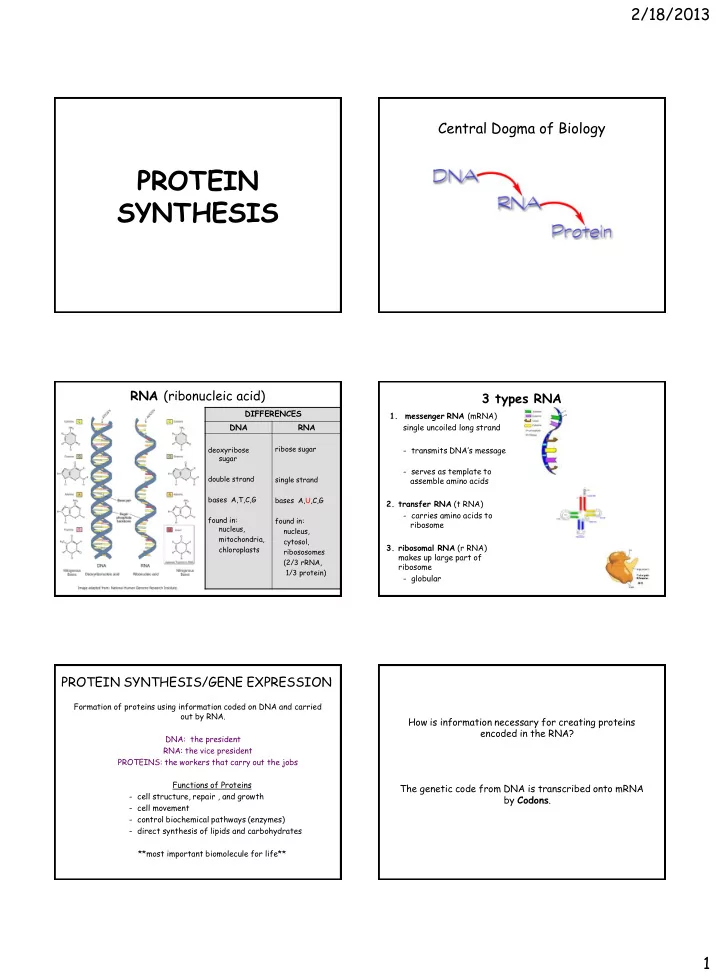
PROTEIN SYNTHESIS RNA (ribonucleic acid) 3 types RNA DIFFERENCES - - PDF document

protein synthesis
SMART_READER_LITE
LIVE PREVIEW

PROTEIN SYNTHESIS RNA (ribonucleic acid) 3 types RNA DIFFERENCES - - PDF document

2/18/2013 Central Dogma of Biology PROTEIN SYNTHESIS RNA (ribonucleic acid) 3 types RNA DIFFERENCES 1. messenger RNA (mRNA) DNA RNA single uncoiled long strand ribose sugar deoxyribose - transmits DNAs message sugar - serves as


slide-1
SLIDE 1

2/18/2013 1

PROTEIN SYNTHESIS

Central Dogma of Biology

RNA (ribonucleic acid)

DIFFERENCES DNA RNA

deoxyribose sugar double strand bases A,T,C,G found in: nucleus, mitochondria, chloroplasts ribose sugar single strand bases A,U,C,G found in: nucleus, cytosol, ribososomes (2/3 rRNA, 1/3 protein)

3 types RNA

  • 1. messenger RNA (mRNA)

single uncoiled long strand

  • transmits DNA’s message
  • serves as template to

assemble amino acids

  • 2. transfer RNA (t RNA)
  • carries amino acids to

ribosome

  • 3. ribosomal RNA (r RNA)

makes up large part of ribosome

  • globular

PROTEIN SYNTHESIS/GENE EXPRESSION

Formation of proteins using information coded on DNA and carried

  • ut by RNA.

DNA: the president RNA: the vice president PROTEINS: the workers that carry out the jobs Functions of Proteins

  • cell structure, repair , and growth
  • cell movement
  • control biochemical pathways (enzymes)
  • direct synthesis of lipids and carbohydrates

**most important biomolecule for life**

How is information necessary for creating proteins encoded in the RNA? The genetic code from DNA is transcribed onto mRNA by Codons.

slide-2
SLIDE 2

2/18/2013 2

Code Word/Codon (triplet):

specific group of 3 successive bases on DNA and mRNA

  • codes for a specific amino acid to be placed on

the protein chain

  • 20 biological amino acids, but more than 20 codons

Like “genetic words” DNA code words: ACA, GCA, TTA RNA codons: TGU, CGU, AAU How many combinations of code words/codons can we make from 4 bases? 64 combinations ( 43 = 64) ** each code word always codes for same amino acid**

Ala: Alanine Cys: Cysteine Asp: Aspartic acid Glu: Glutamic acid Phe: Phenylalanine Gly: Glycine His: Histidine Ile: Isoleucine Lys: Lysine Leu: Leucine Met: Methionine Asn: Asparagine Pro: Proline Gln: Glutamine Arg: Arginine Ser: Serine Thr: Threonine Val: Valine Trp: Tryptophane Tyr: Tyrosisne

How do these code words affect protein synthesis?

Order of code words codes for Order of amino acids codes for Specific type of protein

Stages of Protein Synthesis

  • Building of proteins

2 Stages

  • 1. Transcription

(makes mRNA)

  • 2. Translation

(makes protein)

Stages of Protein Synthesis

I. Transcription (nucleus)

  • first main stage
  • mRNA made from DNA

Steps of transcription

  • 1. The part of the DNA to be

transcribed unzips (only one strand of DNA

molecule needed for transcription)

start codon: AUG always codes for methionine

slide-3
SLIDE 3

2/18/2013 3

Transcription, cont.

  • 2. Complementary nucleotides

are added to the end of RNA (once RNA nucleotides are attached to DNA chain, codons are in proper order)

transcription animation

  • 3. A. Messenger RNA is made until

a stop codon is reached.

  • stop codons:

UAA, UAG, UGA

  • B. Newly formed m RNA goes

into cytoplasm to ribosomes

  • C. DNA rewinds
  • II. Translation (in cytoplasm at ribosome)
  • second main stage
  • process whereby protein is synthesized (created)

from mRNA

  • occurs in cytoplasm
  • gene has 100x more nucleotides than the

protein it makes Ex: 100 a.a. = 300 nucleotides 2 Components of Translation

  • 1. Transfer RNA (t RNA)
  • function: transfers amino

acids to ribosome

  • 20 types – one for each

amino acid (specific for each a.a.)

  • found in cytosol
  • 2. Ribosome
  • 2 subunits make up ribosome
  • normally apart in cytoplasm,

come together during protein synthesis

Steps of translation (second main stage)

1. Subunits attach with MRNA in between them (ribosome ready for protein synthesis)

  • Ribosome moves down mRNA and reads its message
  • amino acid 1 will always be

methionine

  • 2. A. T-RNA with its amino acids

bond to ribosomes

  • B. first a.a. joins to second a.a.
  • C. ribosome moves down mRNA and

first tRNA is released to be used over again

  • D. amino acids continue to be

added to protein chain thru same mechanism 3.stop codon is reached (UAA, UGA, or UAG).

  • A. subunits separate

(can be used over again)

  • B. protein is released into cell
  • C. mRNA is broken down by cell

(not be used again)

  • D. tRNA is released into cell

(used over again)

Protein synthesis animation Protein synthesis animation 2