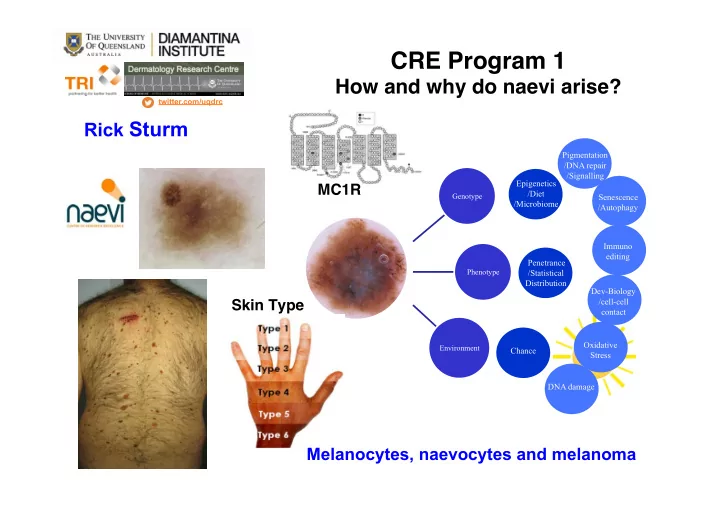
SLIDE 1 Genotype Phenotype Environment
Skin Type
Rick Sturm
CRE Program 1
How and why do naevi arise?
twitter.com/uqdrc
Epigenetics /Diet /Microbiome Chance Penetrance /Statistical Distribution Pigmentation /DNA repair /Signalling Oxidative Stress Dev-Biology /cell-cell contact DNA damage Senescence /Autophagy Immuno editing
Melanocytes, naevocytes and melanoma
MC1R
SLIDE 2
600 control subjects 600 CMM cases or Family History
Brisbane Naevus Morphology Study (BNMS) 2011 to 2016
All have been submitted for Illumina HumanCoreExome genotyping = 500,000 SNPs
AIM
vs
Actual Total N = 1255
Final analysis of survey at 6 years
592 CMM cases + 161 Family History 502 control subjects (no melanoma history) 62 analysed by Whole Exome Sequencing (100x depth)
SLIDE 3
BNMS: Naevi classified by size, profile, colour and dermoscopic naevus pattern
Reticular 8371 (22.5%) Homogeneous /Nonspecific 25,456 (68.4%) Globular 3378 (9.1%) 37,205 melanocytic naevi >5mm Complex
SLIDE 4
Ainger et al., Dermatology 2017
SLIDE 5
Numerous GWAS have identified associations between non-coding SNPs at IRF4, MTAP and PLA2G6 loci and naevus count and melanoma susceptibility
GWAS Meta Analysis for Naevi and CMM
Law et al., Nature Genetics 2015 David Duffy et al “Novel pleotropic risk loci for melanoma and nevus suggest multiple pathways to melanoma”
MC1R ASIP IRF4 MTAP PLA2G6 MITF? MC1R? Naevi (TNC) Melanoma
SLIDE 6
Bertolotto, Scientifica 2013
1 “hit” analysis for CMM
SLIDE 7 Melanoma Predisposition: A “multi-hit” disease
Very Rare Rare Common 1%
Minor allele frequency
High Weak Intermediate Moderate CDKN2A MC1R Very Rare Rare Common 1%
Minor allele frequency
High Weak Intermediate Moderate Very Rare Rare Common 1%
Minor allele frequency
CDKN2A MC1R Extreme
Box et al, AJHG 2001
SLIDE 8 2 “hits” MITF + MC1R
Very Rare Rare Common 1%
Minor allele frequency
High Weak Intermediate Moderate MITF MC1R Very Rare Rare Common 1%
Minor allele frequency
High Weak Intermediate Moderate Very Rare Rare Common 1%
Minor allele frequency
Intermediate MC1R MITF
Sturm et al, JID 2014
SLIDE 9 2 “hits”: MITF + ATM
Very Rare Rare Common 1%
Minor allele frequency
High Weak Intermediate Moderate MITF ATM Very Rare Rare Common 1%
Minor allele frequency
High Weak Intermediate Moderate
Minor allele frequency
Very Rare Rare Common 1% High MITF ATM
SLIDE 10 3 “hits”: MITF + ATM + MC1R
Very Rare Rare Common 1%
Minor allele frequency
MITF ATM MC1R Extreme MC1R Very Rare Rare Common 1%
Minor allele frequency
High Weak Intermediate Moderate Very Rare Rare Common 1% High MITF ATM
SLIDE 11 Round 1 Demonstration Project A genomics approach for screening of patients at high risk of melanoma
Mitch ¡Stark Rick ¡Sturm
Helmut ¡Schaider Erin ¡McMeniman Nikolas ¡Haass Kiaresh ¡Khosrotehrani
Victoria ¡Atkinson Monika ¡Janda Anna ¡Finnane Betsy ¡Peach
380 CMM patients = 280 BNMS + 100 new 1-6 month = 160 exomes 7-12 month = 160 exomes 13-18 month = 60 exomes Develop protocols for targeted melanoma screening in high risk individuals and families