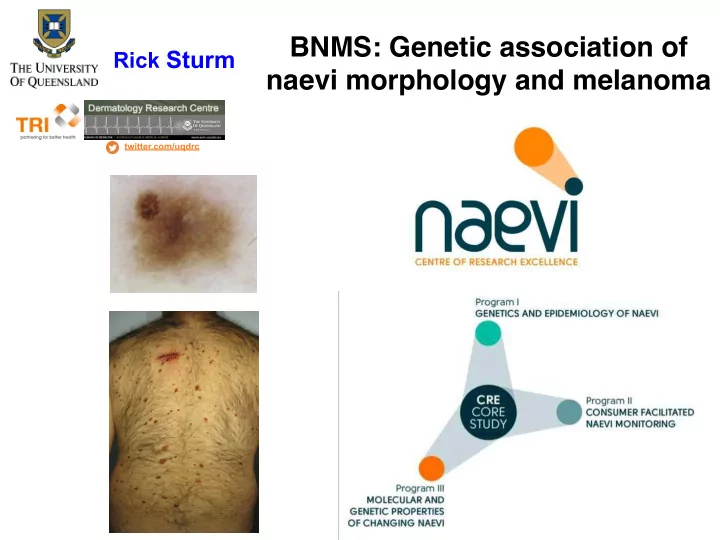
SLIDE 1 Rick Sturm
BNMS: Genetic association of naevi morphology and melanoma
twitter.com/uqdrc
SLIDE 2
BTNS = Brisbane Twin Naevus Study; n>3,000 (QIMR-B controls 23,724 individuals unaffected by CMM)
Study Populations available to the CRE
BERNS = Brisbane Electoral Roll Naevus Study, CRE core study n=150 BNMS= Brisbane Naevus Morphology Study, n=1,200 BMPMNS = Brisbane Multiple Primary Melanoma Naevus Study, n=100 BAMNS = Brisbane Advanced Melanoma Naevus Study n=80 BLTNS = Brisbane Lung Transplant Naevus Study n=90 Nambour trial = Trial of Sunscreen for Melanoma Prevention n= 1,626 MST = QSkin Melanoma Screening Trial n>60,000
SLIDE 3 Genotype Phenotype Environment
What are naevi and how do they arise?
SLIDE 4 Effect of naevogenesis susceptibility genes and phenotypic correlation with dermoscopic characteristics of naevi
- MC1R variant alleles will have a major influence on innate
melanocytic naevus morphology
- Variation in other pigmentation genes such as TYR, which
are modifiers of melanoma risk, may influence melanocytic naevus colour and morphology
- Genes that have recently been recognised to influence
naevus count including IRF4, MTAP and PLA2G6 may also influence naevus morphology
- Genes that regulate melanocytic cell function such as MITF
will also act to modify naevus count and/or morphology
HYPOTHESES:
SLIDE 5
600 control subjects 240 CMM cases + 76 Family History 256 control subjects
Interim analysis of survey at 3 years
600 CMM cases or Family History
Brisbane Naevus Morphology Study (BNMS) 2011 to 2016
Total Dec 2013 with phenotype + genotype N = 572
AIM
vs
N = 1200
Recruited as of April 2016 N > 1100
SLIDE 6
Naevi classified by size, profile, colour and dermoscopic naevus pattern
Reticular
21.9%
Homogeneous/ Nonspecific
62.5%
Globular
15.6%
13,587 melanocytic naevi >5mm
SLIDE 7 Total body naevus count by body-site and sex
Female vs Male
Male 0.0 0.2 0.4 0.6 0.8 1.0 Sex Proportion nevi back/(back+legs)
Nevi on Back/Backl+Legs Female Male
SLIDE 8
Collection of saliva for genetic analysis Assess pigmentation using Spectrophotometer Assess freckling density on face, hand & shoulders Documentation of patient demographics, sun exposure background, personal and family skin cancer / naevi history, medications Photographic documentation of eye colour
SLIDE 9
Male 40 50 60 70 sex reflectance_fac
FH+ Control 40 50 60 70 Hx reflectance_fac
FH+ Control 2 4 6 8 Melanoma Freckling Score Sex Count of nevi >5mm diameter Male Female 1 2 5 10 20 50 100 200
Phenotypic Characteristics of BNMS
Naevus count vs Sex Skin Reflectance vs Sex
Male Male Female Female
Freckling score vs Melanoma P***
Naevi > 5mm
CMM
FH+ Control Freckling Score
Skin Reflectance vs Melanoma
CMM
FH+ Control Facultative Facultative
SLIDE 10
Count of NS Nevi >5mm Melanoma FH+ Control 1 2 5 10 20 50 100
Count of Globular Nevi >5mm Melanoma FH+ Control 1 2 5 10 20 50 100
Count of Reticular Nevi >5mm Melanoma FH+ Control 1 2 5 10 20 50 100
Count of Nevi >5mm Melanoma FH+ Control 1 2 5 10 20 50 100 200
Naevus Count vs Melanoma
Total Globular Reticular P***
CMM
FH+ Control Naevi > 5mm
CMM
FH+ Control Naevi > 5mm
CMM
FH+ Control Naevi > 5mm
CMM
FH+ Control Naevi > 5mm
Nonspecific
SLIDE 11
Sanger Sequencing MC1R Genotyping Sequenom and Taqman based SNP Genotyping Illumina CoreExome 500,000 SNPs Whole Exome Sequencing (WES)
Genotyping platforms
SLIDE 12
Candidate genes and SNPs associated with CMM in BNMS
Rs/loc chr ps p-value -log10(p) gene name
rs11570734 22 38.518622 0.0003 3.541 PLA2G6 mc1r 16 21.800000 0.0006 3.222 R,r,w rs4820314 22 38.518538 0.0007 3.175 PLA2G6 rs7023954 9 21.816758 0.0018 2.743 MTAP V56I mc1r_R163Q 16 89.986154 0.0036 2.449 MC1R R163Q rs7023329 9 21.816528 0.0048 2.319 MTAP
CDKN2A carriers identified by Whole Exome Sequence (WES) Analysis