
SLIDE 1
Best Science for the Most Neglected
Spring Gombe-Götz Policy Advocacy Manager 8 November, 2018 Federal Parliament Belgium
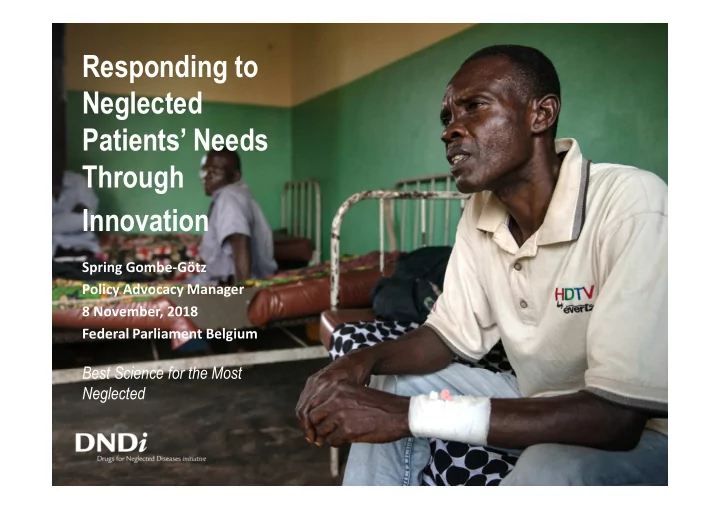
Responding to Neglected Patients Needs Through Innovation Spring - - PowerPoint PPT Presentation
Responding to Neglected Patients Needs Through Innovation Spring Gombe-Gtz Policy Advocacy Manager 8 November, 2018 Federal Parliament Belgium Best Science for the Most Neglected 15 years ago: the creation of DND i 1999 Nobel Peace
Best Science for the Most Neglected
Spring Gombe-Götz Policy Advocacy Manager 8 November, 2018 Federal Parliament Belgium
DNDi creation with founding partners:
Research and Training in Tropical Diseases) as a permanent observer
Mycetoma Hepatitis C
Neglected patients Neglected diseases
Antimicrobial resistance
Neglected models
Treated patients Excluded patients
> New formulations > New indications for existing drugs
> Completing registration dossier > Geographical extension
Research Development > New chemical entities
(NCEs)
Long-term projects
Translation Development Implementation
Medium-term projects
Short-term projects
> 5 YEARS 3-5 YEARS 1-2 YEARS
4
Screen Hit to Lead Pre-clinical Phase I Phase IIa/PoC Lead Opt. Registration Phase IIb/III Access
Screening Emodepside ABBV-4083 Macro Filaricide 3 New Benz Regimens +/- fosravuconazole Screening Biomarkers Chagas H2L Fexinidazole
Benznidazole Paediatric Dosage Form Benznidazole Paediatric Dosage Form
Chagas C205 series
SSG&PM Africa SSG&PM Africa
New Treatments for HIV/VL Screening DNDI-5421 DNDI-5610 Leish H2L DNDI-0690
New VL Treatments Asia New VL Treatments Asia
New Treatments for PKDL New VL Treatments Latin America New CL Combination CpG-D35 (CL) Amino pyrazoles DNDI-6148 CGH VL Series 1 MF/Paromomycin Combo for Africa Fexinidazole Acoziborole SCYX-1330682 SCYX-1608210
NECT Nifurtimox-Eflornithine Combination Therapy NECT Nifurtimox-Eflornithine Combination Therapy
DNDI-5561
GSK3494245 DDD1305143 GSK3186899 DDD853651
Oxfendazole Leish L205 Series Booster H2L Daiichi- Sankyo CH2L Booster H2L Daiichi- Sankyo LH2L
HAT LEISH. CHAGAS FILARIA
RESEARCH DEVELOPMENT TRANSLATION IMPLEMENTATION
Ravidasvir/ Sofosbuvir Two ‘4-in-1’ LPV/r/ABC/3TC LPV/r pellets with dual NRTI
Superbooster Therapy Paediatric HIV/TB Malaria FDC ASAQ Malaria FDC ASMQ
New Chemical Entity (NCE); Fexinidazole (for HAT and Chagas disease) = 1 NCE; Fosravuconazole = 1NCE
Fosravuconazole
MYCETOMA PAEDIATRIC HIV HEPATITIS C
Ravidasvir
CRITERIA FOR SUCCESS
the whole process
Biotechs Pharmaceutical companies PDPs International
NGOs CROs Universities Research Institutes
Anybody & Everybody!
NTD Drug Discovery Booster, Est. 2015 Open Synthesis Network, Est. 2016 The Mycetoma Open Source project (MycetOS),
Efficacy
>95% SVR >= 95% SVR
Safety
No side effects Minimal side effects
Pangenotypic
Yes Yes
Treatment duration
Same regimen F0-F4 10 weeks (8 wks ?) F0-F3 12 weeks F4 12 weeks F0-F3 12 weeks with RBV F4 24 weeks without RBV F4
Populations
Mono & HIV co-infected polytransfused & people who inject drugs Mono & HIV co-infected ; polytransfused & people who inject drugs
Dosing
FDC once a day Two tablets once a day (+/-RBV)
Drug-Drug Interactions
None in HIV/HCV Manageable in HIV/HCV
Monitoring
POC diagnosis, Triage (F?), SVR12 POC diagnosis, Triage (F?), SVR12, Minimal safety monitoring
Cost
~ US$ 300 by 2017 ~ US$ 300 by 2020
8
Minimal Disease Severe Disease
Accelerate R&D
Catalyse ACCESS
Simplify TREATMENT STRATEGIES Accelerating the development
candidates Supporting affordable access to all DAAs Working with health providers to scale – up treatment
with
Pharma companies
Governments
with with
Pharma companies Governments Civil Society
Primary healthcare doctors Non Governmental Organizations
20 entirely new chemical entities (NCEs) in the pipeline 210 staff Half in endemic countries Close to 1,000 people working on DNDi projects EUR 532 million raised equally from public and private sources 4 disease-specific clinical trial platforms Several technology transfers
39 R&D projects
in 8 disease areas with 7 treatments delivered GARDP: new initiative created by WHO and DNDi and incubated by DNDi
Easy to use Affordable Field-adapted Non-patented 2007 ASAQ Malaria >500 million patients reached 2008 ASMQ Malaria Used in Africa and Asia 2009 NECT Sleeping sickness 100% of stage-2 patients 2010 SSG&PM Visceral leishmaniasis in E Africa Now 1st line in all countries 2011 PAEDIATRIC BENZNIDAZOLE Chagas disease Two sources developed 2011 NEW VL TREATMENT ASIA Visceral leishmaniasis in Asia Support to elimination programme 2016 SUPERBOOSTER THERAPY Paediatric HIV Recommended by WHO
Toxic, resistant
Not available
Improved therapy
Oral (10 days)
Single-dose, oral
Focus:
for which adequate treatment is not available.
reflect the realities of clinical practice. Scope:
income countries.
Pathogens
EXTERNAL CONSULTATION AND GOVERNANCE TARGET PRODUCT PROFILES
Key populations Diseases & syndromes
DRUG RESISTANCE & UNMET NEED
Antimicrobial resistance is a major and rapidly growing global public health challenge, with estimates of up to 700,000 deaths per year.
Memory recovery and exploratory: revive and evaluate old knowledge and abandoned projects, support early research. Sexually-transmitted infections: develop a new treatment for drug-resistant gonorrhoea and other STIs. Paediatric antibiotics: exploring ways to
antibiotics for children. Neonatal sepsis: developing treatments for highly drug-resistant infections in babies.
Develop 4 new treatments through:
Build a robust pipeline of pre-clinical and clinical candidates end to end. Actively support appropriate use of and access to new antibiotic treatments. Developing and delivering new or improved antibiotic treatments for which , while endeavouring to ensure sustainable access.
57%
Public EUR 303M
43%
Private EUR 229M
UNRESTRICTED FUNDING (48%) - € 255M
Starr, FINEP, Moreau, BBVA (€5.6M) PORTFOLIO FUNDING (29%)- € 156M
($60.4M)
STRICTLY RESTRICTED FUNDING (23%) – € 121M
Note: Does not include GARDP funding