SurveilLance of invasive and native mOsquito VeCtors and pathogENs - - PowerPoint PPT Presentation

surveillance of invasive and native mosquito vectors and
SMART_READER_LITE
LIVE PREVIEW

SurveilLance of invasive and native mOsquito VeCtors and pathogENs - - PowerPoint PPT Presentation

University of Montenegro Biotechnical faculty SurveilLance of invasive and native mOsquito VeCtors and pathogENs they transmit in Montenegro acronym LOVCEN Project leader: Pajovi Igor Estimated overall duration of the proposed project


slide-1
SLIDE 1

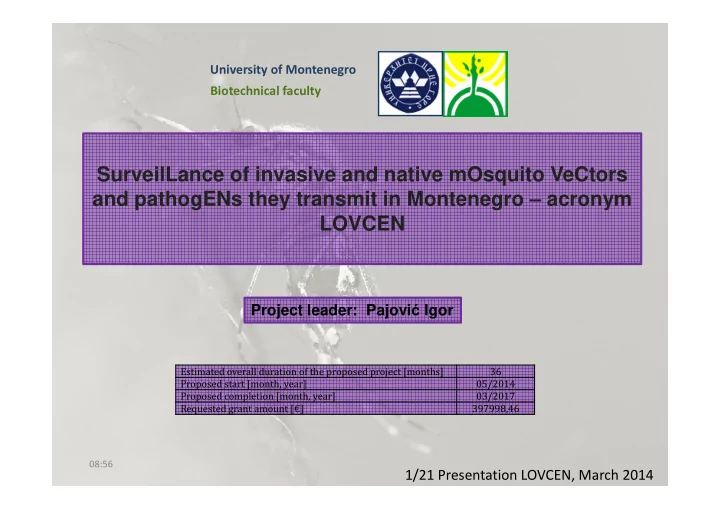
University of Montenegro Biotechnical faculty

SurveilLance of invasive and native mOsquito VeCtors and pathogENs they transmit in Montenegro – acronym LOVCEN

Estimated overall duration of the proposed project [months] 36 Proposed start [month, year] 05/2014 Proposed completion [month, year] 03/2017 Requested grant amount [€] 397998,46

Project leader: Pajović Igor 1/21 Presentation LOVCEN, March 2014

08:56
slide-2
SLIDE 2

List of participants - institutions

Proposed partner institutions on the project are:

  • Applicant institution - Biotechnical faculty

+

  • 3 RSRI (national registered scientific research institutions) –

Institute for Hydro Meteorology and Seismology, Institute for Public Health and Natural History Museum. +

  • 6 ISRI (international scientific research institutions) –

3 from EU (2 from Italy, 1 from Romania) and 3 from region (Serbia) and

  • 1 NS (national small company)

In total 11 institutions and 30 researchers without technical staff. 2/21 Presentation LOVCEN, March 2014

08:56

slide-3
SLIDE 3

Chikungunya fever: Italy in 2007, France in 2010. Dengue fever: France and Croatia in 2010, Portugal in 2012-2013. Europe is vulnerable to

Mosquito vectors (MV) and mosquito-borne diseases (MBD) are rising threat to Europe

Europe is vulnerable to “tropical” MBD outbreaks. Montenegro is not an exception: West Nile virus fever in 2013

3/21 Presentation LOVCEN, March 2014

08:56

slide-4
SLIDE 4

Human and Animal Health High Education and inovative “know how”

High education – capacity building for excellence in the research and innovation in surveillance of mosquito vectors (MV) and mosquito-borne diseases (MBD)

Increasing the quality of human life by decreasing the medical, social and financial impact of MV and MBD’s Health Environment 4/21 Presentation LOVCEN, March 2014

08:56

slide-5
SLIDE 5
  • 1. Capacity building

44 trainings, 27 equipment acquisitions

  • 2. Innovative research
  • SIT,
  • implementation of Guidelines of ECDC,
  • mobile phone application for surveillance of invasive and

indigenous mosquito species,

  • evaluation of novel non-chemical, biodegradable materials for

control of mosquito larvae

Activities designed to achieve high Impact

control of mosquito larvae

  • 3. Dissemination
  • developing Web Site,
  • socio economic impact check,
  • public (radio, TV, newspapers) appearances
  • 4. Sustainability
  • support of the idea by two Ministries – MH and MSDT
  • recruitment of YR, EU competitive research, knowledge transfer
  • SMEs involvement
  • community participation/ KOMARAC /

5/21 Presentation LOVCEN, March 2014

08:56

slide-6
SLIDE 6

(a) Distribution of mosquitoes in Montenegro; (b) Identification of mosquito vector species in Montenegro; (c) Low-cost and sustainable monitoring system - KOMARAC (d) Detection of pathogens carried by mosquito vector species;

Outcomes - novelties for Montenegro, highly valuable and competitive at EU level

(e) Capacity for modelling of climate changes influence on MV and MBD; (f) Survey and feedback on stakeholder’s opinions about direction of the research in vector borne disease prevention/control and (g) Link through applicable research with business. 6/21 Presentation LOVCEN, March 2014

08:56

slide-7
SLIDE 7

(WP1) Collaborative interdisciplinary research on native/invasive mosquitoes and pathogens they transmit in Montenegro and development of non-chemical control measures (WP2) Twinning through exchange of know-how and experience and dissemination activities

LOVCEN WPs - combining capacity building and research in different scientific disciplines

(WP3) Acquisition of research equipment and innovation capacity building (WP4) Management

7/21 Presentation LOVCEN, March 2014

08:56

slide-8
SLIDE 8

Aim Measurable targets Collaborative Research

  • reports of invasive and native mosquito fauna and their

distribution

  • mobile phone and server software for mosquito surveillance
  • reports of pathogen identification in vector mosquitoes
  • social impact check
  • best practices and policy recommendation
  • reports on efficiency of SIT
  • reports on other non-chemical methods for mosquito control
  • reports on scientific visits of researchers from MCM to partner

international research institutions

  • reports on training visits of researchers from partner

Clearly measurable targets

Exchange of Know-How and Experience and Dissemination activities

  • reports on training visits of researchers from partner

international institutions to MCM

  • reports on participation of the MCM research staff at

international conferences

  • report about web page development and maintenance
  • reports on organized promotional and dissemination activities

Acquisition of Equipment and Capacity Building

  • reports about purchasing activities and installation of

equipment

  • reports on training in research skills and innovation capacity

building Management

  • scientific and financial plans for project realization
  • progress reports/annual progress reports of project realization

(scientific and financial).

  • report about LMT, PMT and APM meetings
  • final report of project realization

8/21 Presentation LOVCEN, March 2014

08:56

slide-9
SLIDE 9

“wider impact beyond the scientific community”

EN

Research

Results

Impact on surveillance policies Future research strategies Personell with interdisciplinary background Capacity building Policy makers &

Dissemination and capacity building

LOVCEN

& Grant Agencies National surveillance system Business Partners, NGO’s Health system, Hospitals, Laboratories Laboratory personnel Researchers Meteorologists Community

9/21 Presentation LOVCEN, March 2014

08:56

slide-10
SLIDE 10

LOVCEN

Mapping of MV distribution ECDC/EFSA MBD in Montenegro

National Reference Center

Dissemination and sustainability

European Health Policy Makers European Research Policy Makers European Reference Centers

LO

Control strategies

National Public Health Service Environmental Agency National Policy Makers

We have clear vision about sustainability of activities started by MCM beyond the 36 months of the LOVCEN project. Ministry of Health and Ministry of Sustainable Development and Tourism of Montenegro already expressed their interest in the thematic area proposed by LOVCEN project.

ERA networking towards Horizon 2020

10/21 Presentation LOVCEN, March 2014

08:56

slide-11
SLIDE 11

Project Leader 10 out of 13 researchers gathered to form MCM. They will all be actively engaged in collaborative research and development of non-chemical control measures (WP1), twinning through exchange of know-how and experience and dissemination

Early stage, young researchers (YR) and students

twinning through exchange of know-how and experience and dissemination activities (WP2), acquisition of research equipment and innovation capacity building (WP3) and management (WP4). Introduction of teaching on MV and MBD (WP 2) will recruit new students to take their master and PhD thesis in this subjects. 11/21 Presentation LOVCEN, March 2014

08:56

slide-12
SLIDE 12

We did our best to have a clearly-defined starting

Impact

We tried to avoid our project looks like this:

To start from somewhere here: To finish (“successfully”) after a few years somewhere here: Several years later to be back somewhere here: We did our best to have a clearly-defined starting point (SWOT):

Impact start finish long-term start finish long-term

Clearly-defined activities and evidence of progress to define the Impact at the end (WPs): Ensured long-term Impact after the end (sustainibility plan): And we hope we did it well. 12/21 Presentation LOVCEN, March 2014

08:56

slide-13
SLIDE 13

Thank you!

13/21 Presentation LOVCEN, March 2014

08:56

slide-14
SLIDE 14

West Nile virus fever in 2012 one unconfirmed case

http://ecdc.europa.eu/en/publications/Publications/EU-summary-report-zoonoses-food-borne-outbreaks-2012.pdf#page=241

2013 four unconfirmed cases

http://www.ecdc.europa.eu/en/healthtopics/west_nile_fever/west-nile-fever-maps/pages/index.aspx

QUESTION a) Based on statistics, what is prevalence of MBD in Montenegro

  • ver last decades – are there serious cases of outbreak of MBD? How

situation is expected to change in the future?

Dengue ? Chicungunya ? 2012-2014 Malaria imported cases 1- 3 cases/year 2010-2014 11 Leishmania cases Phleboviruses ? JEV ? Remi Charrel, Marseille University

Establishment of vectors and MBD surveillance system is crucial need for Montenegro (EU).

14/21 Presentation LOVCEN, March 2014

08:56

slide-15
SLIDE 15

QUESTION b) Can the same approach be expedited to other decease transmitting species – statistically which are the most relevant ones/ are the mosquitoes at the top and how easy is to include 2 or more species in the surveillance protocol?

Statistically which are the most relevant decease transmitting species, are the mosquitoes at the top? Mosquitoes – most dangerous animals in the world http://list25.com/the-25-most-dangerous-animals-in-the-world/2/ mosquitos transmit diseases to almost 700 million people annually resulting in 1 to 3 million deaths every year How easy is to include 2 or more species in the surveillance protocol? KOMARAC – will allow many more mosquito species to be included (e.g., malaria vector, WNV vector, ...) Can the same approach be expedited to other disease transmitting species? Yes, it’s easy to include all invasive mosquito species that are threatening Europe at the moment (all are container breeders so larvae inhabit same/similar breading places).

Aedes japonicus, Ae. aegypti, Ae. koreicus, Ae. atropalpus, Ae. triseriatus.

million deaths every year

15/21 Presentation LOVCEN, March 2014

08:56

slide-16
SLIDE 16

QUESTION c) How large BRIC countries or USA are solving the issue?

Brasil, Rusia, India, China and South Africa

1.

  • Diseases of poverty: TB, Chagas Disease, Malaria, Chikungunya, Dengue, Hepatitis,

Diarrheal Diseases, Visceral Leishmaniasis and HIV remain major problems.

  • 2. - The most deadly MBD in BRICS are malaria and dengue hemorrhagic fever.
  • 2. - The most deadly MBD in BRICS are malaria and dengue hemorrhagic fever.

BRICS Health Ministers’ meeting Delhi 2012. Declaration: “We are aware that an effective health and disease surveillance is the key strategy for controlling communicable diseases... to detect early warning signals to control outbreaks and to respond quickly on resource allocation for specific areas. For this purpose, we recognize the need to build capacity for effective health and disease surveillance systems, including setting up surveillance units, strengthening of laboratories.”

16/21 Presentation LOVCEN, March 2014

08:56

slide-17
SLIDE 17

QUESTION c) How large BRIC countries or USA are solving the issue?

USA

CDC organizing National based surveillance program (for over 60 years) e.g. WNV surveillance program since 1999 States: Ae. albopictus since 1986 (Texas). All major critical needs in vector biology and management of vector-borne diseases defined by Institute of Medicine, National Academy of Sciences USA are prioritized in LOVCEN are prioritized in LOVCEN LOVCEN propose using the Guidelines published 2012 by ECDC, Belgium 2013., Greece and Italy 2014. Montenegro – forth in Europe.

In a sense, arboviruses and other VBD (MBD) epidemics are like floods, hurricanes, or tornadoes: they

  • ccur sporadically, but their precise time and location cannot be predicted. Beasley et al. 2013.

17/21 Presentation LOVCEN, March 2014

08:56

slide-18
SLIDE 18

Link through applicable research with business. Development of non-chemical control measures

QUESTION d) Elaborate on commercialization and market potential?

Research

Results

Impact on surveillance policies Policy makers

LOVCEN

Policy makers & Grant Agencies National surveillance system

Business Partners Control measures

18/21 Presentation LOVCEN, March 2014

08:56

slide-19
SLIDE 19

QUESTION e) Elaborate on sustainability of the project?

education no courses available on the subject no capacity for independent modules on medical, veterinary entomology and parasitology detection of other pathogens of

Targets Start of project End of project After the end of project

early warning system enhanced public awareness on MV and MBD raised medical entomology included in existing courses equipment human resources research capacity no capacity for detection of MB viruses moderate level or not trained national projects detection of other pathogens of medical and veterinary importance training of the others Horizon 2020 detection of MB viruses enabled highly trained COST Action TD1303 VectorNet Bilateral projects

19/21 Presentation LOVCEN, March 2014

08:56

slide-20
SLIDE 20

We will already during the project initiate discussion and negotiation with institutions ready to financially support MCM Recruitment of YR EU competitive research Knowledge transfer SMEs involvement

QUESTION e) Elaborate on sustainability of the project?

Staff form MCM institutions, will be actively involved in writing new proposals, utilizing Support of the idea by Ministry of Health, Ministry of Sustainable Development and Tourism, as well as Agency for Environmental Protection Staff form MCM institutions, will be actively involved in writing new proposals, utilizing new equipment, training activities and knowledge transfer to SMEs and other businesses in order to provide sustainability for capacities developed during the LOVCEN project Mosquito surveillance program will be continued on most sustainable way, with community participation, utilizing KOMARAC mobile phone application developed within WP1

20/21 Presentation LOVCEN, March 2014

08:56