Methods of Adding Vectors Geometrically MCV4U: Calculus & - - PDF document

methods of adding vectors geometrically
SMART_READER_LITE
LIVE PREVIEW

Methods of Adding Vectors Geometrically MCV4U: Calculus & - - PDF document

g e o m e t r i c v e c t o r s g e o m e t r i c v e c t o r s Methods of Adding Vectors Geometrically MCV4U: Calculus & Vectors Recall that two vectors are equivalent if they have the same magnitude and direction. This means that vectors


slide-1
SLIDE 1

g e o m e t r i c v e c t o r s

MCV4U: Calculus & Vectors

Adding and Subtracting Vectors

  • J. Garvin

Slide 1/21

g e o m e t r i c v e c t o r s

Methods of Adding Vectors Geometrically

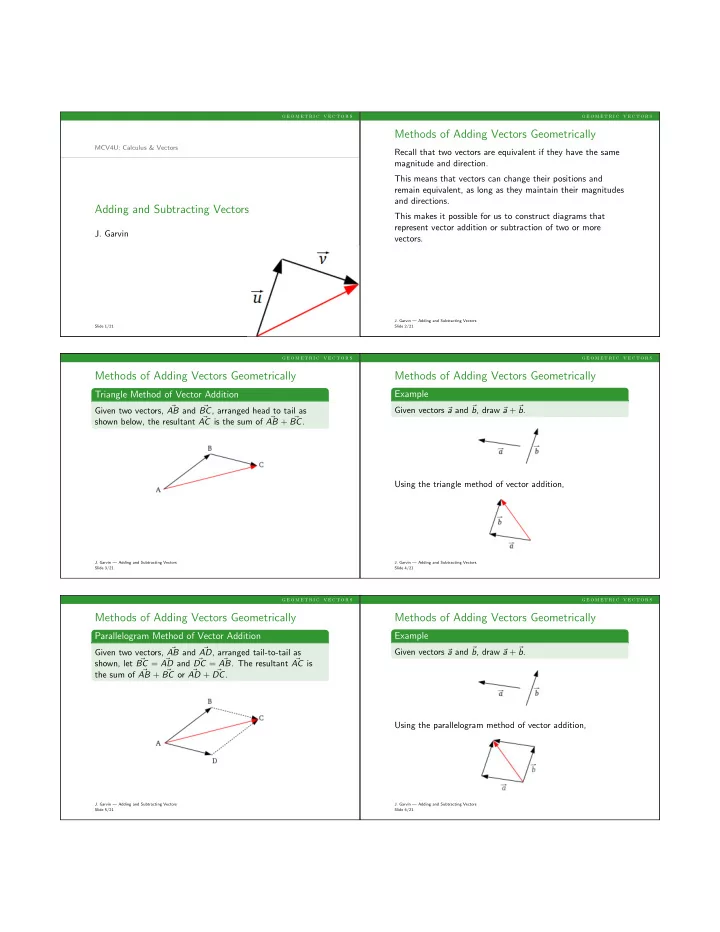
Recall that two vectors are equivalent if they have the same magnitude and direction. This means that vectors can change their positions and remain equivalent, as long as they maintain their magnitudes and directions. This makes it possible for us to construct diagrams that represent vector addition or subtraction of two or more vectors.

  • J. Garvin — Adding and Subtracting Vectors

Slide 2/21

g e o m e t r i c v e c t o r s

Methods of Adding Vectors Geometrically

Triangle Method of Vector Addition

Given two vectors, AB and BC, arranged head to tail as shown below, the resultant AC is the sum of AB + BC.

  • J. Garvin — Adding and Subtracting Vectors

Slide 3/21

g e o m e t r i c v e c t o r s

Methods of Adding Vectors Geometrically

Example

Given vectors a and b, draw a + b. Using the triangle method of vector addition,

  • J. Garvin — Adding and Subtracting Vectors

Slide 4/21

g e o m e t r i c v e c t o r s

Methods of Adding Vectors Geometrically

Parallelogram Method of Vector Addition

Given two vectors, AB and AD, arranged tail-to-tail as shown, let BC = AD and DC =

  • AB. The resultant

AC is the sum of AB + BC or AD + DC.

  • J. Garvin — Adding and Subtracting Vectors

Slide 5/21

g e o m e t r i c v e c t o r s

Methods of Adding Vectors Geometrically

Example

Given vectors a and b, draw a + b. Using the parallelogram method of vector addition,

  • J. Garvin — Adding and Subtracting Vectors

Slide 6/21

slide-2
SLIDE 2

g e o m e t r i c v e c t o r s

Methods of Subtracting Vectors Geometrically

Tail-to-Tail Method of Vector Subtraction

Given two vectors, AB and AC, arranged tail-to-tail as shown, the resultant BC is the difference of AC − AB.

  • J. Garvin — Adding and Subtracting Vectors

Slide 7/21

g e o m e t r i c v e c t o r s

Methods of Subtracting Vectors Geometrically

Example

Given vectors a and b, draw a − b. Using the tail-to-tail method of vector subtraction,

  • J. Garvin — Adding and Subtracting Vectors

Slide 8/21

g e o m e t r i c v e c t o r s

Methods of Subtracting Vectors Geometrically

Alternatively, a vector may be subtracted from another using its opposite vector.

Opposite Vector Method of Vector Subtraction

Given two vectors, AB and AC, arranged tail to tail as shown, let CD = − AB =

  • BA. The resultant

AD is the difference of AC − AB.

  • J. Garvin — Adding and Subtracting Vectors

Slide 9/21

g e o m e t r i c v e c t o r s

Adding and Subtracting Vectors

Example

Using the following diagram, express AB + BC as a single vector.

  • AB +

BC = AC

  • J. Garvin — Adding and Subtracting Vectors

Slide 10/21

g e o m e t r i c v e c t o r s

Adding and Subtracting Vectors

Example

Using the following diagram, express DB − CB as a single vector.

  • DB −

CB = DB + BC = DC

  • J. Garvin — Adding and Subtracting Vectors

Slide 11/21

g e o m e t r i c v e c t o r s

Adding and Subtracting Vectors

Example

Using the following diagram, express ( BC + CD) + DA as a single vector. ( BC + CD) + DA = BD + DA = BA

  • J. Garvin — Adding and Subtracting Vectors

Slide 12/21

slide-3
SLIDE 3

g e o m e t r i c v e c t o r s

Adding and Subtracting Vectors

Example

Using the following diagram, express BC + ( CD + DA) as a single vector.

  • BC + (

CD + DA) = BC + CA = BA

  • J. Garvin — Adding and Subtracting Vectors

Slide 13/21

g e o m e t r i c v e c t o r s

Adding and Subtracting Vectors

The last example illustrates the associative property of vector addition.

Properties of Vector Addition and Subtraction

Given vectors u, v and w:

  • (

u + v) + w = u + ( v + w) (associative property)

u + v = v + u (commutative property)

v + 0 = v (identity property) The zero vector, 0, has a magnitude of zero and arbitrary

  • direction. Thus, adding a vector to the zero vector results in

the original vector.

  • J. Garvin — Adding and Subtracting Vectors

Slide 14/21

g e o m e t r i c v e c t o r s

Adding and Subtracting Vectors

Example

Using the following diagram, let AB = x and BC = y. Express EF in terms of x and y.

  • EF =

CB = − BC = − y

  • J. Garvin — Adding and Subtracting Vectors

Slide 15/21

g e o m e t r i c v e c t o r s

Adding and Subtracting Vectors

Example

Using the following diagram, let AB = x and BC = y. Express BG in terms of x and y.

  • BG =

BC + CG = BC + BA = BC − AB = y − x

  • J. Garvin — Adding and Subtracting Vectors

Slide 16/21

g e o m e t r i c v e c t o r s

Adding and Subtracting Vectors

Example

Using the following diagram, let AB = x and BC = y. Express AD in terms of x and y.

  • AD =

AB + BC + CD = AB + BC + BG = x + y + y − x = 2 y

  • J. Garvin — Adding and Subtracting Vectors

Slide 17/21

g e o m e t r i c v e c t o r s

Adding and Subtracting Vectors

Example

A ship travels 150 km due east of port, then assumes a bearing of N50◦E for 100 km. Use trigonometry to determine the displacement of the ship, and its direction. Use the following diagram.

  • J. Garvin — Adding and Subtracting Vectors

Slide 18/21

slide-4
SLIDE 4

g e o m e t r i c v e c t o r s

Adding and Subtracting Vectors

The displacement is | r|, where r is the resultant vector. Use the cosine law. | r| =

  • |

u|2 + | v|2 − 2| u|| v| cos R =

  • 1502 + 1002 − 2 · 150 · 100 cos 140◦

≈ 235.5km

  • J. Garvin — Adding and Subtracting Vectors

Slide 19/21

g e o m e t r i c v e c t o r s

Adding and Subtracting Vectors

The direction can be found if we know the measure of ∠V . Use the sine law. sin V | v| = sin R | r| ∠V ≈ sin−1 100 · sin 140◦ 235.5

  • ≈ 16◦

The displacement is approximately 235.5 km, at a bearing of approximately N74◦E.

  • J. Garvin — Adding and Subtracting Vectors

Slide 20/21

g e o m e t r i c v e c t o r s

Questions?

  • J. Garvin — Adding and Subtracting Vectors

Slide 21/21