1
BONGARD-LOGO: A NEW BENCHMARK FOR HUMAN-LEVEL CONCEPT LEARNING AND - - PowerPoint PPT Presentation
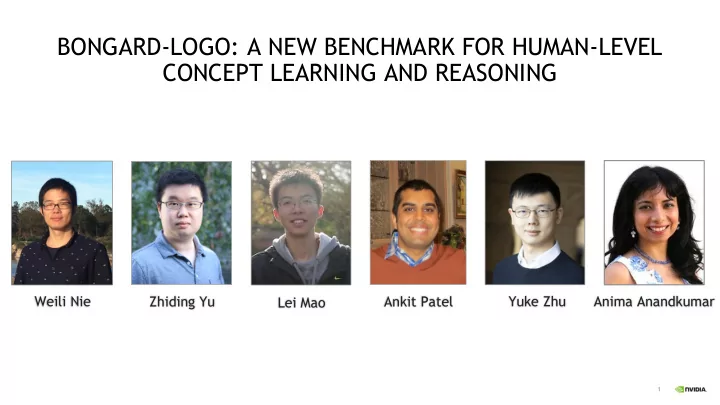
BONGARD-LOGO: A NEW BENCHMARK FOR HUMAN-LEVEL CONCEPT LEARNING AND REASONING Weili Nie Zhiding Yu Ankit Patel Yuke Zhu Anima Anandkumar Lei Mao 1 BACKGROUND: BONGARD PROBLEMS One Hundred puzzles originally invented by M. M. Bongard in 1967
2
BACKGROUND: BONGARD PROBLEMS
- Bongard aimed to demonstrate the key properties of
human visual cognition capabilities.
- Given a set A of six images (positive examples) and
another set B of six images (negative examples),
- the objective is to discover the concept that the
images in set A obey and images in set B violate.
One Hundred puzzles originally invented by M. M. Bongard in 1967
Problem #13 (A neck)
set A set B
3
AN OVERVIEW OF BONGARD-LOGO
- It transforms concept learning into a few-shot binary classification problem
- It consists of 12,000 problem instances
○
The large scale makes it digestible by advanced machine learning methods in modern AI
- The problems in Bongard-LOGO belong to three types based on the concept categories:
○
3,600 Free-form shape problems
○
4,000 Basic shape problems
○
4,400 Abstract shape problems
A benchmark inspired by original BPs for human-level visual concept learning and reasoning
4
THREE TYPES OF BONGARD-LOGO PROBLEMS
(Concept: “ice cream cone”-like shape) (Concept: A combination of “fan”-like shape and “trapezoid”) (Concept: “convex”)
5
KEY PROPERTIES OF BONGARD-LOGO
- Context-dependent perception
○
The same shape pattern has fundamentally opposite interpretations depending on the context
It captures three core properties of human cognition exhibited in original BPs
6
KEY PROPERTIES OF BONGARD-LOGO
- Analogy-making perception
○
Some meaningful structures (i.e., zigzags or a set of circles) can be projected onto another meaningful
- nes (i.e., straight lines or arcs) for underlying concepts
It captures three core properties of human cognition exhibited in original BPs
7
KEY PROPERTIES OF BONGARD-LOGO
- Perception with a few examples but infinite vocabulary
○
There is no finite set of categories to name and describe the geometrical arrangements
It captures three core properties of human cognition exhibited in original BPs
8
PROBLEM GENERATION
- We use LOGO language for procedural generation:
○
The procedural commands for drawing each shape form its ground-truth action program
○
Each action program is a list of actions and each action is depicted by a function: [Action name] ( [moving type], [moving length] , [moving angle] )
- Two benefits:
○
Easily generate arbitrary shapes and precisely control the shape variation in a human-interpretable way
○
Provide a useful supervision in guiding symbolic reasoning in the action space
Automatically generating problems with action-oriented language
Action Programs
9
BENCHMARKING ON BONGARD-LOGO
Comparing SOTA few-shot learning methods with human performance
Test accuracy (%) on free-form shape test set (FF), basic shape test set (BA), combinatorial abstract shape test set (CM), and novel abstract shape test set (NV). Human (Expert) refers to human subjects who carefully follow our instructions while Human (Amateur) do not. The chance performance is 50%.
There is a significant gap between model and human performance
10
INCORPORATING SYMBOLIC INFORMATION
Meta-baseline based on program synthesis (Meta-Baseline-PS) Stage I: Train the program synthesis module to predict action programs Stage II: Use the pre-trained image feature to fine-tune the meta-learner
11
INCORPORATING SYMBOLIC INFORMATION
Meta-baseline based on program synthesis (Meta-Baseline-PS)
Test accuracy (%) on free-form shape test set (FF), basic shape test set (BA), combinatorial abstract shape test set (CM), and novel abstract shape test set (NV). Human (Expert) refers to human subjects who carefully follow our instructions while Human (Amateur) do not. The chance performance is 50%.
Meta-Baseline-PS clearly outperforms previous SOTA methods
12
SUMMARY
- Bongard-LOGO scales up one Hundred original Bongard problems to a large dataset
- Bongard-LOGO demands a new form of human-like perception that is context-dependent, analogical, and of
infinite vocabulary
- We developed a program-guided shape generation technique to produce Bongard-LOGO shapes in action-oriented
LOGO language
- Large performance gap between human and machine in Bongard-LOGO reveals a failure of today's pattern
recognition systems in capturing the core properties of human cognitive learning and reasoning.
- We showed that incorporating symbolic information into neural networks improves the overall performance,