
SLIDE 1
Removing Salt From Coal Mine Wastewater in a Remote, Wet Area: Full Scale Experience
Srikanth Muddasani, P.E. Veolia Water Technologies, USA
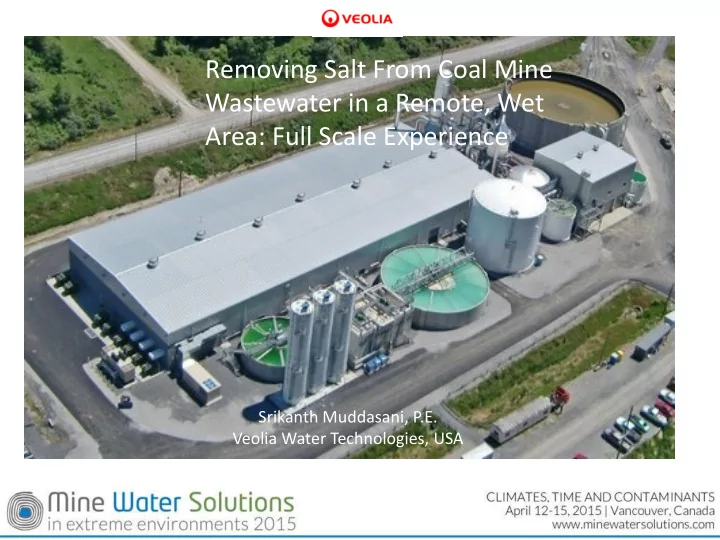
Removing Salt From Coal Mine Wastewater in a Remote, Wet Area: Full - - PowerPoint PPT Presentation
Removing Salt From Coal Mine Wastewater in a Remote, Wet Area: Full Scale Experience Srikanth Muddasani, P.E. Veolia Water Technologies, USA Project Background Centralized ZLW treatment facility to handle water from six mine locations
Srikanth Muddasani, P.E. Veolia Water Technologies, USA
2
18” Force Main collects water from 4 mines to the North 14” Force Main collects water from 2 mines to the South CENTRALIZED TREATMENT FACILITY
4
Note 1: Average Value based on the data collected between Jun 1st 2014 to Dec 31st 2014 Note 2: Average Value based on the data collected between Aug 20th,2014 to Sep 5th, 2014
5
Parameters Original Design Current Design1
Design Flow, gpm 3500 (795 m3/h) 2026 (460 m3/h) pH, S.U. 5 - 10 7.39 Temperature, deg F 38 – 85 (3 – 30 deg C) 60 – 72 (15-22 deg C) Calcium, mg/L 300 217 Magnesium, mg/L 200 104 Iron, mg/L 150 0.27 Manganese, mg/L 2 0.27 Alkalinity, mg/L CaCO3 700 - 1200 891 Sulfate, mg/L 5,500 2700 2 Chloride, mg/L 1,500 1530 2 TDS, mg/L 10,000 8600 Silica, mg/L as SiO2 10 10
Note 1: Applied to product water prior to remineralization
6
Parameters Maximum Effluent Concentration
Chlorides, mg/L < 218 TDS, mg/L < 150 1 pH, S.U. 6 to 9 Minimum Hardness, mg/l as CaCO3 ≥ 50
7
8
Primary Objectives
9
Evaporator Crystallizer RO Trains Raw Water Tank Multimedia Filters Lime & Soda Ash Silos Softening System 1st Stage Clarifier Dewatering Building
precipitation of metals such as manganese and iron
alkalinity and hardness
settling characteristics
design
10
in the effluent from upstream clarification and aluminum precipitation processes
Raw Water Feed Tank
System
11
Reverse Osmosis System
while operating at a high recovery rate
flow, 1 standby
seawater RO membrane elements
distillate from Brine Management System
mineralized using carbon dioxide and lime water, to protect aquatic life
reuse in energy-related operations.
12
Evaporator
with a low concentration side and a high concentration side
by allowing a portion of the evaporation to occur at a lower boiling point rise than the final concentration
Recompression System
auxiliary steam
pumped through a Feed Preheater for heat transfer to the incoming brine
13
pump, and forces circulation heat exchanger
the Crystallizer are recompressed and recirculated through the heater
solution becomes supersaturated and salts precipitate, resulting in a brine slurry
centrifuges for dewatering
landfill along with the dewatered sludge from the softening processes
14
15
Crystallizer Evaporator Heat Exchanger Distillate Tank Crystallizer
Sludge is brought separately to
approximately 90 – 95% in solids concentration and Sludge contains 50 – 65% in solids concentration.
before applied to landfill
collected in storage tank and metered back to thermal system
16
System
17
18
2,000 4,000 6,000 8,000 10,000 12,000 14,000 16,000 18,000 06/01/14 07/06/14 09/16/14 10/21/14 11/25/14 12/31/14 Conductivity (µs/cm) Days Current Feed Conductivity Design Feed Conductivity
Original Design Conductivity = 13,000 µs/cm Current Avg Conductivity = 11,180 µs/cm
19
Product water Cond before Remineralization = 63 µs/cm Final Effluent Discharge Cond = 142 µs/cm 20 40 60 80 100 120 140 160 180 200 06/01/14 07/06/14 09/16/14 10/21/14 11/25/14 12/31/14 Conductivity (µs/cm) Days Product Water Cond before Remin Final Eff Discharge Cond
20
1400 1450 1500 1550 1600 1650 8/20/14 8/22/14 8/26/14 8/28/14 9/1/14 9/2/14 9/3/14 9/4/14 9/5/14 Chlorides (mg/L) Days Current Feed Chlorides Current Avg Feed Chlorides = 1,530 mg/l
21
0.00 5.00 10.00 15.00 20.00 25.00 1/1/2014 1/21/2014 2/10/2014 3/2/2014 3/22/2014 4/11/2014 5/1/2014 5/21/2014 6/10/2014 Effluent Chlorides, mg/l Days Final Effluent Chlorides = 16 mg/l
Please Note: Waste Estimation for design condition was estimated based on 3500 gpm flow Waste Estimation for Current Average Condition was estimated based on 2026 gpm flow
22
Waste Design Condition Current Average Condition
Softening Sludge (on a 100% dry basis) 6,666 lb/hr (3,030 kg/hr) 2,200 lb/hr (1,000 kg/hr) Salt (on a 100% dry basis) 17,500 lb/hr (7,954 kg/hr) 8,710 lb/hr (3,960 kg/hr) Total Waste Generated (on 100% dry basis) 24,166 lb/hr (10,984 kg/hr) 10,910 lb/hr (4,960 kg/hr)
state-of-the-art membrane technology
management
generated at the landfill is sent back to the facility’s thermal treatment process
a “zero liquid waste” (ZLW) facility
23