Air quality impacts of oil and gas development in the Bakken - - PowerPoint PPT Presentation

air quality impacts of oil and gas development in the
SMART_READER_LITE
LIVE PREVIEW

Air quality impacts of oil and gas development in the Bakken - - PowerPoint PPT Presentation

Western Air Quality Modeling Workshop Air quality impacts of oil and gas development in the Bakken formation region J. L. Collett, Jr. 1 , A. Evanoski Cole 1 , A. Prenni 2 , D. Day 2 , A. Sullivan 1 , Y. Li 1 , B. Sive 2 , Y. Zhou 1 , A.


slide-1
SLIDE 1

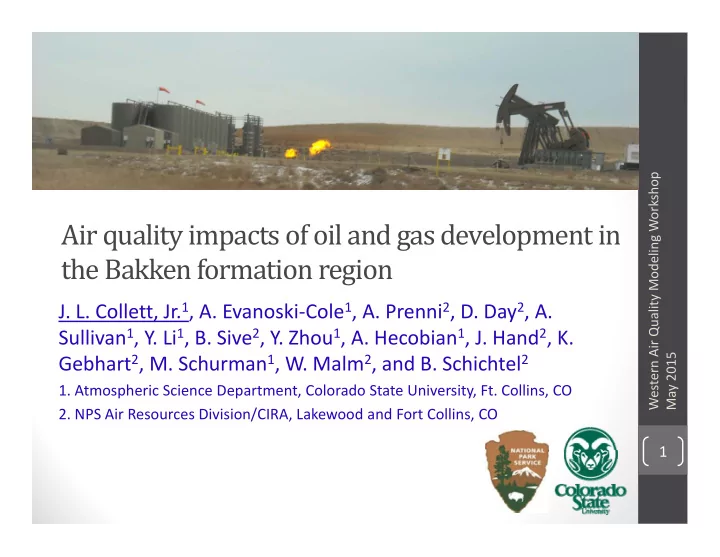
Air quality impacts of oil and gas development in the Bakken formation region

  • J. L. Collett, Jr.1, A. Evanoski‐Cole1, A. Prenni2, D. Day2, A.

Sullivan1, Y. Li1, B. Sive2, Y. Zhou1, A. Hecobian1, J. Hand2, K. Gebhart2, M. Schurman1, W. Malm2, and B. Schichtel2

  • 1. Atmospheric Science Department, Colorado State University, Ft. Collins, CO
  • 2. NPS Air Resources Division/CIRA, Lakewood and Fort Collins, CO

Western Air Quality Modeling Workshop May 2015

1

slide-2
SLIDE 2

Study Motivation

  • NOx emissions

reductions substantially reduced PM2.5 nitrate in much of U.S.

  • Increasing winter

nitrate, however, in some regions

  • Increases

in U.S. oil and gas production may be relevant

2

Western Air Quality Modeling Workshop May 2015

slide-3
SLIDE 3

Regional Power Plant Emissions

Large decreases achieved in regional power plant emissions, but NOx emissions estimates for the basin suggest these are more than offset by growth in oil and gas emissions. Measured NO2 concentrations in recent years have been flat or increasing.

Source: EPA Clean Air Markets Database

3

Western Air Quality Modeling Workshop May 2015

slide-4
SLIDE 4

Bakken winter 2012/13 and 2013/14 study

4

Western Air Quality Modeling Workshop May 2015

  • Particle mass

and speciation

  • NOx, O3, NH3,

HNO3, SO2, CH4

  • Speciated VOCs
slide-5
SLIDE 5

Summary of Pilot Study Results

  • Good news: O3 concentrations were low, typical of rural sites
  • Bad news: High particle concentrations
  • Multi‐day episodes occur across study region
  • Worst episodes in March during stagnant/recirculating air periods
  • Primarily ammonium nitrate and ammonium sulfate

Concentration (µg m‐3)

5 10 15 20

Theodore Roosevelt North Unit (THRO‐N)

Calcium Ammonium Nitrate Sulfate 5 10 15 20 2/14/13 2/21/13 2/28/13 3/7/13 3/14/13 3/21/13 3/28/13 4/4/13

Fort Union (FOUN)

5

Western Air Quality Modeling Workshop May 2015

slide-6
SLIDE 6

Did ammonia limit NH4NO3 formation?

0.2 0.4 0.6 0.8 1 2/14/13 2/21/13 2/28/13 3/7/13 3/14/13 3/21/13 3/28/13 4/4/13

NH3 / (NH4

+ + NH3)

FOUS THRO‐N

  • Ammonia nearly depleted in Theodore Roosevelt National Park

during episode 1, but not episode 2

  • Excess ammonia available both periods at Fort Union

1 2

6

Western Air Quality Modeling Workshop May 2015

slide-7
SLIDE 7

Spatial patterns of methane and ethane

Methane elevated in oil and gas production and some other regions; ethane tied more directly to oil and gas

7

Western Air Quality Modeling Workshop May 2015

slide-8
SLIDE 8

Light alkanes at all stationary sampling sites: Markers for oil and gas

Concentrations elevated by ~an order of magnitude. Oil and gas impacts seen at all sites.

8

Western Air Quality Modeling Workshop May 2015

slide-9
SLIDE 9

Bakken VOC concentrations in context

Ethane Propane i-Butane n-Butane i-Pentane n-Pentane Ethyne Benzene Toluene

Mixing Ratio (ppbv)

0.01 0.1 1 10 100

North Dakota Bakken Formation (this study)

1NE Colorado, Denver-Julesburg Basin 2Southwest Pennsylvania 3Houston shipping channel, TX 4Mexico City, upper=in city, lower=downwind 5SW U.S., upper=Sept. mean, lower=Apr. mean 628 U.S. Cities range of means

1) Swarthout et al., 2013; 2) Swarthout et al., 2014, submitted; 3) Gilman et al., 2009; 4) Apel et al., 2010; 5) Katzenstein et al., 2003; 6) Baker et al., 2008

Western Air Quality Modeling Workshop May 2015

slide-10
SLIDE 10

Pentane isomer ratio as a source marker

Constant i‐pentane to n‐pentane ratio suggests all sites are impacted by same source region during periods of high concentrations.

n-pentane (ppbv)

5 10 15 20

i-pentane (ppbv)

2 4 6 8 10 12 14 NE Colorado, Denver-Julesburg Basin Thompson Farm, Durham, NH (Oct.-May) Thompson Farm, Durham, NH (June-Sept.) Hickory, PA, Marcellus Shale Pittsburgh, PA Detroit, MI Natural Gas (Weld County, CO) Typical Urban Ratio THRO-NU FOUS MELA

R2 = 1.00 Slope = 0.74 0.76 2.33 1.50 1.11 1.00

Oil and Gas Rural/Urban

10

Western Air Quality Modeling Workshop May 2015

slide-11
SLIDE 11

Aerosol Composition, THRO‐N

11

High particle concentrations in December, February, & March. Dominated by ammonium sulfate and ammonium nitrate.

Western Air Quality Modeling Workshop May 2015

slide-12
SLIDE 12

Increases in particle concentrations seen at all sites.

Aerosol Composition at all Sites

12

Western Air Quality Modeling Workshop May 2015

slide-13
SLIDE 13

2‐Day Back Trajectories from Low Concentration Days at Main Site

13 12/16/13 2/17/13 3/9/13

Western Air Quality Modeling Workshop May 2015

slide-14
SLIDE 14

2‐Day Back Trajectories from High Concentration Days at Main Site

14 12/22/13 2/15/14 3/6/14 2/13/14

Western Air Quality Modeling Workshop May 2015

slide-15
SLIDE 15

Alkanes dominate .OH reactivity, due to their abundance, despite their intrinsically low reactivity

Bakken VOC reactivity

Nitration rates of alkanes provide a chemical “clock” for aging Bakken VOCs

15

Western Air Quality Modeling Workshop May 2015

slide-16
SLIDE 16

Highest PM2.5 Concentrations Correspond with Short VOC Lifetimes

16

Western Air Quality Modeling Workshop May 2015

slide-17
SLIDE 17

Conclusions

  • Decreases in NOx emissions from traditional sources have been
  • ffset by oil and gas development in the Bakken oil patch.
  • Oil & gas production is a major regional source of light alkanes.
  • During air stagnation, SO2 and NOx accumulate and are oxidized to

sulfuric and nitric acids. VOC “clock” suggests that PM episodes are associated with local emissions.

  • Cold winter temperatures and available ammonia permit

substantial NH4NO3 formation. Sufficient ammonia is available to support additional PM formation if NOx emissions continue to grow.

17

Western Air Quality Modeling Workshop May 2015

slide-18
SLIDE 18

Fort Union ammonia supply

1.0 0.8 0.6 0.4 0.2 0.0 11/29/13 12/6/13 12/13/13 12/20/13 12/27/13 1/3/14 1/10/14 1/17/14 1/24/14 1/31/14 2/7/14 2/14/14 2/21/14 2/28/14 3/7/14 3/14/14 3/21/14 Median Sample Time 2.0 1.5 1.0 0.5 0.0

Concentration (µg / m

3)

NH4

+

NH3 NH3 / N(-III)

slide-19
SLIDE 19

5 10 15 20

Knife River (KNRI)

5 10 15 20

Medicine Lake (MELA)

Bakken winter 2012/13 particle composition

Concentration (µg m‐3) Sampling Date

Episode 1 Episode 2

5 10 15 20

Theodore Roosevelt North Unit (THRO‐N)

Nitrite Chloride Sodium Potassium Magnesium Calcium Ammonium Nitrate Sulfate 5 10 15 20

Fort Union (FOUN)

slide-20
SLIDE 20

2013/14 study shows regional haze episodes, but lower peak concentrations

2 2 1 1

Medicine Lake

11/29/13 12/6/13 12/13/13 12/20/13 12/27/13 1/3/14 1/10/14 1/17/14 1/24/14 1/31/14 2/7/14 2/14/14 2/21/14 2/28/14 3/7/14 3/14/14 3/21/14

Sample Time

5 5 4 4 3 3 2 2 1 1

Fort Union

5 5 4 4 3 3 2 2 1 1

Main Site Ammonium Nitrate Sulfate Aerosol Concentration (µg m

  • 3)
slide-21
SLIDE 21

Main Study Aerosol at Theodore Roosevelt NP

MARGA – Hourly Inorganic PM2.5 AMS – 5 Minute Organic PM1 Aethalometer – Black Carbon

slide-22
SLIDE 22

Initial Motivation for the Study: Trends from IMPROVE data

PM2.5 and haze have increased since 2000, counter to national trends.

22

Western Air Quality Modeling Workshop May 2015

slide-23
SLIDE 23

2013/14 Measurements

  • Theodore Roosevelt NP
  • PM2.5 mass (15 min; 24 hr)
  • Particle scattering (15 min)
  • Aerosol composition
  • Inorganic (24 hr, 1 hr PM2.5; 15

min PM1)

  • Organic (24 hr; 1 min PM1)
  • Black carbon (15 min, 24 hr)
  • Trace gases:
  • NOx, NOy, NH3, CO, O3 (15 min)
  • SO2, NH3, HNO3 (1 hr, 24 hr)
  • VOCs (grab samples

throughout; limited PTR‐MS)

  • Fort Union (weekly in January)
  • Particle scattering (15 min)
  • Aerosol composition
  • Inorganic (24 hr)
  • Trace gases:
  • SO2, NH3, HNO3 (24 hr)
  • VOCs (grab samples 4 days/wk)
  • Medicine Lake
  • Particle scattering (15 min)
  • Aerosol composition
  • Inorganic (weekly)
  • Trace gases:
  • SO2, NH3, HNO3 (weekly)
  • VOCs (grab samples weekly)
  • Mobile Measurements
  • CH4 (continuous) and VOCs

23

Western Air Quality Modeling Workshop May 2015

slide-24
SLIDE 24

Pentane isomers as a source marker

At low concentrations, greater contribution from background air or potentially Alberta oil sands.

(Simpson et al., 2010)

24

Western Air Quality Modeling Workshop May 2015

slide-25
SLIDE 25

Western Air Quality Modeling Workshop May 2015

2 day back trajectories 24 hr samples

Elevated NOx, BC, and SO2

25

slide-26
SLIDE 26

Western Air Quality Modeling Workshop May 2015

2 day back trajectories 24 hr samples

Low concentrations. Trajectories suggest little time in Bakken region.

26