
SLIDE 1
6/30/2020 1
Remote Proctoring General Exam Information Session
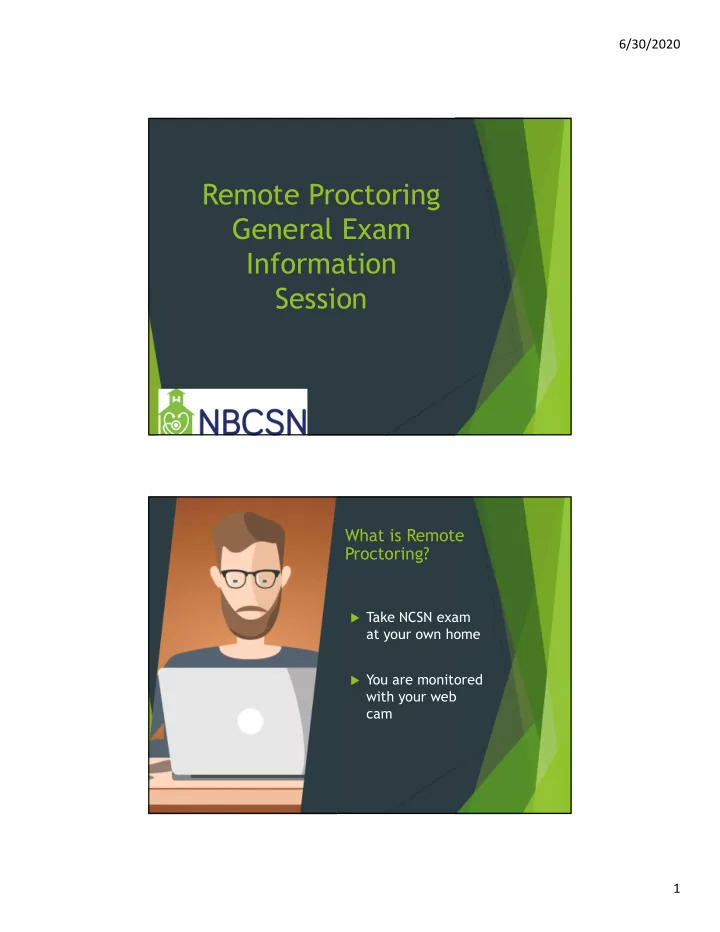
What is Remote Proctoring?
Take NCSN exam
at your own home
You are monitored
with your web cam
Remote Proctoring General Exam Information Session What is Remote - - PDF document
6/30/2020 Remote Proctoring General Exam Information Session What is Remote Proctoring? Take NCSN exam at your own home You are monitored with your web cam 1 6/30/2020 NBCSN.org How Does it Work? Schedule exam the same way
6/30/2020 1
What is Remote Proctoring?
Take NCSN exam
at your own home
You are monitored
with your web cam
6/30/2020 2
Schedule exam the same
way
Check in process Can use your computer
You will be recorded for
exam security purposes
No recording-no testing
6/30/2020 3
For Check-In 1:1 For the exam there
This is a one-to-
with a Prometric employee.
They will check
your ID.
6/30/2020 4
You’ll be asked to show:
Hands Eyewear Or to stand
360º room scan
and your work surface.
Please allow at
least 15 minutes for the check in process.
6/30/2020 5
Laptop/Desktop computer – be sure it is plugged into a
power source
Operating System – Windows 7 or higher/MacOS 10.13 or
higher
Web Browser – Current version of Google Chrome Internet Connection Speed – 0.5 mbps or greater
https://www.speedtest.net/
Wi-Fi Connection – position where you get the strongest
from your computer to your router
Screen Resolution – minimum is 1024 x 768
Must be
indoors
6/30/2020 6
No other
person (or pets) can be in the room with you.
No:
Pens Electronic Devices Posting on walls Dual monitors
6/30/2020 7
One piece of
plain paper (scratch) and an unmarked pencil
Note taking is
not permitted
What IS Permitted in the Room?
TWO tissues ONLY
6/30/2020 8
What IS Permitted in the Room?
Light comfort
clothing comfort (sweater, scarves, etc.)
If removed they
must be placed
your chair.
You are
permitted an unscheduled break, however, the exam time will not stop.
Food and drink
are prohibited in the exam room.
6/30/2020 9
Summer
Application Window: March 19 – June 23,
2020
Test Window: July 9 – August 15, 2020
Fall
Application Window: August 6 – October
5, 2020
Test Window: November 5-18, 2020
6/30/2020 10
NBCSN offers 2 practice exams on the NBCSN
website
https://www.nbcsn.org/ncsn/the-exam/exam-prep/
Candidate Handbook
https://www.nbcsn.org/wp-
content/uploads/2018/11/nbcsn-handbook-2018_v6_sep- 2018.pdf Exam Bibliography
https://www.nbcsn.org/wp-
content/uploads/2019/05/nbcsn-bibliography-rev-1- 18.pdf Challenge the School Nurse
New question is posted to NBCSN.org under
Resources/Exam Prep/Challenge the School Nurse
NASN SchoolNurseNet Discussion
board
National Certification Exam Candidates Discussion group that meets about 6
weeks before the exam and is led by NBCSN board member, Robin Cogan
Registration for the group is not
required, only a SchoolNurseNet account (free)
6/30/2020 11
Quinn, B. L., & Peters, A. (2017). Strategies to reduce nursing student test anxiety: A literature review. Journal of Nursing Education, 56(3), 145-151.
Impairment
memory Fear of
if fails
Anxiety
6/30/2020 12
Prepare to be Calm
(while studying or during exam)
Relaxation,
breathing
Classical music Guided
reflection/ positive journaling
Lemon or
Lavender
Quinn, B. L., & Peters, A. (2017). Strategies to reduce nursing student test anxiety: A literature review. Journal of Nursing Education, 56(3), 145-151.
6/30/2020 13
After Check-In
Take 5 deep breaths Drop your shoulders Reframe “I’m so scared/anxious” to “I’ve got this” Close your eyes and count to 10 Open your eyes, take one more big breath, and BEGIN
A Guide to Testing Smart on Computer-Based Multiple Choice Exams: https://www.com.msu.edu/application/files/1215/8032/2592/Academic
6/30/2020 14
10 Test-Taking Strategies
assume you “get it” before you read the whole thing
the stem, then the whole stem and options
the options
provided
10 Test-Taking Strategies
6.
If your response is there, read all options anyway to make sure there isn’t a better one
7.
If your response is not there, re-read the question and rule out the incorrect options
8.
If you’re stuck, re-read the question; don’t just keep reading the options. You may have missed something in the question
9.
If you’re still stuck, take your best guess and move on
6/30/2020 15
11 Test Taking Tips and Strategies for Nursing Exams https://nurseslabs.com/11-test-taking-tips-strategies/
Read the stem and then
ask yourself:
What is the question
really asking?
Are there any keywords? What info in the stem is
relevant to answering this question?
How would I ask this
question?
How would I answer this
question?
6/30/2020 16
Then Ask…
Is there an option that is similar
to my answer?
Is this option the best, most
complete answer to the question?
Deal with the question ON THE
SCREEN
Don’t read into it, or
make assumptions about it
Answer the question asked, not
the one you would like to answer
Keywords alert you to caution
Always Most likely or least likely Initial Priority or best Every Entire Only Never or rarely
6/30/2020 17
All of the following are services of the National Kidney Foundation EXCEPT:
Details
ingest alcohol if he wants to live. To effect a change in his behavior while he is in the hospital, the nurse should attempt to:
1.
Help the client set short-term dietary goals
2.
Discuss his hopes and dreams for the future
3.
Discuss the pathophysiology of the liver with him
4.
Withhold approval until he agrees to stop drinking
6/30/2020 18
Answers
The four levels of cognitive ability are:
psychiatric nursing
When teaching newly diagnosed diabetic clients
about their condition, it is important for the nurse to focus on:
6/30/2020 19
Components
After a cholecystectomy the
postoperative diet is usually:
The government agency responsible for
administering the nursing practice act in each state is the:
1.
Board of regents
2.
Board of nursing
3.
State nurses' association
4.
State hospital association
6/30/2020 20
Similar to the Stem
When a person develops symptoms of physical
illness for which psychogenic factors act as causative agents, the resulting illness is classified as:
Communicating with a male client who
is deaf will be facilitated by:
6/30/2020 21
From Earlier Questions
inserted for the treatment of intestinal obstruction. Intestinal suction can result in excessive loss of:
1.
Protein enzymes
2.
Energy carbohydrates
3.
Water and electrolytes
4.
Vitamins and minerals
with intestinal suction should include observation for:
1.
Edema
2.
Nausea
3.
Belching
4.
Dehydration
Better to guess than
leave blank
Can usually eliminate at
least one option
Thus increasing your
probability from 25-50% correct
6/30/2020 22
2020 Eligibility Requirements
Current RN license Evidence of a
Bachelors or Masters in Nursing (BSN or MSN)
Evidence of 1,000
clinical hours in a school setting within the last three years
6/30/2020 23
Go to NBCSN.org and click on the “Login” button
located in the upper right corner.
Create a login/profile (name must match your ID) Complete the application Pay the application fee ($360)
Confirmation @24 hrs
later via email
Approved for exam
OR
Selected for random
audit
6/30/2020 24
If approved,
you will receive an
Authorization to Test (ATT) email with information for how to schedule your exam.
After You Apply
If audited,
Be sure to login back
into your account and
Re-submit your
will review your application and reach
questions.
6/30/2020 25
Scores are released approximately 6-8 weeks after the close of the exam window.
The NCSN exam is a post-
equated exam.
All items are evaluated after the
close of the window to ensure all questions were fair questions.
This process:
determines if any need to be
tossed out, and
rescoring the exams takes
approximately 6-8 weeks.
6/30/2020 26