Register-Transfer Level (RTL) Building blocks: Registers - - PDF document

register transfer level rtl
SMART_READER_LITE
LIVE PREVIEW

Register-Transfer Level (RTL) Building blocks: Registers - - PDF document


slide-1
SLIDE 1

1

  • 03 Logic networks

03.05 Digital systems

  • RTL representation
  • Data path and Control unit
  • Project styles
  • Examples
  • Data transfers among registers
  • BUS and Address
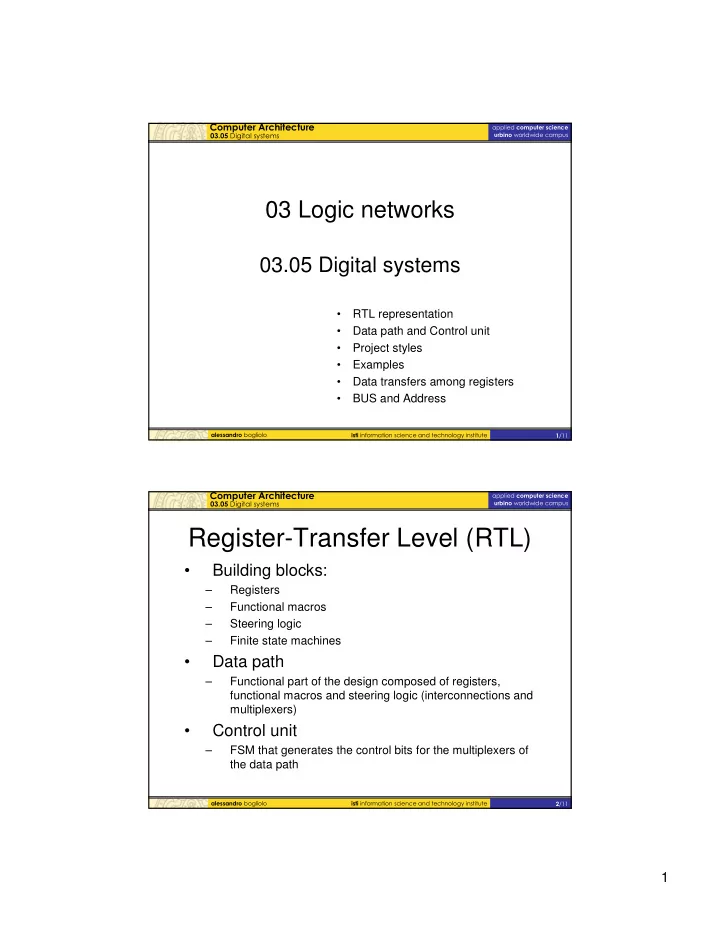
  • Register-Transfer Level (RTL)
  • Building blocks:

– Registers – Functional macros – Steering logic – Finite state machines

  • Data path

– Functional part of the design composed of registers, functional macros and steering logic (interconnections and multiplexers)

  • Control unit

– FSM that generates the control bits for the multiplexers of the data path

slide-2
SLIDE 2

2

  • Project styles

1. Single-stage network (e.g., RCAn)

  • Computation requires a single clock cycle

2. N-stage network (e.g., SRCAn)

– Computation requires N clock cycles – Stages may be balanced or unbalance

3. Pipelining (e.g., PRCAn)

  • A new computation is started every clock cycle

independetly of the latency

4. Resource sharing (e.g., BSAn)

  • The same functional macro is used to perform

different operations in different clock cycles

  • Example
  • F=a*b+c

* + * + Tc=Tc(ADD) Tp=Tp(MUL)+Tp(ADD) Single-stage 2-stage

slide-3
SLIDE 3

3

  • Example
  • F=x1*c1+x2*c2+x3*c3

* + * * + Tc=Tc(MUL)+Tc(ADD) Tp=Tc(MUL)+2Tp(ADD)

  • Example
  • F=x1*c1+x2*c2+x3*c3

* + * * + 2-stage network has lower latency than 3-stage network iff Tp(ADD)<3/4 Tp(MUL) 2-stage network has higher throughput than 3-stage network iff Tp(ADD)<1/2 Tp(MUL) * + * * +

slide-4
SLIDE 4

4

  • Example
  • F=x1*c1+x2*c2+x3*c3

*1 +3 *2 *2 +3 Resource sharing: Use 2 multipliers to perform 3 products Use 1 adder to perform 2 sums

  • Control unit

clock cycle a b c

  • 1

1 1 1 2

  • clock cycle

a b c 00

  • 01

1 1 1 10

  • clock cycle control

00 01 1 10

control = s0 s0

next = s0’s1’

s1

next = s0

state control next state 00 01 01 1 10 10 00

slide-5
SLIDE 5

5

  • Data transfer among registers

(BUS)

Shared communication channel (BUS) Issues:

  • Select a single (source) register at the time to drive the BUS
  • Enable a single (destination) register at the time to get data from the BUS

Tri-state output Gated clock

  • Data transfer among registers

(BUS)

slide-6
SLIDE 6

6

  • Addressing